
Lead Response Time for Marketing Agencies
Learn response time benchmarks for agencies.
A prospect fills out a form on a marketing agency website at 2:17 p.m.
They are not casually browsing.
They need help with paid search, their CPL is rising, and they want to talk to someone this week. The form asks for budget, services needed, timeline, industry, and monthly ad spend. They complete all of it.
Then nothing happens.
Not because the agency does not care.
Not because the lead was bad.
Not because the inbox was broken.
The delay starts because the agency wants to qualify the lead first.
Someone has to review the form.
Someone has to decide whether this is a fit for SEO, PPC, paid social, or full-funnel retainer work.
Someone has to check whether the budget is real.
Someone has to figure out who should follow up.
That service-based qualification step is where speed disappears.
And that is the real issue behind Lead Response Time for Marketing Agencies. In agency sales, the first delay often is not outreach itself. It is the time lost between inquiry and qualification. When qualification is slow, follow-up is slow. When follow-up is slow, intent fades.
Here is the hard truth: for agencies, speed is not just about replying fast. Speed is about qualifying fast enough to keep the conversation alive.
Lead Response Time for Marketing Agencies breaks down during qualification
Most marketing agencies do not sell a simple product with one obvious next step.
They sell services.
That changes everything.
A software company might route every demo request to the same SDR team. A local business might just call every new lead immediately. But agencies usually need to understand the lead before deciding what happens next.
Is this a startup looking for SEO strategy?
Is it an ecommerce brand needing paid social management?
Is it a small business that wants a one-time website refresh but filled out the same form as enterprise prospects?
Because service offers vary, agencies often insert a manual review layer before the first real touch.
That review feels responsible. It feels efficient. It feels like good lead management.
But in practice, it creates a silent gap.
The lead submits a form, then sits in a queue waiting for a human to interpret it. That queue may only be 20 minutes. It may be 2 hours. It may stretch to the next morning if the right person is in meetings.
From the agency's perspective, the process is still moving.
From the lead's perspective, no one responded.
This is one of the clearest examples of why companies miss inbound leads. They do not lose them at the point of demand generation. They lose them in the handoff between inquiry and qualification.
The problem is not interest loss first. It is qualification lag
Many articles talk about leads going cold as if buyers simply lose interest on their own.
For agencies, that is incomplete.
A better way to think about it is this:
Leads do not cool down naturally. They stall out in your qualification queue.
That is the memorable insight.
A service-based lead arrives with context, urgency, and often a specific problem. But agencies frequently treat the first few minutes as analysis time instead of conversation time.
That creates qualification lag.
Qualification lag is the delay between lead capture and the first meaningful interaction because the business is trying to decide how to handle the lead before actually handling the lead.
This is especially common in agencies because:
- service lines are different
- deal sizes vary widely
- owner-led sales teams want to screen for fit
- account executives are specialized
- forms collect too much information upfront
Each of those factors slows the handoff.
And once qualification lags, follow-up lags with it.
The first email gets delayed.
The first call happens later.
The first appointment option arrives after intent has already softened.
If you want a broader view of why inbound leads go cold, the pattern usually starts with this timing gap.
Why service-based agencies are uniquely vulnerable to slow first-touch follow-up
Marketing agencies often believe they need more information before making contact.
That belief sounds sensible, but it creates the exact bottleneck that damages conversion.
Here is the mechanism.
The lead fills out a form.
The CRM captures it.
Someone on the team gets notified.
Then instead of triggering immediate outreach, the agency pauses to classify it.
That pause exists because agency sales is rarely one-size-fits-all.
Different buyers need different discovery paths. A SaaS company asking for paid acquisition support should not necessarily get the same intake as a local franchise group looking for multi-location SEO. So agencies build qualification logic into the front of the process.
The problem is that this logic often depends on humans.
Humans read the form.
Humans interpret need.
Humans decide priority.
Humans choose the next step.
That means speed depends on attention, availability, and judgment.
And service businesses do not scale first-touch speed well when every new lead needs a person to decode the opportunity before outreach begins.
This is why many agencies struggle to hit the standards described in the 5-minute rule for inbound leads. The issue is not that they do not know speed matters. It is that qualification has been placed in front of contact.
What this delay costs agencies in real terms
A qualification delay does not just hurt reply speed.
It hurts sales efficiency.
When a lead hears back late from an agency, the immediate cost is obvious: fewer conversations happen.
But the deeper cost is more specific.
Late qualification produces weaker discovery.
By the time someone finally reaches out, the prospect is no longer in active evaluation mode. They are back in work, back in meetings, back in internal politics. The conversation that could have started with urgency now starts with re-explanation.
That changes the quality of the sales process.
Instead of saying, "We're trying to fix paid search performance this quarter," the lead says, "Can you remind me what this is regarding?"
Instead of discussing scope, you are trying to re-open the thread.
For agencies, that means:
- fewer booked strategy calls
- lower show rates on intro meetings
- more ghosting after first contact
- longer sales cycles
- weaker close rates on high-intent inquiries
And because agency deals are often high value, even small delays are expensive.
Missing one qualified retainer opportunity per month because qualification sat too long is not a workflow issue. It is a revenue issue.
The hidden mistake: agencies confuse filtering with responsiveness
This is where many firms get it wrong.
They think being selective requires being slower.
It does not.
You can respond instantly and still qualify carefully.
Those are not opposing goals.
In fact, agencies that win often separate them.
They do not wait to complete internal qualification before acknowledging, engaging, and advancing the lead. They start the interaction immediately, then gather and confirm fit inside the conversation.
That is the reframing.
Qualification should happen at the speed of conversation, not at the speed of internal review.
This matters more in agencies than in many other businesses because service sales are trust-heavy. A fast first touch signals operational sharpness. If an agency cannot respond quickly to a hand-raising prospect, buyers may quietly assume campaign execution will feel slow too.
So speed is not just tactical.
It is reputational.
Practical ways to improve Lead Response Time for Marketing Agencies
If the bottleneck is service-based qualification and follow-up, the fix is not just "reply faster."
The fix is to redesign qualification so it does not delay first touch.
Here are the most effective ways to do that.
1. Shorten the intake required before outreach
Many agencies ask too many questions on the first form because they want to pre-qualify.
But every additional field increases friction for both sides. The lead spends more time filling it out, and the team spends more time reviewing it.
Capture only what is necessary to begin the conversation:
- name
- company
- contact info
- primary need
- rough budget or timeline
Everything else can happen in the first interaction.
2. Define qualification tiers before leads arrive
Do not make every lead a custom decision.
Set simple routing categories such as:
- high-budget growth services
- local service leads
- one-time project inquiries
- not a fit
This reduces interpretation time and lets the first response happen faster.
3. Use immediate acknowledgment with next-step framing
An instant email alone is not enough, but it is better than silence if it sets expectations.
For example: "We got your request. We'll text or call shortly to learn more and get you to the right strategist."
That keeps the lead oriented around action, not waiting.
4. Move qualification into the first live interaction
The first contact should not be delayed until the perfect account owner is selected.
A fast initial touch can gather missing details, confirm fit, and determine the right next meeting. This is especially useful for agencies with multiple service lines.
5. Standardize follow-up timing
If no one answers the first call or text, the next steps should already be defined.
Fast agencies do not improvise follow-up.
They sequence it.
That is why systems for automated lead follow-up are so important in service businesses where humans are busy and lead intent is short-lived.
How automation and AI solve this exact agency problem
This is where automation becomes more than a convenience.
It becomes the infrastructure that removes qualification lag.
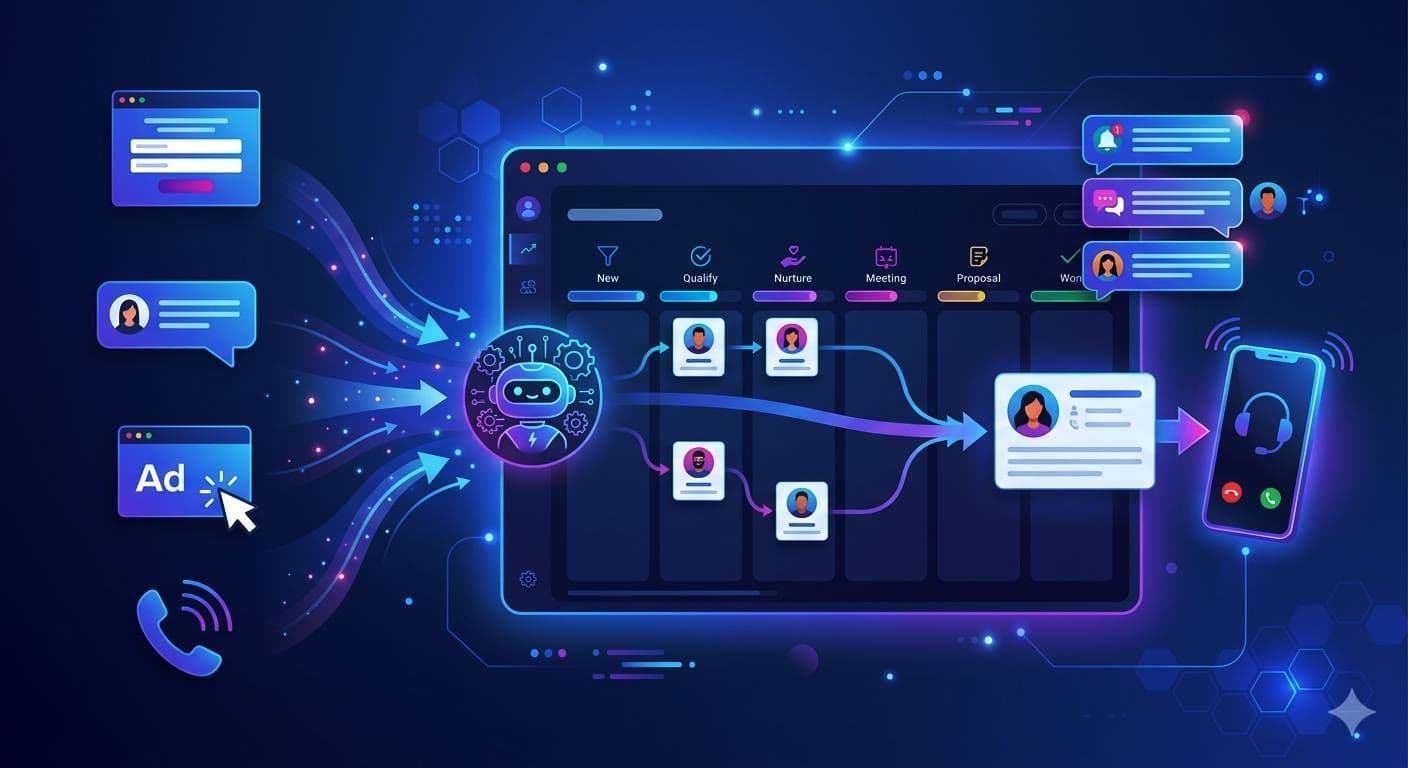
An AI-powered lead response system can engage the lead immediately after form submission through SMS, voice, or email. Instead of waiting for a strategist to review the inquiry, the system starts the qualification process at once.
It can ask service-specific questions like:
- Are you looking for SEO, PPC, paid social, or full-service support?
- What is your monthly spend or target budget?
- Are you looking for help this month or researching options?
- Would you like to book a call with the right specialist?
That matters because the agency no longer has to choose between speed and fit.
The system handles the first layer of qualification in real time.
Then it can:
- route the lead to the right person
- book a discovery call
- trigger a follow-up sequence if there is no response
- capture qualification data inside the CRM
For agencies, this is especially powerful because the core problem is not lack of lead flow. It is the lag between lead arrival and service alignment.
AI compresses that lag.
And once the lag disappears, follow-up gets sharper, not just faster.
Key takeaways
Marketing agencies often think they have a response-time problem.
More specifically, they have a qualification-speed problem.
Because agency sales are service-based, teams often place manual review before first contact. That slows outreach, weakens follow-up, and causes high-intent leads to lose momentum before a real conversation starts.
The solution is not to abandon qualification.
It is to stop letting qualification delay engagement.
That is the real lesson behind Lead Response Time for Marketing Agencies. The agencies that convert more inbound demand are usually not the ones with the longest forms or the most careful internal screening. They are the ones that qualify in motion.
In service sales, speed is not about being rushed.
It is about keeping buyer intent alive long enough for the right conversation to happen.
FAQ
Why is lead response time harder for marketing agencies than for other businesses?
Because agencies sell multiple services and often need to determine fit before assigning the lead. That extra qualification step creates delay unless the process is standardized or automated.
What is a good lead response time for marketing agencies?
The goal should still be within minutes, not hours. Even if full qualification takes longer, the first touch should happen immediately so the lead stays engaged while next steps are determined.
How can agencies qualify leads quickly without wasting strategist time?
Use a short intake form, define simple qualification tiers, and let automation or AI handle the first interaction. That allows the agency to gather useful context fast and route the lead correctly without delaying follow-up.
Next step
Want to fix slow lead response?
See how FusionSync responds in seconds, qualifies inbound leads, and moves them toward a booked next step automatically.
Where it works
View all use cases