
How AI Call Systems Improve Lead Response Time
Learn how AI call systems enable instant lead response.
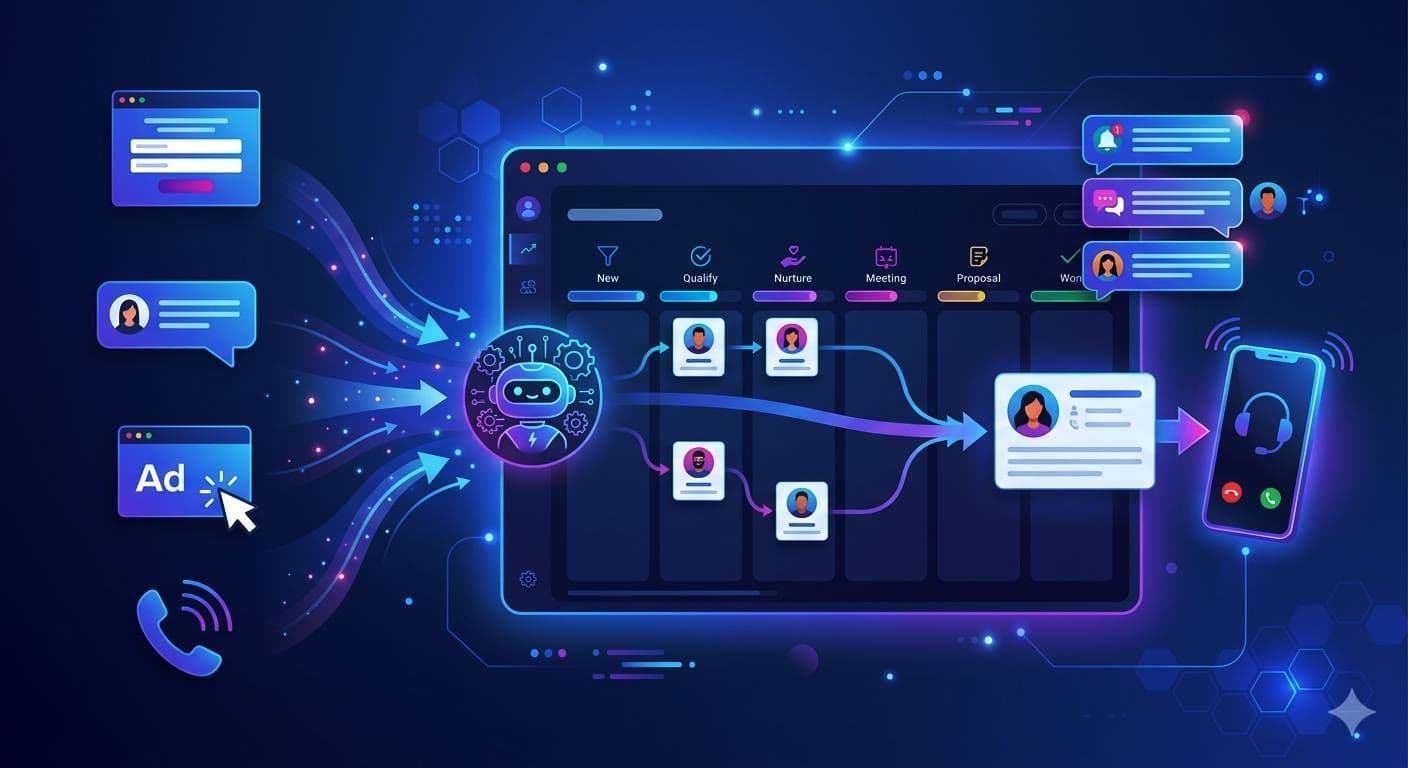
A roofing company launches a storm-season landing page on a Thursday afternoon.
By 4:15 p.m., the first lead comes in.
A homeowner wants an inspection after a leak started during heavy rain.
By 4:17, three more form submissions arrive.
The office manager is on the phone with an insurance adjuster. The sales rep is on-site. The owner is driving between jobs. Everyone is technically “working the leads.”
But nobody is free to call right now.
So the new inquiries sit in the CRM for 18 minutes.
That delay sounds small on paper. In reality, it is the gap between a homeowner who urgently wants help and a homeowner who has already mentally moved on, searched again, or decided to wait until tomorrow.
This is exactly where understanding How AI Call Systems Improve Lead Response Time becomes practical, not theoretical.
For high-intent inbound leads, the biggest problem is often not awareness, traffic, or even sales skill. It is the absence of an immediate call at the exact moment intent is highest.
That is the angle too many companies miss.
The issue is not just “slow follow-up.” The issue is that most businesses still rely on humans to initiate the first call, and humans are almost never available at the exact second a lead submits a form.
AI call systems solve that specific gap by calling inbound leads instantly, qualifying them in real time, and moving the conversation forward before attention fades.
A useful way to think about it is this:
Inbound intent has a voice window. If you do not speak to the lead quickly, the window closes.
The real problem is the missing first call
When a lead fills out a form, most companies treat that action like the start of a queue.
It is not.
It is the start of a live buying moment.
That distinction matters because forms create a false sense of security. Teams assume the lead is safely captured because the data reached the CRM. But captured is not the same as contacted.
And contacted is not the same as connected.
For many businesses, the delay is caused by one specific operational break: nobody places the first call immediately.
The lead may get an email confirmation. They may receive an internal status update. A rep may even plan to follow up “as soon as possible.”
But if the call itself does not happen in the moment, response time expands from seconds to minutes or hours.
That is why articles about instant lead response software matter so much right now. The market is shifting from notification-based response to action-based response.
A notification tells your team a lead exists.
An instant call system actually does something about it.
How AI Call Systems Improve Lead Response Time
AI call systems reduce lead response time by removing the waiting period between form submission and first outreach.
Instead of this:
- lead submits form
- CRM records lead
- rep gets notified
- rep finishes current task
- rep calls later
The workflow becomes this:
- lead submits form
- AI initiates a call within seconds
- lead answers while still thinking about the request
- qualification begins immediately
- next step gets booked or routed live
That change sounds simple, but it alters the entire response model.
Traditional sales response depends on rep availability.
AI call response depends on system design.
That is the breakthrough.
An AI call system does not need to wrap up another meeting first. It does not forget to check Slack. It does not wait for someone to notice a webhook, assign a lead, or clear a task queue.
It acts at the moment of submission.
For businesses with paid traffic, service requests, demo forms, or urgent quote inquiries, this matters because the lead is most reachable right after they convert. If they just asked for help, they are far more likely to answer the phone than they will be 27 minutes later.
Why instant call-based automation works better than delayed outreach
Most teams underestimate how narrow the answer window really is.
A lead who submits a form is in a temporary state of focused attention. They have their phone nearby. They remember what they asked for. They are prepared to answer questions. In many cases, they are still on your website.
An instant AI call meets the buyer inside that moment.
A delayed human callback usually does not.
This is not only about speed in the abstract. It is about context retention.
When the call happens immediately:
- the lead still remembers the problem clearly
- urgency is still active
- the buying conversation feels like a continuation of the form
- qualification questions feel timely, not intrusive
When the call happens later:
- the lead is back to work, driving, or distracted
- the request has lost emotional priority
- the phone call feels unexpected
- the rep has to recreate momentum that already existed before
That is why AI voice agents for lead response are becoming more relevant. They do not just make outreach faster. They preserve the original buying context.
A strong reframing here is this:
Lead response is not about chasing interest later. It is about converting attention while it still exists.
What happens when the first call is delayed
The cost of a delayed first call is easy to hide.
The lead still sits in the CRM.
The rep still has a task.
The marketing dashboard still counts the conversion.
So on the surface, it looks like the process worked.
But under the surface, the economics change fast.
First, contact rates fall. The lead is simply less likely to answer.
Second, qualification quality drops. Even if you connect later, the conversation is colder and less specific.
Third, booking rates suffer. A lead who would have scheduled immediately may now say, “Send me some info,” which often means the moment has passed.
Fourth, ad efficiency declines. If you paid to generate the lead but failed to call while intent was highest, part of that budget was wasted operationally, not strategically.
This is especially visible in categories where timing and urgency are linked: home services, legal inquiries, med spas, agencies, software demos, and high-ticket local services.
In those categories, the first missed call window often does more damage than a weak nurture email sequence ever could.
If you want the broader context for why inbound leads go cold, the answer often starts here: there was no live conversation when the buyer was ready for one.
The hidden operational bottleneck is human initiation
Most businesses do not have a follow-up problem first.
They have an initiation problem.
The person responsible for placing the call is usually doing something else when the lead arrives.
That is normal.
Sales reps are on demos. Front desk staff are helping customers. Owners are in transit. Account executives are in pipeline reviews. Even highly disciplined teams cannot guarantee that a human will always be free at the exact moment a form is submitted.
That means any response process that begins with “someone will call soon” is structurally slow.
Not because the team is lazy.
Not because the CRM is broken.
But because human-triggered calling is batch behavior trying to solve a real-time problem.
That mismatch is the root issue.
It also explains why many teams struggle even after reading guides on how to reduce lead response time in sales teams. Better discipline helps, but discipline alone does not create instant availability.
Only automation does.
What an effective AI call workflow actually looks like
The best AI call systems are not random robocalls fired at every form fill.
They are structured response workflows designed around the first 60 seconds after submission.
A practical setup often looks like this:
1. Form submission triggers an immediate outbound call
The lead submits a request.
The AI system calls within seconds.
That timing is the core advantage.
2. The AI confirms intent
It can reference the inquiry directly:
“Hi Sarah, thanks for requesting a roofing estimate. I wanted to help you get started right away.”
This makes the interaction feel continuous, not disconnected.
3. The AI asks qualification questions
It can gather specifics such as:
- service needed
- timeline
- location
- budget range
- urgency level
That reduces lag before the handoff.
4. The system books or routes the next step
If the lead is qualified, the AI can schedule an appointment or transfer the call.
If not, it can trigger the right follow-up path automatically.
5. The CRM updates instantly
The rep does not start from scratch later. They inherit a live conversation, not a silent record.
This is why instant callback systems are so effective. They turn passive lead capture into active engagement.
Why phone is uniquely powerful in the first-response moment
Email and SMS have value, but this article is about a specific angle: instant call-based response automation.
And there is a reason call systems matter so much.
A call creates immediate two-way communication.
You do not have to wait for the lead to open a message.
You do not have to hope they click a calendar link.
You do not have to rely on them to restart the conversation themselves.
A call compresses the sales cycle because it handles acknowledgment, qualification, and booking in one motion.
That is especially important for high-intent leads who are not looking for a newsletter. They are looking for an answer.
Phone is the fastest path from inquiry to conversation.
AI simply makes that path available all the time.
How businesses should implement this without creating a bad buyer experience
The goal is not to sound automated.
The goal is to be immediate, relevant, and helpful.
A good implementation includes a few principles:
Use context from the form
Reference what the person asked for. Generic calls feel jarring. Specific calls feel timely.
Keep the first interaction short
The first job is to connect, confirm, and move the lead forward. It is not to force a 15-minute script.
Define clear handoff rules
Know when the AI should book, when it should transfer, and when it should schedule a rep callback.
Measure answer rate, qualification rate, and booking rate
Do not only track total leads. Track whether instant calls produce live conversations.
Design for urgency-based segments first
Start where response timing matters most, such as demo requests, quote forms, and paid ad leads.
When implemented well, AI call automation does not replace sales. It protects the earliest and most fragile part of the sales process: the first response moment.
Key takeaways
- The biggest lead response gap is often the missing first call, not the missing CRM entry.
- Inbound leads are most reachable immediately after form submission.
- AI call systems improve response time by removing the delay between submission and outreach.
- Instant calls preserve context, urgency, and answer rates better than delayed callbacks.
- Human-led follow-up is valuable, but human-initiated first response is too slow for many inbound workflows.
- The best AI systems qualify and route leads in real time, not just acknowledge them.
If you are evaluating How AI Call Systems Improve Lead Response Time, the main takeaway is simple: the speed advantage comes from replacing wait time with live conversation.
FAQ
1. What is an AI call system for inbound leads?
An AI call system automatically calls a new lead right after they submit a form, asks qualifying questions, and helps route or book the next step without waiting for a human rep to start the process.
2. How quickly should an AI call system contact a lead?
Ideally within seconds. The value of the system comes from reaching the lead while their attention is still active and they are most likely to answer.
3. Will instant AI calls feel too aggressive?
Not if the call is contextual and relevant. When someone has just requested information, a prompt call that references their inquiry usually feels helpful, especially in high-intent situations.
Next step
Let's Fix Your Lead Response in 30 Minutes
We'll walk through your current lead flow, identify where leads are slowing down or getting missed, and show you exactly what can be automated to increase speed, conversations, and bookings.
Where it works
View all use cases