
AI Lead Qualification Explained
Understand how AI qualifies leads automatically.
A roofing company in Phoenix launches a weekend storm-damage campaign.
The ads work.
By Saturday afternoon, estimate requests start coming in fast. Homeowners fill out forms, upload photos, and ask the same urgent questions: How soon can someone come out? Do you handle insurance claims? What areas do you cover?
The problem is not lead volume.
The problem is what happens in the gap between submission and qualification.
Some leads are serious and need a call now. Some are outside the service area. Some want financing. Some need emergency repair. But before a rep can respond properly, someone has to review the form, figure out fit, ask follow-up questions, and decide who should call.
That qualification delay is where momentum disappears.
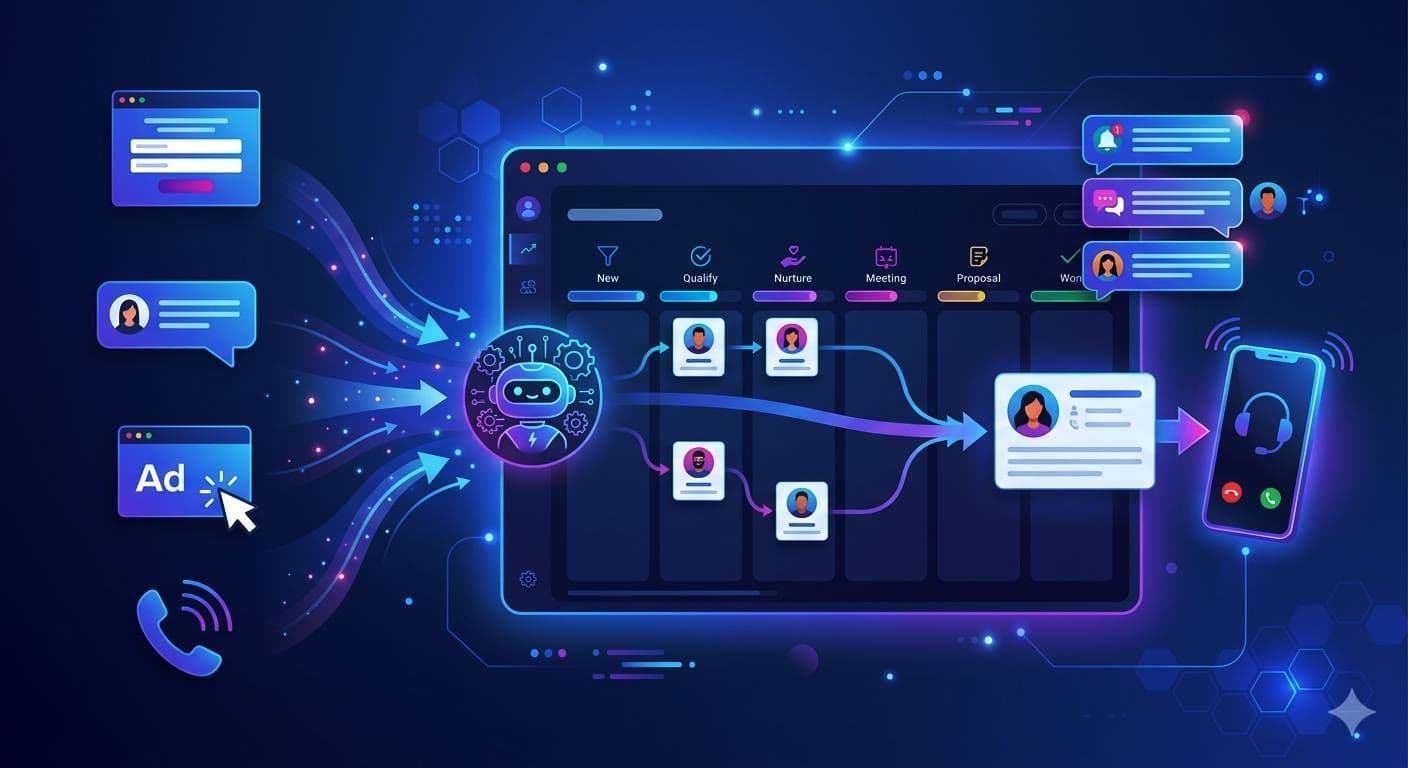
This is the core idea behind AI Lead Qualification Explained: AI does not just help teams sort leads faster. It compresses the delay between interest and action. Instead of waiting for a person to read, assess, and route each inquiry, AI can qualify leads instantly, respond in real time, and move the right prospects into the next step while intent is still high.
And that matters more than most teams realize.
A useful reframing is this:
qualification is not a separate stage after response. In modern inbound sales, qualification is the response.
The Real Problem Is Qualification Delay, Not Just Response Delay
When most teams talk about speed, they focus on first touch.
Did we email the lead quickly?
Did someone call within five minutes?
Did the CRM send a notification?
Those are important questions, but they miss the deeper issue.
A fast acknowledgement is not the same as a fast qualification.
If a lead receives an instant email that says, “Thanks, someone will be in touch,” but then waits 45 minutes for the real conversation, the business has not actually matched the buyer’s moment of intent.
This is where many companies lose ground.
The delay is often hidden inside the qualification process itself:
- reviewing form details
- checking territory or service fit
- figuring out urgency
- deciding which rep should handle it
- gathering missing information before outreach
Each of those steps sounds small.
Together, they slow the only moment that really matters: the first useful interaction.
That is also why understanding
http://fusionsync.ai/posts/good-lead-response-time
is only part of the picture. A team can respond quickly on paper and still qualify too slowly in practice.
AI Lead Qualification Explained: What It Actually Does
Let’s make this simple.
AI lead qualification uses automation and conversational AI to assess a new inbound lead immediately after submission. Instead of waiting for a sales rep to manually ask screening questions, the system starts the process right away.
Depending on the business, AI can:
- call the lead within seconds
- send an SMS and continue the conversation there
- ask qualifying questions based on the form submission
- identify service need, budget range, urgency, location, or timeline
- detect whether the lead is sales-ready
- route the lead to the right rep or book an appointment automatically
The key advantage is not just efficiency.
It is timing.
AI removes the dead space between inquiry and qualification.
In a manual workflow, qualification starts when a person becomes available. In an AI workflow, qualification starts when the lead raises their hand.
That difference changes outcomes.
Why Manual Qualification Creates Hidden Delays
Most businesses do not think of qualification as a bottleneck because it is spread across multiple micro-steps.
A lead fills out a form.
The CRM captures it.
A notification goes out.
Someone glances at it between meetings.
They notice the lead did not include enough detail.
They send an email or make a call.
If the lead does not answer, the real qualification process gets pushed further out.
Nothing looks broken.
But nothing is actually fast either.
This is especially common in service businesses and high-intent inbound funnels, where the first rep often needs answers before they can move forward. The rep wants to know whether the lead is local, ready to buy, properly budgeted, or in the right segment.
So the business waits to qualify before acting decisively.
That is the trap.
The lead is ready now, but the company is waiting to become ready to respond.
If you want to understand the broader mechanics behind
http://fusionsync.ai/posts/qualify-inbound-leads
this is the operational gap that matters most: manual qualification inserts human availability into a moment that demands immediacy.
Why This Delay Causes Leads to Cool Off So Fast
Inbound leads are not evaluating you in a calm, linear way.
They are usually in an active decision window.
They are comparing options, checking pricing, talking internally, and trying to solve a problem with some level of urgency. Even when the need is not an emergency, the intent spike is real.
Qualification delay weakens that spike in three specific ways.
1. The Lead Does Not Get Momentum
When someone submits a form, they expect the next step to feel immediate and relevant.
Not generic.
Not delayed.
Not disconnected.
A fast qualification flow keeps momentum alive because the conversation moves forward instantly. The lead answers a few questions, gets clarity, and feels progress.
A delayed qualification flow does the opposite. It creates friction before value appears.
2. The Business Fails to Match Buyer Energy
Buyers arrive with a certain level of urgency.
Manual qualification often forces the company to respond at a lower energy level than the buyer came in with. By the time a rep follows up, the conversation starts from behind.
That is why
https://www.fusionsync.ai/posts/lead-response-time-5-minute-rule
is often less about total response time and more about whether the business captured intent while it was still active.
3. The Next Step Becomes Harder Than It Should Be
If qualification happens late, booking the call, assigning the rep, or moving to estimate becomes slower too.
The cost of qualification delay compounds.
It is not one delay.
It becomes a chain of delays.
The Business Impact of Slow Qualification
When qualification lags, the damage shows up everywhere, even if the team is still generating plenty of leads.
First, contact rates drop.
Not because the leads were bad, but because timing made them harder to reach.
Second, conversion rates soften.
By the time the business identifies who is actually qualified, some of the best opportunities have already lost urgency.
Third, sales capacity gets wasted.
Reps spend time chasing leads that could have been filtered, prioritized, or routed earlier.
Fourth, marketing performance looks worse than it really is.
Campaigns get blamed for low lead quality when the real issue is that high-intent leads were not qualified quickly enough to convert.
This is one of the most important operational truths in inbound sales:
Poor qualification speed makes good leads look bad.
That insight matters because many companies try to fix conversion problems by changing ad creative, landing pages, or lead scoring models, when the real leak is the lag between capture and qualification.
What AI Changes in the First 60 Seconds
AI is most valuable at the exact point where manual systems are weakest: the first minute after conversion.
In that short window, an AI lead qualification system can do more than most teams can do manually in half an hour.
It can:
- acknowledge the inquiry instantly
- start a two-way conversation
- gather missing details
- determine urgency
- identify fit
- route based on rules
- offer appointment times
- trigger follow-up if there is no answer
This is why AI improves both speed and quality at the same time.
It is not just reaching out faster.
It is learning fast enough to act intelligently.
For businesses exploring
http://fusionsync.ai/posts/ai-lead-response
this is the real unlock. Instant response matters because it allows instant qualification, and instant qualification enables the right next step before the window closes.
A Practical Example of AI Qualification in Action
Go back to the roofing company.
A homeowner submits a form at 2:14 PM requesting an estimate for storm damage.
Instead of waiting in a queue, the AI system calls in under 30 seconds.
It confirms the property ZIP code.
It asks whether the issue is active leaking or cosmetic damage.
It checks insurance involvement.
It asks when the homeowner wants service.
Based on the answers, the system tags the lead as high urgency, in territory, insurance-related, and ready for inspection.
Then it offers the earliest available inspection window and books it.
Now compare that to the manual version.
The form sits in the CRM until someone sees it. A coordinator reviews it later, realizes key details are missing, and sends an email. The homeowner does not reply immediately because they are already back to dealing with the actual problem.
Same lead.
Same source.
Very different outcome.
The difference is not marketing.
It is the removal of qualification delay.
How to Use AI Without Making the Experience Feel Robotic
Some teams worry that AI qualification will feel cold or scripted.
That usually happens only when the workflow is poorly designed.
Good AI qualification feels simple, direct, and useful.
Ask Only What Is Needed for the Next Decision
Do not turn the first interaction into an interrogation.
The goal is not to collect every possible field.
The goal is to gather enough information to take the right next step immediately.
Match the Channel to the Situation
For urgent, high-value, or local service leads, an instant call may work best.
For other inquiries, SMS can be the fastest path to engagement.
Route Based on Action, Not Just Score
Static lead scores are often too slow to matter in real time.
Conversation-based signals are more useful because they show actual readiness.
Keep Human Handoff Tight
AI should not trap qualified leads in automation.
Once the system identifies fit and intent, it should route or book without delay. This is where
http://fusionsync.ai/posts/automatic-lead-assignment
becomes important. Qualification speed only matters if the next operational step is just as fast.
Why AI Qualification Is Becoming Essential
As inbound channels speed up, qualification cannot remain a manual checkpoint.
Paid traffic, demo forms, local service inquiries, and landing page conversions all create moments of compressed intent. Businesses do not have the luxury of letting leads wait while someone pieces together context.
AI solves that by making qualification immediate instead of sequential.
That is the bigger shift.
Old model: capture lead, wait, qualify, respond, route.
New model: capture lead, qualify in real time, route instantly, move forward.
That is why AI is not just a productivity tool.
It is a timing tool.
And in inbound sales, timing shapes conversion.
Key Takeaways
- Qualification delay is often the real reason inbound momentum disappears.
- A fast acknowledgement is not enough if useful qualification happens later.
- AI shortens the gap between form submission and next-step action.
- Real-time qualification improves contact rates, routing, booking, and conversion.
- Poor qualification speed can make strong marketing look weak.
- The strongest AI workflows qualify only what is needed, then hand off or book immediately.
Conclusion
If you want the short version of AI Lead Qualification Explained, it is this: AI helps businesses respond faster because it qualifies faster.
That may sound subtle, but it changes everything.
Most lead handling problems are not caused by a lack of interest from buyers. They come from internal delays between capture, assessment, and action. AI removes that lag by turning qualification into an immediate event instead of a manual task waiting in line.
The result is not just quicker outreach.
It is a better-timed sales process.
And better timing is often what separates a booked appointment from a lead that quietly fades out.
FAQ
What is AI lead qualification?
AI lead qualification is the use of automation and conversational AI to assess inbound leads immediately after they submit a form or inquiry. It can ask questions, identify fit, determine urgency, and route or book the lead without waiting for a rep to do it manually.
How does AI reduce qualification delay?
AI reduces qualification delay by starting the screening process the moment a lead comes in. Instead of waiting for a salesperson to review details and reach out later, the system gathers information in real time and triggers the next step instantly.
Is AI lead qualification only useful for large sales teams?
No. Smaller teams often benefit even more because they have less capacity to monitor every inbound lead instantly. AI helps them respond and qualify at a speed that would otherwise require constant human availability.
Next step
Let's Fix Your Lead Response in 30 Minutes
We'll walk through your current lead flow, identify where leads are slowing down or getting missed, and show you exactly what can be automated to increase speed, conversations, and bookings.
Where it works
View all use cases