
How AI Can Respond to Leads Instantly
Discover how AI technology enables instant lead engagement.
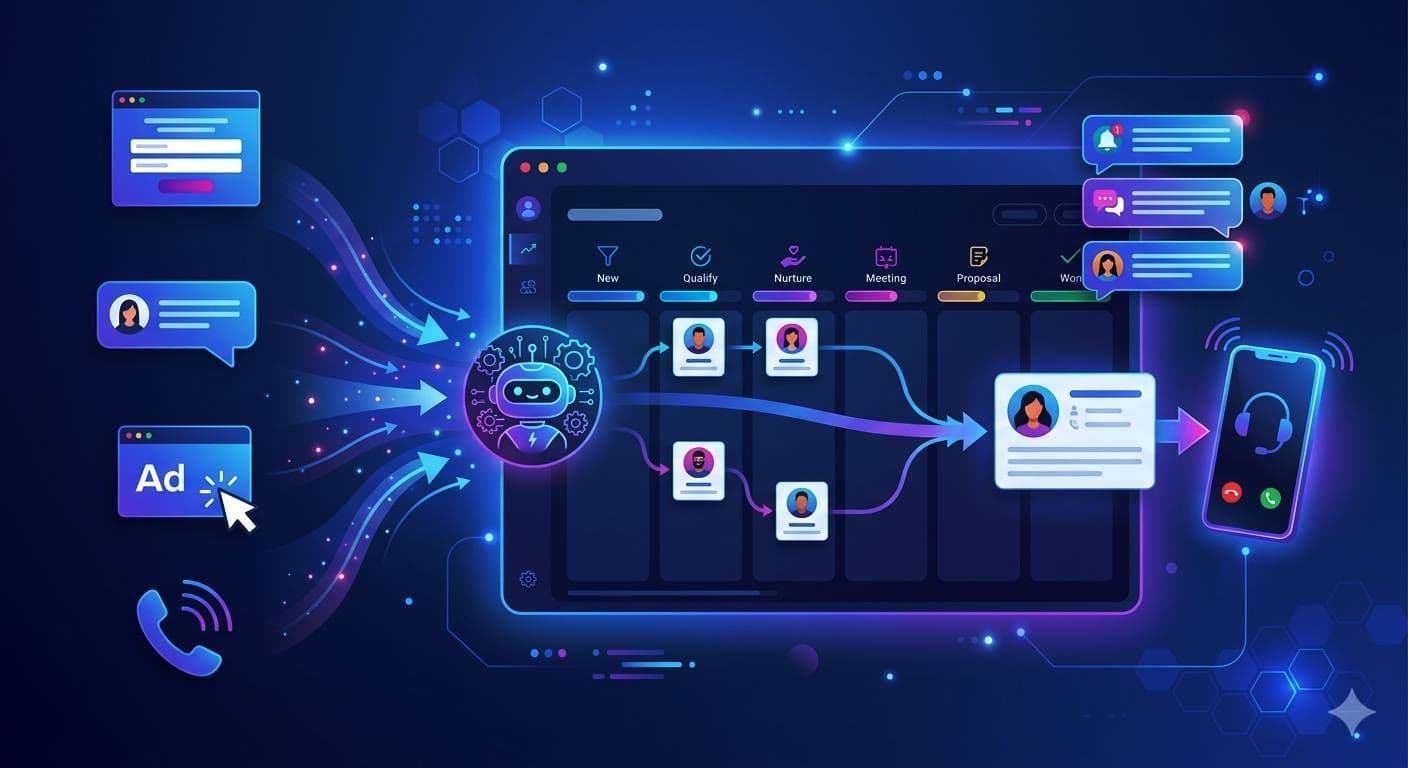
At 8:17 p.m., a regional home services company gets a form submission from a homeowner whose furnace just stopped working.
The office is closed.
The sales manager is at dinner.
The CSR team will not see the lead until morning.
By 8:18, the prospect is already checking their phone for a reply.
Not because they want a nurture sequence.
Because they want help now.
This is the real context behind How AI Can Respond to Leads Instantly. It is not about adding flashy technology to sales. It is about removing the delay between buyer intent and business response.
For inbound leads, that delay is where momentum disappears.
And the point is sharper than most companies realize: the biggest lead response problem is not poor effort. It is that human teams are built to respond when available, while buyer intent happens whenever it wants.
AI closes that gap.
The Problem Is Not Follow-Up Quality. It Is the Waiting Gap.
Most teams assume lead handling breaks down because reps are not disciplined enough, or because the CRM is messy, or because the workflow needs a few tweaks.
Those things matter, but they are not the core issue in this article.
The core issue is response delay.
A prospect raises their hand at the exact moment they are ready to engage. Then nothing happens for 10 minutes, 45 minutes, or 12 hours because the business still depends on a person noticing, opening, assigning, and replying.
That silent gap is where demand weakens.
A useful reframing is this:
Leads do not usually go cold because your team said the wrong thing. They go cold because nobody said anything while intent was still alive.
That is why AI matters so much in inbound sales. It is not just another automation layer. It is a system designed to remove the dead air after a form fill, ad submission, or demo request.
If you want a broader breakdown of
https://www.fusionsync.ai/posts/lead-response-time-5-minute-rule
the pattern is clear: delay changes outcomes fast.
How AI Can Respond to Leads Instantly in the First Critical Seconds
The value of AI starts with what it can do immediately, not eventually.
When a lead comes in, an AI response system can trigger in seconds and take action before a human rep even sees the notification.
That action can include:
- sending a confirmation text
- placing an outbound call automatically
- asking qualifying questions
- capturing urgency, need, or location
- routing the lead based on answers
- offering available appointment slots
- booking the meeting into the calendar
The mechanism matters.
Traditional lead handling is sequential. A form arrives, then a person notices it, then decides what to do, then reaches out.
AI compresses that sequence.
Instead of waiting for human availability, the system responds the instant the lead is created. That is the operational difference between "we try to be fast" and "the lead is contacted right now."
For companies evaluating different tools, this is where
http://fusionsync.ai/posts/instant-lead-response-software
becomes more than a nice-to-have. It becomes infrastructure.
Why Human Teams Create Delay Even When They Care
Most businesses do not respond slowly because they are careless.
They respond slowly because manual response depends on interruption.
A new lead has to interrupt whatever a human is already doing.
That rep may be:
- on another sales call
- driving between appointments
- working through old follow-ups
- offline after hours
- trying to understand whether the lead is worth immediate attention
Even highly motivated teams cannot maintain instant reaction time across every source, every hour, every day.
This is the key mechanism behind delay: human response is event-based, but human availability is variable.
AI removes the variability.
It does not need to finish a meeting first.
It does not forget to check the CRM.
It does not leave Friday evening leads untouched until Monday morning.
That is why the strongest AI lead response systems are not just messaging bots. They are availability engines. Their core purpose is to make your business present at the exact moment a buyer reaches out.
The Hidden Cost of Delay Is Not Just Lost Leads. It Is Lost Buying Energy.
Companies often measure lead response failure in crude terms like missed calls or unworked records.
But the deeper loss is buying energy.
When someone submits a lead form, they are mentally active. They are comparing options, estimating budget, discussing timing, and deciding whether this problem gets solved today.
If nothing happens right away, that mental state changes.
The issue may still exist, but the urgency softens.
The attention shifts.
The emotional readiness to talk declines.
This is especially true in high-intent categories like:
- home services emergencies
- legal inquiries
- med spa consult requests
- insurance quote requests
- SaaS demo forms after pricing page visits
In these moments, speed is not just operational.
Speed is emotional alignment.
That is the original insight many sales teams miss.
Fast response works because it matches the lead's state of mind while it is still active. AI is valuable because it preserves that alignment automatically.
This is also why
http://fusionsync.ai/posts/ai-inbound-lead-response
is becoming a serious revenue lever rather than a support tool.
What Instant AI Response Actually Looks Like in Practice
Let’s go back to the after-hours home services example.
A homeowner submits a request at 8:17 p.m. saying their heat is out.
An AI-powered workflow can do the following by 8:18:
- Send a text confirming the request was received.
- Call the lead immediately.
- Ask whether the issue is no heat, weak airflow, or thermostat failure.
- Confirm ZIP code and service area.
- Identify whether this is an emergency request.
- Offer the next available appointment window.
- Book the appointment.
- Push the details into the CRM.
- Notify the on-call team with context already captured.
Notice what AI solved here.
Not persuasion.
Not closing.
Not some abstract efficiency metric.
It solved delay.
The lead did not have to wait until business hours to feel acknowledged and moved forward. The company did not need a night shift to create responsiveness. The system absorbed the timing problem.
That is the central promise of AI in this category.
Why Instant Response Changes Conversion Before a Salesperson Ever Joins
A common mistake is thinking conversion starts when a rep begins the sales conversation.
In reality, conversion starts at the first response.
The first interaction determines whether the lead:
- feels seen
- stays engaged
- answers the phone
- shares more context
- accepts a meeting
So when AI responds instantly, it is not just doing admin work. It is protecting the conditions needed for conversion.
This has a downstream effect on the entire funnel.
When response happens in seconds:
- more leads are contacted
- more leads are qualified
- more appointments get booked
- fewer leads require repeated manual chasing
- sales reps spend more time speaking with active prospects
Teams that want to improve this area often focus on
http://fusionsync.ai/posts/ai-lead-response-time
but the more important point is what better response time unlocks. It preserves intent long enough for the human sales process to begin.
AI Eliminates the Handoff Delay That Breaks Inbound Systems
Many inbound workflows fail in the handoff.
Marketing generates the lead.
The CRM stores it.
Someone gets notified.
Someone else reviews it.
Then eventually a rep responds.
Each handoff adds idle time.
And idle time compounds fast. Five minutes becomes 20. Twenty becomes two hours. Not because anybody made a dramatic mistake, but because no system was designed to act instantly.
AI changes this by collapsing handoff layers.
Instead of waiting for internal coordination, the response system handles the first touch automatically and captures structured information at the source.
That means when a salesperson joins the process, they are not starting from zero. They already know:
- what the lead asked for
- how urgent the request is
- whether the lead answered the phone
- whether an appointment is booked
- what next action is required
This is where AI becomes operationally powerful. It does not just speed up messaging. It removes the waiting that usually happens between systems, people, and priorities.
Practical Ways to Use AI to Remove Response Delays
If the goal is to eliminate lag, implementation should stay focused on the first five minutes.
Start there before optimizing anything else.
1. Trigger Response From Every Lead Source Instantly
Your forms, landing pages, paid ads, and chat entries should all fire the same immediate workflow.
Do not create a system where some leads get instant action and others sit in a queue.
2. Use AI Voice or SMS for the First Touch
Email alone is often too passive for high-intent leads.
An AI call or text engages the prospect in the moment they are still holding their phone and expecting a reply.
3. Ask Only the Questions Needed to Move the Lead Forward
The first response should not feel like a 14-field intake form.
Use AI to gather the minimum useful information needed to route, qualify, or book.
4. Connect Booking Directly Into the Workflow
Do not make the lead wait for another human step once interest is confirmed.
If the system can qualify, it should also be able to offer times and secure the appointment.
5. Escalate Exceptions, Not Every Lead
The best AI setups do not send every inquiry straight to a rep immediately. They handle the initial response automatically and escalate based on urgency, fit, or lead behavior.
That keeps the team focused where human involvement matters most.
AI Is Not Replacing Sales. It Is Replacing Silence.
This is the mindset shift that makes AI adoption easier.
Some teams hear "AI lead response" and assume the goal is to remove reps from the process.
That is usually the wrong frame.
For most inbound teams, AI is most valuable at the exact point where sales coverage is weakest: the first response.
It handles the moment humans are least able to cover consistently.
That means your reps still do what they do best:
- build trust
- handle nuance
- answer complex questions
- close opportunities
But they do it after the lead has already been acknowledged, engaged, qualified, and moved forward.
In other words, AI does not replace the sales conversation.
It makes sure the conversation actually happens.
Key Takeaways
- Inbound lead loss often starts with one issue: response delay.
- Human teams create delay because availability is inconsistent, even when effort is high.
- AI solves this by responding the instant a lead is created.
- The biggest value of AI is not automation for its own sake. It is preserving buyer intent while it is still active.
- Instant AI response can text, call, qualify, route, and book without waiting for a person to become available.
- The best implementation focus is simple: eliminate the silent gap in the first five minutes.
Conclusion
The real lesson behind How AI Can Respond to Leads Instantly is simple.
AI wins here because it removes the waiting period that manual sales processes cannot reliably prevent.
When a lead reaches out, the clock does not start when your team gets around to it. It starts immediately.
Businesses that rely only on human availability will always have pockets of delay. Businesses that use AI to respond instantly create coverage where timing used to break down.
That is the advantage.
Not more noise.
Not more dashboards.
Not more follow-up tasks.
Just faster engagement at the exact moment the lead is ready.
And in inbound sales, that is often the difference between a lead that moves forward and one that disappears.
FAQ
Can AI really respond to leads instantly?
Yes. If connected properly to your forms, ad platforms, CRM, or scheduling system, AI can trigger a text, call, qualification flow, or booking sequence within seconds of lead submission.
What is the biggest advantage of AI for inbound lead response?
The biggest advantage is eliminating response delay. AI does not wait for a rep to become available, so leads get engaged while intent is still high.
Does AI replace human sales reps in the lead response process?
Usually no. The most effective use of AI is handling the first touch instantly, then passing qualified or booked leads to human reps for deeper conversations and closing.
Next step
Let's Fix Your Lead Response in 30 Minutes
We'll walk through your current lead flow, identify where leads are slowing down or getting missed, and show you exactly what can be automated to increase speed, conversations, and bookings.
Where it works
View all use cases