
Inbound Lead Management
Why Meta Lead Ads Need a Sub-2-Minute Follow-Up System

Updated
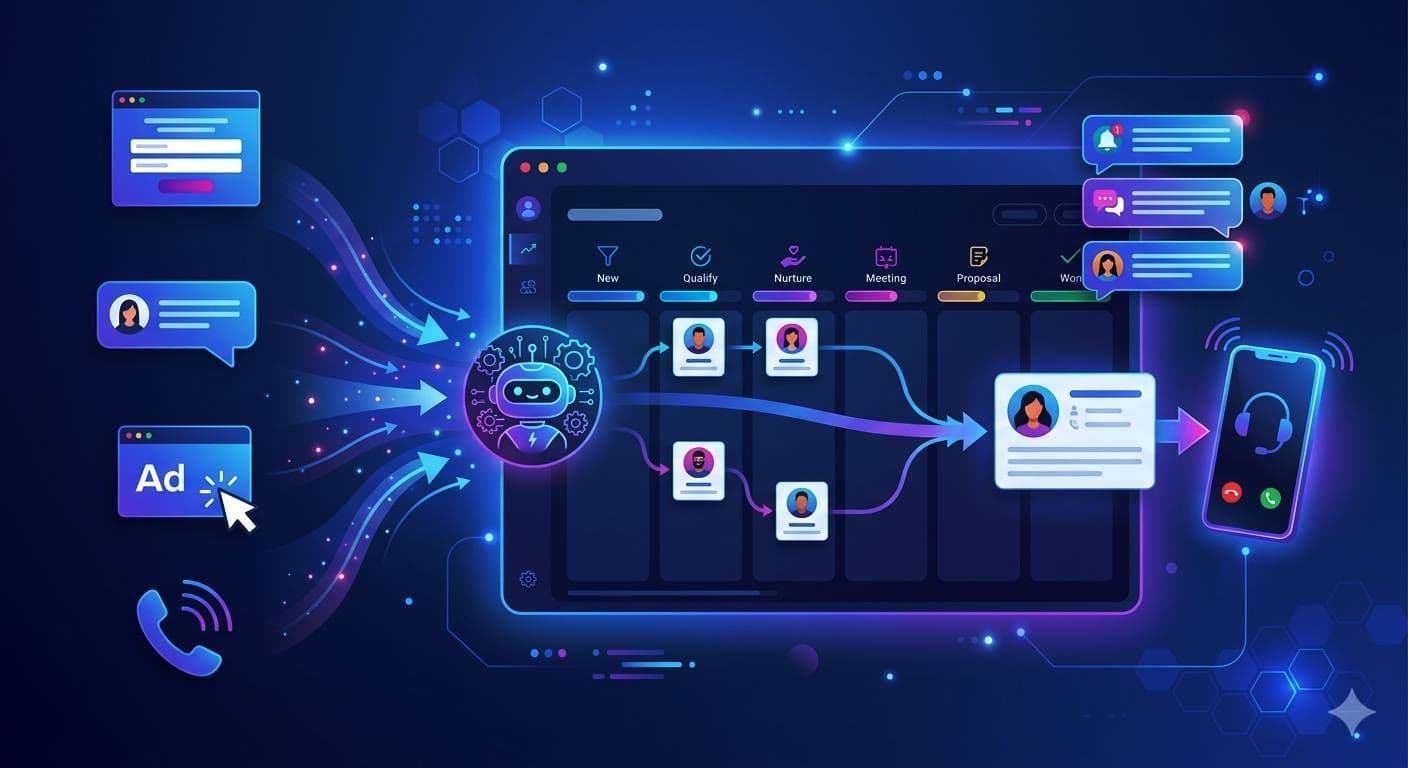
Meta Lead Ads convert when you reply in under two minutes. Here is the WhatsApp-first follow-up architecture that actually hits that window.
The ad spend problem nobody attributes
You spend on Meta. The ad library shows your creative is working. Lead volume is fine. But the booking rate per lead is half what your blended CAC math assumed. The CFO asks why the channel is underperforming and you blame creative, audience, or "lead quality".
Lead quality is usually not the problem. The problem is that Meta delivered the lead at 2:17 PM and your team responded at 11:08 PM. Nine hours of silence, on a lead who had filled out a form ten seconds ago and clicked away to scroll Reels.
This is the most expensive leak in paid acquisition and the easiest to fix. The leak is not in the creative, the targeting, or the offer. It is in the time between Meta posting the lead and a real human conversation starting.
Why Meta Lead Ads are especially time-sensitive
A Lead Ad lead is fundamentally different from a contact form lead in three ways, and all three make speed matter more.
1. The prospect did not visit your site. They filled the form inside Facebook or Instagram. Their attention is still on the app. The moment they exit the form, they are scrolling again. Your competitor's ad is one scroll away.
2. The form is auto-filled. Meta pre-populates name, email, and phone from the user's profile. The prospect probably did not even type. The effort barrier was effectively zero, which means the consideration was shallow. You have to add the consideration in your follow-up.
3. The lead exists in your funnel as raw structured data, not a conversation. Unlike an Instagram DM (which is already a conversation), a Lead Ad lead is a record in a list. Someone or something has to start the conversation. The first message you send is the first conversation the prospect has with your brand.
All three push the follow-up window tighter. We treat 2 minutes as the upper bound on the first useful WhatsApp message after Meta posts the lead.
The 2-minute architecture
Meta's Lead Ads webhook delivers leads in real time. The whole architecture sits on top of that.
Stage 1: Webhook subscription
Subscribe your endpoint to the leadgen event for the page running the ad. Meta posts the lead within seconds of submission. Your handler retrieves the full lead via the Marketing API. Total budget: 1 to 3 seconds.
Stage 2: WhatsApp template send
Use an approved WhatsApp Business Cloud API template message to make the first contact. Templates are required for the first outbound WhatsApp message after a Lead Ad submission because the prospect has not yet messaged you, and Meta enforces the 24-hour customer service window. The template should pre-fill name, the offer the lead opted into, and one short call to action.
Approved template example:
Two parameters: name, offer name. Survives Meta review reliably. Total budget for this stage: 5 to 10 seconds.
Stage 3: In-thread qualifier
The prospect replies. The qualifier takes over and asks the next-best question. One question per turn, structured field extraction (event date, headcount, venue type, budget band, source ad ID). The qualifier does not pitch; it qualifies. Once the qualifying ruleset clears, the conversation is labelled closer-ready and routed to a human closer. The same pattern as the Instagram OS, with WhatsApp as the channel from message one.
Stage 4: CRM writeback
Every event in the conversation writes to the CRM in real time. Source ad ID, qualifying fields, label, transcript link. The marketing manager can attribute revenue back to a specific creative without manually stitching reports the next week.
Total end-to-end: a Lead Ad lead submitted at t=0 has a structured WhatsApp message at t+10 seconds and is in a real conversation by t+45 seconds.
What "fast follow-up" looks like in numbers
Concrete comparison for a Meta Lead Ad campaign with 200 leads in a month:
| Metric | Slow team (2 to 24 hour follow-up) | Fast system (sub-2-minute) |
|---|---|---|
| Leads contacted at all | 70% | 100% |
| Replied to first message | 18% | 55% |
| Qualified in conversation | 9% | 28% |
| Booked a discovery call | 4% | 14% |
| Cost per booked call (₹500 CPL) | ₹12,500 | ₹3,571 |
The cost-per-booking shift is the line that makes the math work. Same ad budget, same creative, same audience. The follow-up speed is the only variable. At the typical Meta CPL band, fast follow-up usually pays for itself in the first 30 days.
The WhatsApp template hurdle
The most common failure mode in the architecture is not technical. It is template rejection. Meta reviews every WhatsApp Business template before it can be sent. Templates that look too sales-y or include prohibited phrases (urgency, pressure, prize claims) get rejected. Common reasons:
| Failure | Cause | Fix |
|---|---|---|
| "Limited time" or "act now" in template body | Urgency triggers Meta's marketing-template scrutiny | Replace with neutral phrasing |
| Missing opt-out instruction | Meta requires opt-out language on marketing templates | Add "Reply STOP to opt out" |
| Wrong category (Utility vs Marketing) | Categorisation must match content | Submit as Marketing for ad follow-ups |
| Variables look spammy ({{1}} = full sentence) | Template variables must be short tokens, not paragraphs | Use names, dates, short labels only |
Templates that follow Meta's content rules and ship as Marketing category typically get approved in under 24 hours. We submit two templates (a primary and a fallback) for every Lead Ad campaign so a single rejection does not delay a launch.
What if the prospect does not reply
A meaningful share of Meta Lead Ad leads do not reply to the first WhatsApp message. That is expected; the form was effortless and consideration was shallow. The nurture pattern is:
| Time after first message | Action |
|---|---|
| 30 minutes (silent) | Soft follow-up: "Quick check, do you want me to share a few options?" |
| 24 hours (still silent) | One last nudge with a specific offer detail |
| 72 hours (still silent) | Move to a slower email sequence; close the WhatsApp thread |
The 24-hour customer service window matters here. If the prospect has not replied within 24 hours, you cannot freely message them; you have to use another template. Plan the nurture template set up front so you do not get stuck.
Why human follow-up cannot match the architecture
A common ask from teams: "What if we just commit to 2-minute follow-up manually?". The math does not support it. A Meta campaign that lands 20 leads on a Tuesday afternoon, distributed unevenly, with each lead requiring 30 seconds of context-switch and 90 seconds of writing a thoughtful message, blocks one person for 40+ minutes of pure response time. During that 40 minutes, more leads land. The queue grows, the response time degrades, and by lead 6 you are at 5 minutes; by lead 15 you are at 20 minutes.
A human follow-up team is fine for sub-5 daily lead volume. Above that, the math breaks and you need infrastructure. The full architecture is in the speed-to-lead post if you want the underlying numbers.
Where this sits in the broader pipeline
The Meta Lead Ad follow-up architecture is one channel into the broader inbound operating system. Instagram DMs, WhatsApp inbound, ad forms, and website forms all funnel into the same qualifier and the same closer queue. The Lead Ad path is special only in two ways: the first contact has to be a WhatsApp template (Meta's 24-hour rule), and the source attribution carries the ad ID, ad set, and campaign so reporting works.
If you are running Meta Lead Ads and your team is already on the Instagram OS, the Lead Ad follow-up is an add-on, not a separate project.
What this is not
- It is not a chatbot pitch. The chatbot is one component; the system is the bigger thing.
- It is not "respond faster" advice. Advice does not survive a 2 PM Tuesday lead spike.
- It is not a CRM. The CRM is downstream; the architecture writes to it.
- It is not a substitute for good creative. If your creative is wrong, faster follow-up will not save you. It will just deliver bad-fit leads faster.
FAQ
Will Meta approve a WhatsApp template that follows up on a Lead Ad? Yes, if the template is categorised as Marketing, uses neutral phrasing, includes an opt-out, and uses short variables. We submit a primary and a fallback template per campaign so a single rejection does not block the launch.
Do I have to send WhatsApp from the same Business Manager as my ad account? You need a WhatsApp Business Account linked to the same Meta Business Manager that owns the ad account, but the WhatsApp phone number can be different from any phone on the ad account. For teams without a SIM, the Twilio number verification path sets up a working production sender quickly.
What about prospects who only respond to email or phone? The architecture supports parallel channels. We can fire a WhatsApp template, an SMS, and an email simultaneously and unify the responses in the same CRM lead. Most teams turn on WhatsApp first and add SMS/email if WhatsApp coverage is poor in their geography.
Will fast follow-up reduce my CPL? No, fast follow-up does not change cost per lead. It changes cost per booked call. Meta charges the same per submission regardless of how fast you respond. The downstream economics shift because more of your submitted leads convert to conversations.
How long to install? A working sub-2-minute Lead Ad follow-up for one campaign installs inside the same 4 to 7 day pilot we run for the full system. Template approval is the slowest step; everything else is configuration.
The bottom line
Meta Lead Ads (Facebook and Instagram) deliver leads to your webhook in seconds. Your team usually takes hours. That gap is where the ad spend dies. The fix is a sub-2-minute follow-up system that fires the moment Meta posts a lead, sends a structured WhatsApp message, qualifies in-thread, and hands a closer-ready conversation back to your team. Same ad budget, same creative, same audience; the follow-up speed is the only variable that moves cost per booked call.
- Meta Lead Ads land in your webhook in seconds. Most teams respond in hours. That gap is where the ad budget dies.
- Sub-2-minute is the upper bound for Lead Ad follow-up. Under 60 seconds is even better.
- The architecture: Lead Ads webhook + approved WhatsApp template + in-thread qualifier + CRM writeback.
- The math: same CPL, lower cost per booked call. The system usually pays for itself inside 30 days at typical Meta CPL bands.
- Template approval is the longest-lead-time step. Submit two templates per campaign so a single rejection does not block launch.
If your Meta ad spend is delivering leads faster than your team can follow up, the next step is a 7-day production pilot on one campaign. We install the follow-up system, you run the spend as usual, you watch the conversion math.
White-label tech partner
Your agency has the clients. I have the tech layer.
You don't need to build a technical team before you can take on technical work. Whether you're an established agency or just getting started, I can provide the technical layer behind your delivery, from building the system to getting it into production.
PolarBuild case study →You only sell once
We never compete for your end clients. One partnership conversation. You fulfil for every account in your base.
Free POC before big builds
A three-day sales demo on the proven stack before any large software investment. You pitch to your prospects or existing clients. Implementation starts only when someone pays.
Geography replication
UK dental becomes US dental with a new local partner and new integration targets. Same playbook, new market.