
Why Fast Response Increases Meeting Bookings
Discover why fast responses increase meeting rates.
A prospect lands on your pricing page at 9:12 p.m.
They have already read your case studies. They have already compared you to two competitors. They fill out your demo form, not because they want a brochure, but because they are finally ready to talk.
At that moment, they are not just a lead. They are a schedulable buyer.
This is the core reason Why Fast Response Increases Meeting Bookings. Fast response does not just improve contact rates. It preserves the short window when a prospect is mentally available to commit to a meeting.
That distinction matters.
Many teams think of speed as a sales efficiency metric. In reality, speed is a scheduling metric. If you respond while intent is still active, the lead is far more likely to pick a time, answer qualifying questions, and move into your calendar. If you wait, the lead has not necessarily lost interest in your product. They have simply left the moment in which booking felt easy.
A useful reframing is this:
Meetings are not won by persuasion first. They are won by timing first.
That is why businesses that respond in minutes often book more calls without changing their offer, pricing, or sales script.
The real problem is not interest loss. It is scheduling decay.
When an inbound lead submits a form, most companies assume the next challenge is getting that person interested enough to speak with sales.
But for high-intent inbound leads, interest is often already present.
The immediate challenge is much narrower: can you convert that active interest into a scheduled meeting before the prospect switches context?
This is the angle many teams miss.
A delayed response does not just lower the odds of a conversation someday. It lowers the odds of booking a meeting right now, when the prospect is still in decision mode, still at their desk, still thinking about the problem, and still willing to open their calendar.
Once that moment passes, scheduling becomes harder for practical reasons:
- they return to work
- they move into meetings
- they forget to check personal text or email
- they need to revisit the problem later
- they lose the momentum that made booking feel natural
So the issue is not simply that the lead goes cold. It is that the booking window closes.
If you want to understand the broader mechanics behind why inbound leads go cold, speed is the first lever. But in the specific context of appointment generation, the mechanism is even more direct: delayed response creates scheduling friction.
Why Fast Response Increases Meeting Bookings
Fast response increases meeting bookings because it matches the lead's highest willingness to take the next step.
That willingness is temporary.
When someone fills out a form, they are already in action mode. They are not passively browsing. They are actively trying to solve something. In that moment, booking a meeting feels like progress.
If your business responds immediately, three things happen that make scheduling far more likely.
1. The prospect is still in decision mode
Right after form submission, the buyer has context loaded in their mind.
They remember why they reached out. They can answer questions quickly. They are more likely to say yes to a call because the issue is still urgent to them in that moment.
Hours later, the same person may still be a fit, but they are no longer in the same mental state. Booking now feels like another task instead of a continuation of the one they already started.
2. The calendar ask feels natural
A meeting request works best when it feels like the obvious next step.
Immediate outreach creates a seamless progression:
submit form, get response, answer a few questions, pick a time.
Delayed outreach breaks that flow. Now the meeting request feels disconnected from the original action. The buyer has to reconstruct context before they can commit.
That extra mental step reduces scheduling success.
3. Convenience is highest in the first few minutes
Most teams underestimate how much appointment booking is driven by convenience rather than persuasion.
A prospect who just submitted a request is already holding their phone or sitting at their laptop. They are in a perfect position to confirm a time.
Later, even interested buyers delay simple actions because life gets in the way.
This is why response speed affects conversion rates so strongly. Booking a meeting is often less about convincing and more about capturing the moment when taking action is easiest.
The hidden mechanism: speed reduces scheduling friction
The deepest reason fast response improves meeting rates is that it removes friction at the exact point where commitment happens.
Scheduling friction sounds minor, but it kills a surprising number of qualified opportunities.
Here is what friction looks like in practice:
- the lead receives a generic email with no direct booking path
- the rep follows up later when the lead is busy
- the prospect has to go back and forth to find a time
- the calendar link arrives after the original urgency fades
- the first response asks them to "let us know when works"
None of these issues means the lead is unqualified.
They simply make booking harder than it should be.
Fast response reduces this friction because it keeps the handoff tight. The buyer does not have to restart the process. They are already engaged, so even a simple prompt like "Want to book a quick intro call for tomorrow?" can convert efficiently.
This leads to an important insight:
Speed does not just create more conversations. It compresses the distance between intent and commitment.
That compressed distance is where more meetings come from.
What delayed response does to your pipeline
When businesses respond slowly, they often notice a drop in booked meetings before they notice a drop in revenue.
That is because scheduling sits early in the pipeline. If appointment volume weakens, everything downstream suffers.
A small delay at the top creates a larger gap later:
- fewer conversations start
- fewer qualified opportunities enter pipeline
- sales reps work smaller calendars
- follow-up cycles get longer
- marketing spend produces less visible return
This is especially painful for companies investing in paid acquisition or high-intent channels. A lead that comes from a demo page or contact form is not just traffic. It is a potential calendar event.
If that event never gets booked, the funnel never really begins.
This is one reason many teams focus too much on lead volume and not enough on booking velocity. They keep trying to generate more inquiries when the real leak is happening between form submission and calendar confirmation.
Real-world behavior: buyers book when momentum is highest
Think about your own behavior as a buyer.
When you research a tool, request a quote, or ask for a demo, there is usually a short burst of motivation behind it. You are comparing options, trying to solve a problem, and ready to take action.
During that burst, scheduling a meeting feels easy.
The next day, even if you still care, your attention is fragmented. You may still intend to reply, but intention and action are not the same thing.
That is why the first few minutes matter so much. Not because all buyers vanish instantly, but because immediate follow-up captures them at the peak of practical responsiveness.
For teams trying to improve appointment generation, this is more useful than broad theory. It points to a clear operational priority: create a system that reaches leads while action momentum still exists.
This is also why the 5-minute rule for inbound leads matters in practice. It is not just about being first. It is about booking while the prospect is still mentally prepared to say yes.
Practical ways to improve scheduling success through speed
If your goal is more booked meetings, your process should be designed around immediate scheduling opportunity, not delayed human availability.
Here are the most effective ways to do that.
Respond with a booking path immediately
Do not send a vague confirmation.
Your first response should move directly toward the calendar. That can mean:
- a text with a scheduling link
- an immediate callback
- a short qualification flow followed by available times
- an email that asks for one simple next step
The faster you present the path to book, the higher the chance the lead acts while intent is still active.
Keep qualification lightweight at the start
Long forms and heavy screening can slow scheduling momentum.
Ask only what you need to route or qualify the lead enough to offer the right next step. You can gather deeper details after the meeting is booked.
If your process demands too much before the calendar appears, you are adding friction during the most valuable part of the journey.
Use channels that match how people respond quickly
For many inbound leads, SMS and phone outperform email in the first-contact window because they create faster action.
That does not mean email has no role. It means your earliest touch should prioritize immediacy.
A quick multi-channel approach often works best: instant text, fast call attempt, then email confirmation.
Make scheduling feel assisted, not self-service only
Some buyers will book through a link. Others respond better when the process feels guided.
A message like "I can get you set up for a 15-minute intro tomorrow at 10 or 2, which works better?" often outperforms passive calendar links because it reduces decision effort.
How automation and AI solve this exact booking problem
This is where automation becomes more than an efficiency upgrade.
It becomes a scheduling system.
If fast response improves meeting bookings because it protects buyer momentum, then the ideal setup is one that reacts instantly every time a lead comes in, not only when a rep is free.
AI and automation can do that consistently.
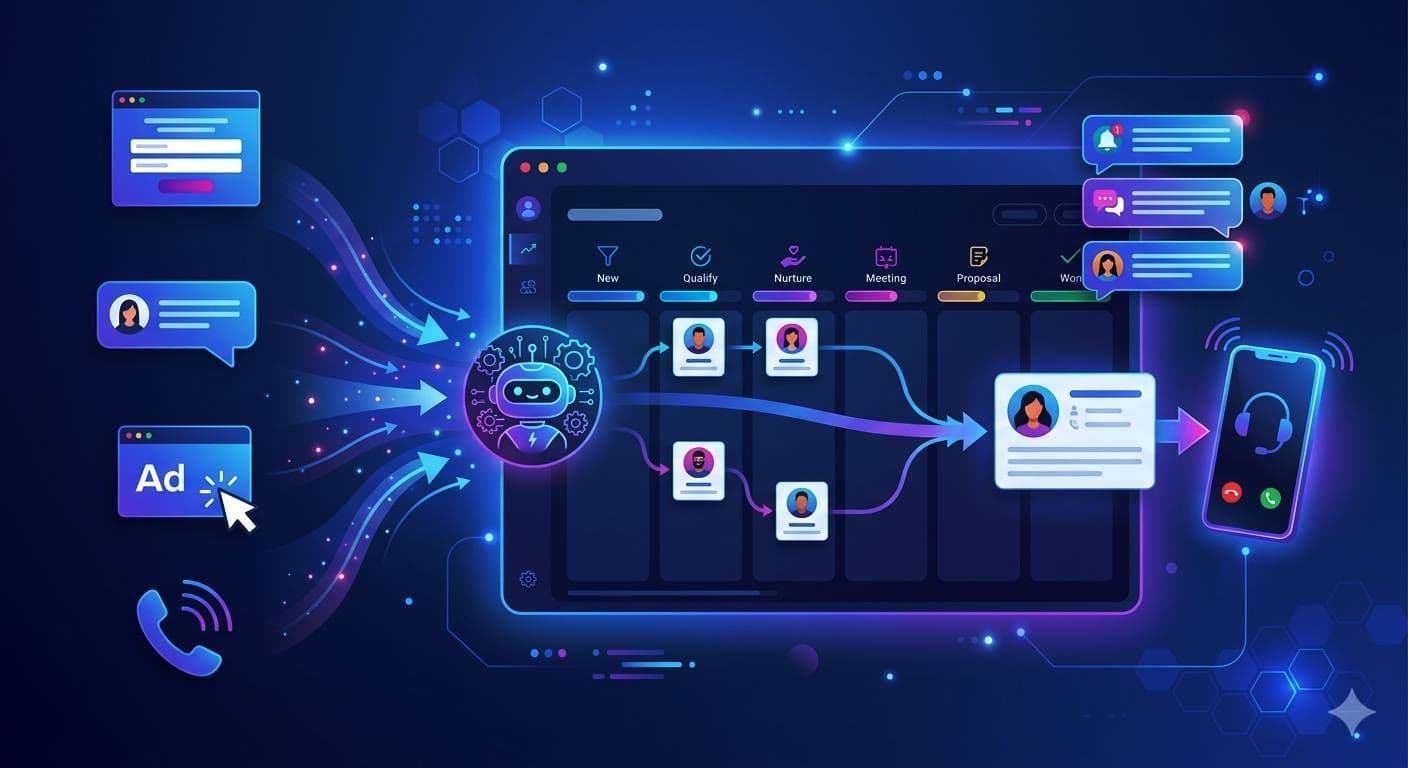
For example, an automated lead response system can:
- detect a new form submission instantly
- send an immediate text confirmation
- place an instant outbound call
- ask qualifying questions
- route the lead correctly
- offer live calendar slots
- trigger follow-up if no booking happens on the first attempt
This matters because the booking window is short and unpredictable. Leads come in during lunch, after hours, during rep meetings, and between other priorities. Manual teams cannot reliably protect every one of those moments.
Automation can.
That is the practical value of tools like instant lead response software. The benefit is not just a faster timestamp in your CRM. The benefit is more meetings booked while the buyer is still ready to book.
For companies with meaningful inbound volume, this is often the simplest route to better calendar conversion without increasing ad spend.
Key takeaways
Fast response improves scheduling success because it captures the lead during their highest-action moment.
The main issue is not abstract interest loss. It is that the opportunity to book a meeting becomes less convenient with every passing minute.
Remember these points:
- inbound leads are most schedulable immediately after they submit
- delayed response creates scheduling friction, even when interest remains
- booking rates improve when the next step is immediate and simple
- automation helps preserve the booking window at scale
The clearest takeaway is this:
A lead does not need to become uninterested for you to lose the meeting. They only need to become busy.
That is exactly Why Fast Response Increases Meeting Bookings.
FAQ
1. Why does fast response increase meeting bookings more than later follow-up?
Because the prospect is most ready to act right after submitting the form. They still have the problem in mind, they are already engaged, and booking feels like a natural continuation of what they just started.
2. Is the main benefit of fast response better qualification or more appointments?
Both can improve, but in this context the immediate benefit is more appointments. Fast response protects the short window where scheduling is easiest, which increases booked meetings before deeper qualification even begins.
3. How can businesses improve meeting booking rates without hiring more reps?
The most effective approach is to automate the first response and the booking path. Instant texts, AI calls, smart routing, and automatic follow-ups help convert more inbound intent into scheduled meetings without depending on rep availability.
Next step
Want to fix slow lead response?
See how FusionSync responds in seconds, qualifies inbound leads, and moves them toward a booked next step automatically.
Where it works
View all use cases