
Inbound Lead Management
The 5-Minute Rule for Inbound DMs, Forms, and WhatsApp

Updated
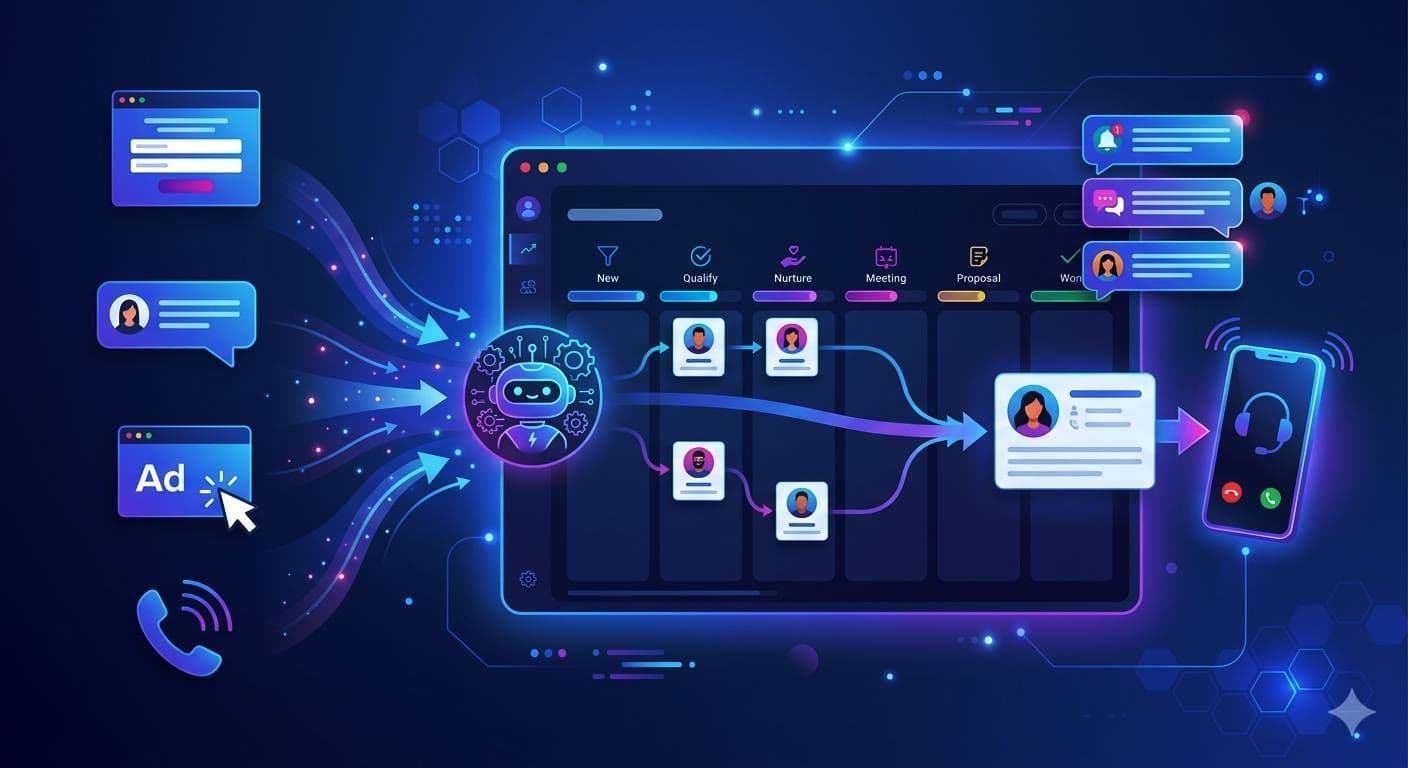
The 5-minute rule is older than your CRM and still right. Here is what it means now for Instagram DMs, WhatsApp inbound, and ad form leads.
Where the rule comes from
The 5-minute rule comes from the Lead Response Management Study published in 2007 by James Oldroyd and David Elkington, working with InsideSales and supported by data from MIT. The headline finding has been quoted to death and is still right:
The odds of contacting a lead drop by a factor of 10 between the first 5 minutes and the first 30 minutes. The odds of qualifying a lead drop by a similar factor between 5 minutes and an hour.
The study covered thousands of B2B leads from web forms in 2007. It predates Instagram DMs, WhatsApp Business, and Meta Lead Ads. The curve has gotten steeper since, not flatter, because every prospect has more competitors one tab away than they did in 2007.
The original curve, simplified:
| Time to first contact | Relative odds of qualifying |
|---|---|
| 1 minute | 1.00 (baseline) |
| 5 minutes | 0.79 |
| 30 minutes | 0.21 |
| 1 hour | 0.10 |
| 24 hours | Effectively zero |
Read that as: the lead you respond to in 5 minutes is roughly 4x more likely to qualify than the one you respond to in 30, and 10x more than the one you respond to in an hour. The math has not changed.
What the rule means in 2026
The 5-minute rule was written for desktop web forms in business hours. In 2026 your inbound is more diverse and more impatient.
| Channel | 2007 expectation | 2026 expectation |
|---|---|---|
| Web contact form | 5 minutes | 3 to 5 minutes |
| Email enquiry | 1 hour | 30 minutes |
| Phone call missed | Same-day callback | Under 5 minutes via SMS or WhatsApp |
| Instagram DM | Did not exist | Under 60 seconds |
| WhatsApp inbound | Did not exist | Under 60 seconds |
| Meta Lead Ad form | Did not exist | Under 2 minutes |
| Missed booking (Cal.com etc) | Did not exist | Under 5 minutes |
Five minutes is now the upper bound across all channels. For Instagram and WhatsApp, the expectation is closer to a minute. The phrase "5-minute rule" survives because it is memorable and because it still describes the channels (web forms, emails) where most teams have not yet caught up.
Why the rule keeps getting tighter
Three things have changed since 2007.
1. Buyers have more options one tap away. In 2007 a B2B buyer comparing software might have three vendors open in tabs. In 2026 an event-planning bride has six vendors saved in her Instagram Saved folder and DMs all of them in the same afternoon. The first vendor to engage gets the discovery call; the rest get scrolled past.
2. The first reply is now a chat message, not an email. Chat messages have a higher attention budget. If you reply to an Instagram DM in 5 minutes, the prospect has already moved on. Email gives you 30 minutes. Chat gives you 60 seconds.
3. Automation is no longer optional. In 2007 an instant auto-responder was a novelty. In 2026 every competent competitor has one. The 5-minute rule used to be "be the team that responds fast". It is now "be the team whose automated qualifier is fast and useful".
The misuse of the rule
Two common mistakes that look like compliance with the rule but are actually not.
Mistake 1: counting auto-responders as "the response"
Sending an automated "Thanks for reaching out, we will get back to you within 24 hours" message inside 60 seconds does not satisfy the 5-minute rule. The rule is about a meaningful response: one that engages, asks the next-best question, or otherwise moves the conversation forward. Queueing the prospect with an apology is not a response; it is a delay notification.
A useful first reply for an event company looks like this:
Hi Priya, what date are you looking at?
That is automated, sub-5-second, and useful. The qualifying field gets extracted on message one.
Mistake 2: hitting the rule during business hours, missing it everywhere else
Inbound does not happen during business hours. Saturday afternoon is the highest-volume inbound window for most consumer-facing service businesses. If your team is the response system, you cannot satisfy the rule on weekends, evenings, lunch, or during meetings. You are satisfying the rule maybe 30% of the working week, which is functionally the same as not satisfying it.
This is why speed-to-lead infrastructure is the answer, not "tell the team to be faster". A person cannot be on-call for an inbox 24/7. A webhook can.
The 5-minute rule by channel, applied
Instagram DMs
Target: first qualifying reply in under 60 seconds. Architecture: webhook subscription on the Instagram Graph API, qualifier that asks one structured question, idempotent send via the IG Send API. See the Instagram OS post for the full setup.
WhatsApp inbound
Target: first qualifying reply in under 60 seconds. Architecture: WhatsApp Business Cloud API inbound webhook, same qualifier pattern as Instagram. The send goes through the WhatsApp Cloud API messages endpoint. For teams without a SIM, the Twilio number verification path is the cleanest production setup.
Meta Lead Ads
Target: first reply in under 2 minutes. Architecture: Lead Ads webhook subscription, qualifier triggered on lead receipt. Meta delivers lead data via webhook within seconds; the rest is your response budget. See why Facebook lead ads require fast follow-up for the Meta-specific shape.
Web contact forms
Target: first reply in under 3 minutes. Architecture: form submit POST to a webhook handler, qualifier replies via email and SMS, optionally triggers an outbound call. The shape is the same; the channels are slower and less attention-rich than chat.
Missed calls
Target: callback or SMS in under 5 minutes. Architecture: phone system webhook on missed call, callback either via AI voice agent or by ringing the closer's mobile. See the AI voice agent + GoHighLevel setup for the most common pattern.
What "meaningful response" actually contains
For each channel, the first message has the same job: extract one structured field while making the prospect feel like a human is engaged. The template is:
Examples that work:
- "Hi Priya, what date are you looking at?"
- "Quick check, are you looking at outdoor or indoor?"
- "Got it, roughly how many guests?"
Examples that fail (do not count as a response):
- "Thanks for reaching out, our team will get back to you within 24 hours."
- "We have received your message and will respond shortly."
- "Hi there, you have reached our automated system. Please share your details."
The line between the two is sharp. One advances the conversation, the other queues the prospect.
How to measure compliance
Compliance with the modern 5-minute rule is a metric, not a hope. The two numbers to watch:
| Metric | Target | What it tells you |
|---|---|---|
| First reply latency, p50 | Under 30 seconds | Whether capture and qualifier are healthy in steady state |
| First reply latency, p95 | Under 5 minutes | Whether spikes are degrading the system |
If p95 is over 15 minutes, you have a spike problem. If p50 is over 2 minutes, your qualifier is slow or the webhook is broken. If both are fine but bookings are flat, the latency is not your problem; the qualifier content is. The numbers tell you exactly which component to fix.
What this is not
- It is not "respond to leads faster" as a team policy. Policies do not survive Saturday afternoons.
- It is not a chatbot. Chatbots satisfy the rule by sending the wrong kind of message inside 60 seconds.
- It is not channel-specific. The rule applies across DMs, WhatsApp, ad forms, web forms, missed calls.
FAQ
Is the 5-minute rule still accurate? The 5 minutes is the upper bound. For modern chat channels (Instagram, WhatsApp), under 60 seconds is the win threshold. The shape of the curve is unchanged: every multiple of time-to-response drops your qualifying odds by a factor.
Do I lose the lead permanently if I miss the 5 minutes? Not permanently, but the odds drop sharply. A lead reached at 30 minutes is still worth working; the conversion rate is just much lower. Follow-up nurture flows exist to claw some of those back. Better to not miss in the first place.
Does the rule apply to high-ticket sales with long buying cycles? Yes. The buying cycle is long; the response window is not. A high-ticket buyer doing six months of research still expects an instant first reply when they finally reach out. The shape is the same.
My team responds in 10 to 15 minutes. Is that bad? It is the typical SMB number, and it is below the modern threshold. You are losing roughly 60% of the qualifying odds you would have at 60 seconds. Whether that matters depends on volume. Below 5 inbound leads a week, probably not. Above that, almost certainly.
Will hitting the rule increase my booking rate? Improving response time tends to improve the rate at which leads qualify, which in turn lifts bookings. The size of the lift depends on how slow you were before and how much of the qualification you can do in-thread. For inbound-heavy event companies coming from 30-minute median response time, we typically see qualifying rates roughly double.
The bottom line
The 5-minute rule says: respond to a new inbound lead within five minutes or expect a sharp drop in your odds of qualifying that lead. The rule is from a 2007 lead response study and has only sharpened with the rise of Instagram DMs, WhatsApp inbound, and Meta ad forms. Five minutes is now the upper bound, not the target. Under 60 seconds is the modern win threshold for chat channels. A response only counts if it moves the conversation forward; an auto-responder that says "we will get back to you" does not.
- The 5-minute rule is the upper bound, not the target. For chat channels, the target is under 60 seconds.
- A response only counts if it moves the conversation forward. Auto-responders are not responses.
- The rule applies across every modern inbound channel. The thresholds vary slightly by channel; the shape does not.
- Compliance is a measurable metric: first reply latency p50 and p95. Track both.
- The right architecture (webhook + qualifier + send + monitoring) makes compliance default-on. Asking a team to be faster does not scale.
If your inbound response time is above the modern thresholds, the next step is a 7-day production pilot on one campaign. We install the response architecture, you watch the latency numbers, you decide.
White-label tech partner
Your agency has the clients. I have the tech layer.
You don't need to build a technical team before you can take on technical work. Whether you're an established agency or just getting started, I can provide the technical layer behind your delivery, from building the system to getting it into production.
PolarBuild case study →You only sell once
We never compete for your end clients. One partnership conversation. You fulfil for every account in your base.
Free POC before big builds
A three-day sales demo on the proven stack before any large software investment. You pitch to your prospects or existing clients. Implementation starts only when someone pays.
Geography replication
UK dental becomes US dental with a new local partner and new integration targets. Same playbook, new market.