
How Fast Should You Respond to a Lead?
Discover how quickly businesses should respond to inbound leads to maximize conversions.
At 8:17 p.m., a homeowner requests an estimate for a kitchen remodel.
They have their laptop open, a budget in mind, and three contractor tabs still sitting in the browser.
At 8:18, they are still in decision mode.
At 8:27, they are comparing portfolios.
At 8:46, they are back to helping their kids with homework, the urgency is fading, and the form they filled out already feels like something they did earlier in the night.
By the next morning, that same lead is not necessarily lost. But they are no longer the same lead.
That is the real question behind How Fast Should You Respond to a Lead?
Not “when can my team get to it?”
Not “is same day good enough?”
The real question is:
At what point does response delay start collapsing the probability of a real conversation and, eventually, a sale?
The answer is more precise than most teams think. Conversion probability does not decline evenly. It drops in thresholds.
A lead at 60 seconds is different from a lead at 10 minutes. A lead at 10 minutes is different from a lead at 2 hours. And a lead at 24 hours is usually operating on a completely different level of intent.
Here is the sharp takeaway: speed is not just responsiveness. It is timing against intent decay.
That is why the best teams do not treat lead response as a general service metric. They treat it as a conversion window.
If you want to understand why inbound leads go cold, start by understanding the thresholds where buying intent is strongest and where it begins to disappear.
The problem is not delay in general. It is crossing the wrong threshold.
Most companies think about follow-up in broad categories:
- Fast
- Slow
- Same day
- Next day
But leads do not experience time that way.
A lead does not think, “This company replied within business hours, so that feels acceptable.”
They experience your response relative to the moment they raised their hand.
That means response time works less like a service standard and more like a probability curve.
In practical terms, the biggest drop in conversion odds often happens early. Not after two days. Not after one week. In the first few minutes and first hour.
That is what many teams miss.
They optimize for eventually responding. The market rewards whoever responds during the lead’s peak attention window.
How Fast Should You Respond to a Lead? The thresholds that matter most
Here is the simplest way to think about ideal response time.
0 to 1 minute: highest conversion probability
This is the gold zone.
The lead still remembers exactly what they submitted, why they submitted it, and what question they wanted answered.
There is almost no context switching yet.
If your business responds in this window, you are not reactivating interest. You are meeting it while it is still active.
This is why instant SMS, instant callbacks, and immediate qualification flows perform so well. They match the lead’s current attention rather than trying to recover it later.
1 to 5 minutes: still excellent, but decline has started
This is the classic benchmark for a reason.
Within five minutes, most leads still feel like the interaction is connected to the action they just took. The inquiry and the response belong to the same mental moment.
That continuity matters.
The lead does not need to reconstruct context. They are still emotionally and mentally available.
This is also why the widely cited five-minute benchmark remains so important. If you want a deeper breakdown of that standard, see The 5-Minute Rule for Inbound Leads Explained.
5 to 15 minutes: meaningful drop in contactability
This is where friction appears.
The lead may still answer. They may still reply. But now your response is no longer part of the original action. It is an interruption arriving after the moment has passed.
That changes behavior.
A lead who was eager a few minutes ago may now send you to voicemail, leave your email unread, or decide to “come back to this later.”
This is not because they are unqualified. It is because the buying moment has cooled.
15 to 60 minutes: conversion probability falls sharply
By this point, attention has usually moved elsewhere.
The lead is back in work mode, in meetings, commuting, or handling something unrelated. Even if they are still interested, responsiveness falls because your timing no longer aligns with their intent peak.
This is the hidden problem with “pretty fast” sales teams. A 30-minute response sounds efficient internally. Externally, it often misses the highest-converting window entirely.
1 to 24 hours: recovery mode, not peak conversion mode
A response in this range is not ideal follow-up. It is salvage follow-up.
You are now trying to reopen a decision process that has already cooled, shifted, or been deprioritized.
Some deals will still happen. But the probability is materially lower because the lead is no longer acting from the same urgency that created the inquiry.
24+ hours: most leads have decayed substantially
At this point, you are often contacting a lead who has mentally moved on.
They may still be polite.
They may still say they are interested.
But the original momentum is gone.
That is why average response time can be such a misleading metric. Teams can technically respond to every lead while still missing the only window that really mattered.
Why these thresholds affect conversion so directly
The mechanism is simple.
Inbound leads are generated at moments of concentrated intent.
A person has a pain point, a project, a deadline, a budget discussion, or a buying question. They act while that intent is vivid enough to produce a form fill, demo request, or quote inquiry.
That moment has energy.
Response speed determines whether your business meets that energy or arrives after it has dissipated.
This is the part many teams misunderstand: the lead is not static after form submission.
Every minute changes the state of the lead.
- In the first few minutes, they are attentive.
- Shortly after, they are distracted.
- Later, they are passive.
- Eventually, they are difficult to re-engage.
A useful reframing is this: you are not calling the same lead later. You are calling a lower-intent version of that lead.
That is why threshold-based response targets matter more than average response targets.
What this does to revenue and pipeline
When response delays push leads across these thresholds, the business impact compounds fast.
First, contact rates drop.
Then qualification rates drop.
Then appointment booking rates drop.
And because fewer early conversations happen, pipeline volume shrinks upstream before sales leadership even sees the problem clearly.
This is one reason teams often blame lead quality when the real issue is timing.
If 100 inbound leads come in and most are answered after the high-intent window, the pipeline may look like a top-of-funnel problem.
It is often a speed problem disguised as a quality problem.
This is especially true for paid traffic. If you are buying clicks from search or social, every delay lowers the yield on marketing spend. The lead cost stays the same. The conversion probability does not.
That is why teams focused on performance increasingly connect speed-to-lead with ROI. This is explored further in How Speed to Lead Impacts Marketing ROI.
Real-world pattern: “same day” is often too slow
A lot of businesses still think same-day follow-up is strong.
Operationally, it may be better than the market average.
Conversion-wise, it is usually far too late.
If a lead fills out a demo request at 9:12 a.m. and your rep replies at 3:40 p.m., that may count as a successful SLA internally.
But from the lead’s perspective, six and a half hours passed.
- The researching window is gone.
- The comparison set may have changed.
- The urgency may have faded.
- The original question may no longer feel immediate.
This is why “same day” is not a serious conversion benchmark for most inbound sales motions.
It is an administrative benchmark.
The best response targets for modern teams
If the goal is maximizing conversion probability, use thresholds like these:
- Ideal: under 1 minute
- Strong: under 5 minutes
- Acceptable but suboptimal: 5 to 10 minutes
- At-risk: 10 to 30 minutes
- Low-probability: 30+ minutes
These ranges are practical because they map to actual intent decay.
They also force the right operational question:
Not “Did we respond?”
But “Did we responded before conversion probability materially dropped?”
How to improve response time without relying on rep availability
The biggest mistake companies make is treating fast response as a rep discipline problem.
It is usually a system design problem.
If your target is under five minutes, you cannot depend on someone noticing a notification, checking the CRM, deciding who owns the lead, and manually reaching out every time.
That process is too fragile for threshold-based performance.
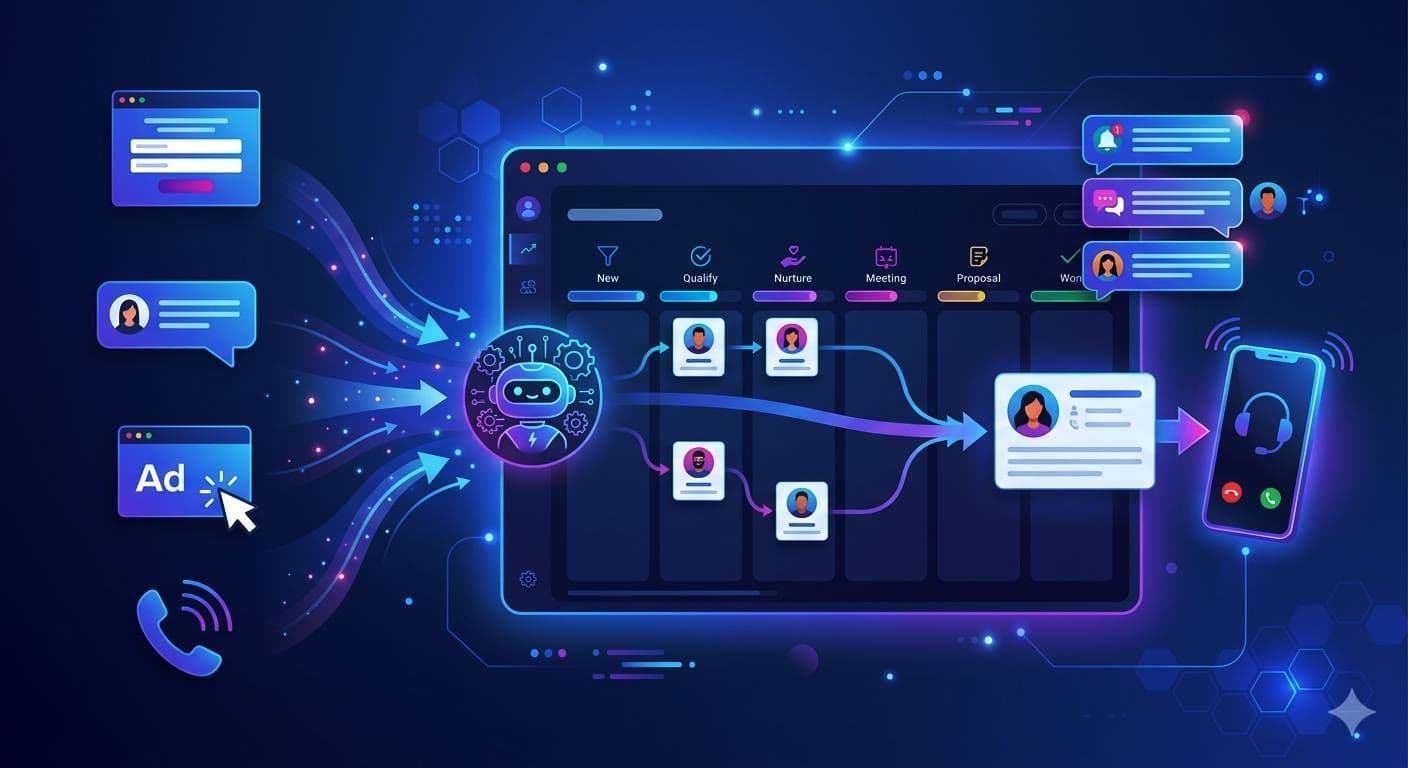
A better model looks like this:
- the lead submits a form
- the system responds instantly
- qualification starts immediately
- routing happens automatically
- booking options are presented while intent is still high
That approach is much more reliable than hoping a sales rep is free at the exact right moment.
If your current workflow involves manual assignment, this is often the first bottleneck to remove. Automatic Lead Assignment for Sales Teams covers that piece well.
How automation and AI solve this exact threshold problem
This is where automation becomes more than convenience.
It becomes conversion protection.
AI-powered lead response systems can engage a lead in seconds through SMS, voice, or email the moment the inquiry is submitted.
That matters because automation does something human teams struggle to do consistently: it performs at the earliest threshold every time.
An AI system can:
- acknowledge the inquiry instantly
- place an immediate call
- ask qualifying questions
- capture buying timeline and need
- book an appointment automatically
- trigger follow-up if the lead does not answer
The advantage is not just that it is fast.
The advantage is that it preserves the highest-probability window before the lead crosses into a lower-intent state.
Key takeaways
- Lead response speed works in thresholds, not in vague categories like “fast” or “slow.”
- The best conversion window is usually the first 1 to 5 minutes.
- After that, contactability and booking probability begin dropping quickly.
- Same-day response may satisfy an internal process while still missing the lead’s peak intent window.
- The right metric is not whether you responded. It is whether you responded before intent decayed.
- Automation and AI help because they protect that window consistently, not occasionally.
Conclusion
So, How Fast Should You Respond to a Lead?
If conversion is the goal, the ideal answer is immediately.
Under one minute is best.
Under five minutes should be the minimum serious target.
Anything beyond that starts lowering the odds that the lead will answer, engage, qualify, and book.
That is the central truth many businesses miss.
Lead response is not just a matter of courtesy. It is a race against intent decay.
And once that decay crosses the wrong threshold, recovering the opportunity becomes much harder than capturing it in the first place.
FAQ
1. How fast should businesses respond to inbound leads?
The ideal response time is under one minute, and under five minutes should be the standard target. Those early minutes are when intent is highest and conversion probability is strongest.
2. Is responding within an hour still good enough?
Usually not if you want to maximize conversions. An hour may feel fast internally, but it often misses the lead’s peak attention window and significantly lowers the chance of meaningful engagement.
3. Why does conversion probability drop so quickly after a form submission?
Because inbound leads are created during moments of active intent. As time passes, attention shifts, urgency fades, and the lead becomes less receptive. Response timing directly affects whether you catch the lead at peak interest or after that moment has cooled.
Next step
Want to fix slow lead response?
See how FusionSync responds in seconds, qualifies inbound leads, and moves them toward a booked next step automatically.
Where it works
View all use cases