
Instant Lead Response Software Explained
Learn how instant response tools engage inbound leads quickly.
A homeowner fills out a “Get a Same-Day Estimate” form for a HVAC company at 9:12 PM.
They are not casually browsing.
Their air conditioning just failed, the house is getting hot, and they want to talk to someone now. They submit the form, expect a quick reply, and keep their phone nearby for a few minutes.
Nothing happens.
No text. No call. No confirmation that anyone even saw the request.
By 9:20 PM, they are back on Google, filling out another form.
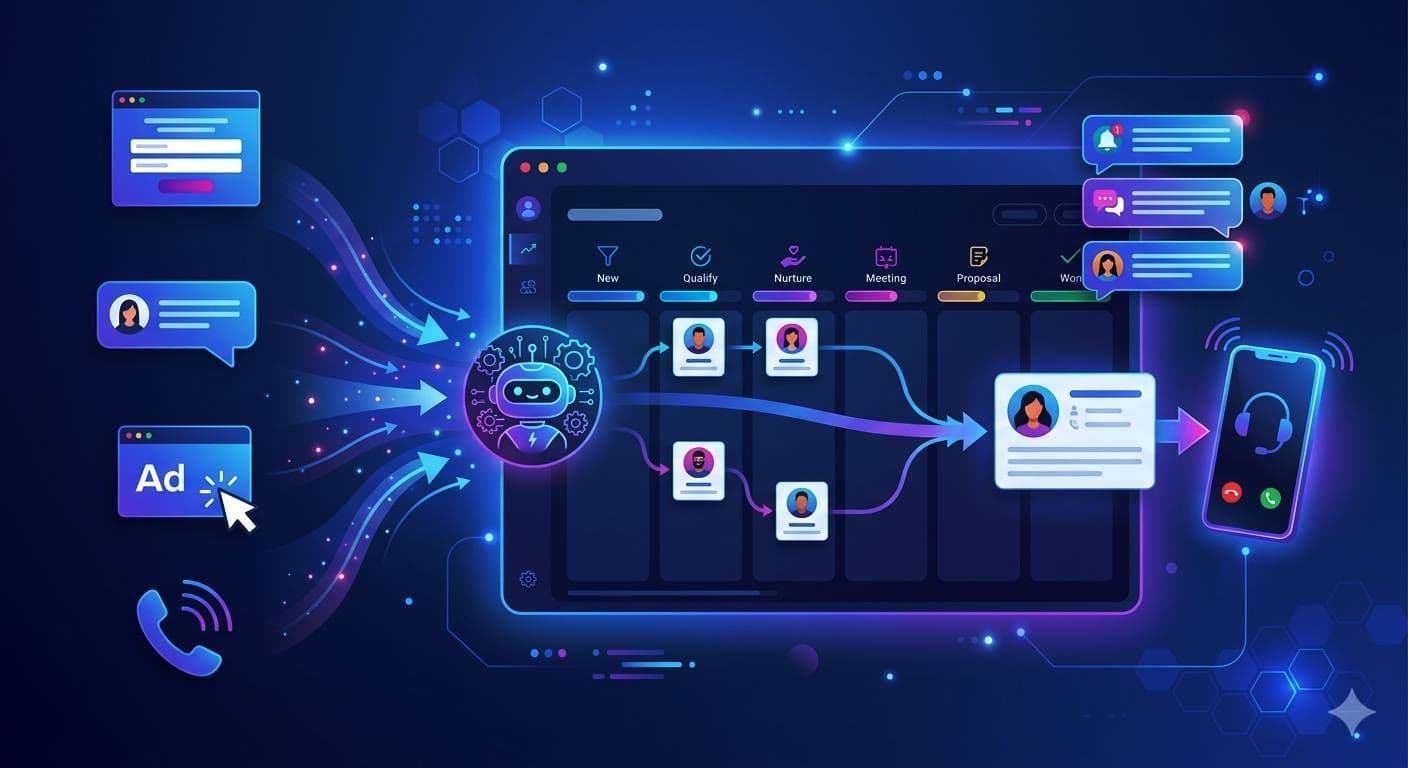
This is the real context behind Instant Lead Response Software Explained. It is not just software that sends an auto-email. It is a set of tools built to respond in real time, while buyer intent is still active, using channels like phone, SMS, CRM routing, calendar booking, and AI qualification.
The mistake many companies make is thinking speed is only about sales discipline. It is not. Inbound response speed is mostly a tooling problem.
Here is the sharper way to say it:
Leads do not wait for teams. They wait for systems.
If your business depends on a person seeing a notification, opening a CRM, deciding who owns the lead, and then manually reaching out, you do not have instant response. You have delayed response wearing a modern interface.
Instant Lead Response Software Explained
Instant lead response software is technology designed to engage an inbound lead the moment they convert.
That engagement can include:
- an immediate text message
- an instant callback
- an AI voice call within seconds
- automatic lead qualification
- real-time lead routing
- appointment booking
- triggered follow-up sequences
The point is not just acknowledgment.
The point is conversation momentum.
A lot of businesses already have pieces of this stack. They have a CRM. They have form fills going into a pipeline. They have email notifications. But those are not the same as response tools.
A CRM records demand.
Instant response software acts on demand.
That difference matters because the lead’s highest-intent moment is usually measured in minutes, not hours. If the software cannot do something meaningful right away, the business is still relying on delay.
This is closely connected to broader questions around what lead response time actually means, but the practical issue is simpler: what tools fire immediately when a lead raises their hand?
The real problem is not awareness. It is missing real-time tools
Most teams know they should respond quickly.
That is not the issue.
The issue is that their tech stack is built for storage, not speed.
A typical workflow looks efficient on paper:
- A lead submits a form
- The form pushes data into the CRM
- A rep gets notified
- The rep follows up when available
From an operations perspective, that feels organized.
From the buyer’s perspective, it feels like silence.
This is where leads cool off. Not because the company does not care. Not because the rep is lazy. But because there is no tool in the middle that converts an inbound event into an immediate response.
That middle layer is what instant lead response software provides.
Without it, every inquiry sits in a gap between intent and action.
And that gap is expensive.
Why real-time response requires more than one tool
Businesses often search for a single product to “fix lead response.” In practice, real-time response is usually created by a coordinated toolset.
1. Form-to-action triggers
The moment a form is submitted, the system should trigger something automatically.
That trigger might launch:
- a text confirmation
- an AI phone call
- a routing rule
- a booking workflow
- a follow-up sequence
If there is no trigger engine, there is no instant response.
2. SMS response tools
SMS is powerful because it meets the lead where they already are.
A simple, immediate message can confirm receipt, set expectations, and prompt action.
This is one reason many teams explore how SMS improves lead response speed.
3. Instant callback and AI voice systems
For high-intent leads, text alone may not be enough.
Instant callback systems and AI voice agents can call the lead within seconds.
This is especially useful for home services, legal, healthcare, real estate, and similar industries.
4. Lead qualification logic
Real-time response becomes more valuable when it qualifies the lead immediately.
This might include:
- What service do you need?
- What is your timeline?
- What location are you in?
- What budget range fits your project?
This connects to AI lead qualification.
5. Live calendar booking
A strong system offers an immediate next step.
Booking tools allow leads to schedule instantly without waiting.
In many businesses, compression is conversion.
Why these tools change buyer behavior
Instant response changes perception.
When someone gets:
- a text in 10 seconds
- a call in 30 seconds
- a booking option within a minute
Your business feels available.
Available feels credible.
Credible gets callbacks.
This is also tied to why inbound leads go cold.
What happens when the software is missing
Small delays compound:
- reps are in meetings
- leads arrive after hours
- notifications are missed
- routing is delayed
Each delay seems minor.
Together, they create lost opportunities.
Paid traffic becomes less effective.
Sales effort becomes less efficient.
Forecasting becomes less accurate.
Speed is not operational. It is positional.
What strong instant lead response software should actually do
Respond in seconds
Immediate action after form submission.
Work across channels
SMS, calls, email, and booking links together.
Qualify automatically
Capture useful context early.
Route intelligently
Assign leads instantly based on logic.
Continue follow-up automatically
Persist beyond the first attempt.
How automation and AI solve the exact gap
Automation handles timing.
AI handles interaction.
Together, they:
- respond instantly
- qualify leads
- route correctly
- enable booking
- continue follow-up
The key shift:
The business no longer depends on human availability at the exact moment.
That is the breakthrough.
Key takeaways
- Instant response is a tooling problem, not just a sales habit
- CRM stores data, it does not create speed
- Real-time response requires trigger-based systems
- SMS, calls, AI, routing, and booking work together
- The goal is preserving intent, not just replying
- Better response systems outperform without more traffic
FAQ
What is instant lead response software?
Software that engages leads immediately using SMS, calls, qualification, routing, and booking.
Is a CRM the same thing?
No. CRM stores data. Response software acts instantly.
Who benefits most?
Any inbound-driven business, especially SaaS, services, and local businesses.
Next step
Let's Fix Your Lead Response in 30 Minutes
We'll walk through your current lead flow, identify where leads are slowing down or getting missed, and show you exactly what can be automated to increase speed, conversations, and bookings.
Where it works
View all use cases