
Best Way to Respond to Website Leads
Discover the most effective way to respond to website inquiries quickly.
A prospect lands on a law firm's website at 9:12 p.m.
They are not casually browsing.
They just had a stressful event, searched for answers, read three firm websites, and filled out two contact forms within six minutes.
One firm sends an auto-email that says, "Thanks, we'll be in touch."
The other calls in under 60 seconds.
The second firm gets the consultation.
That is the real answer to the question, Best Way to Respond to Website Leads.
It is not mainly about having the perfect script, the most polished email, or even the best sales rep.
It is about timing.
When a website lead raises their hand, there is a short window where interest, context, and urgency are all at their highest. If you respond inside that window, you are part of the buying decision. If you respond after it closes, you are trying to restart a conversation the buyer has already moved past.
That is why response timing is not just a workflow detail. It is the success factor.
The Best Way to Respond to Website Leads Is to Respond While Intent Is Still Active
Most businesses think the lead form submission is the finish line for marketing and the starting line for sales.
In reality, it is something more fragile.
It is a moment.
A website lead is not simply a contact record in your CRM. It is a person acting on current motivation. They may have just gotten budget approval, just had a problem escalate, or just decided to compare vendors before the day ends.
That motivation has a half-life.
The best way to respond is to engage while the reason for reaching out is still fresh in the buyer's mind.
This is the part many teams miss. They assume a lead that inquired at 10:03 a.m. will be equally available and interested at 1:30 p.m. But website intent does not wait politely in a queue.
It decays.
A useful reframing is this:
Speed is not operational. It is positional.
If you respond fast, you meet the buyer in their active decision window. If you respond late, you meet them after the decision window has already shifted.
That is the entire game.
Why Timing Matters More Than Message Quality
Businesses often overinvest in what they will say and underinvest in when they will say it.
Of course messaging matters. But timing determines whether your message even lands in a meaningful context.
A lead who submits a website form is usually in one of three states:
- actively comparing options
- trying to solve something now
- open to a conversation because the problem feels immediate
A fast response connects to that state.
A delayed response interrupts a different state. By then, the lead may be back in meetings, handling something else, or no longer emotionally connected to the problem that made them inquire.
This is why even a simple, timely call often outperforms a beautifully written but delayed email.
The lead is not judging you only on polish. They are judging whether you showed up when they were ready.
For teams trying to improve conversion, this is closely tied to understanding what a good lead response time actually looks like. The standard is much faster than most businesses assume.
What Actually Happens in the Minutes After a Form Fill
The mechanism is straightforward, but its impact is massive.
Right after a website inquiry, the lead still remembers:
- what page they were on
- what problem they wanted solved
- why they chose to submit the form
- what outcome they are hoping for
That context is gold.
If you respond immediately, the conversation starts with continuity. The buyer does not have to reconstruct their own intent. They are still mentally in the moment that caused the inquiry.
If you wait 30 minutes, 2 hours, or until the next day, continuity breaks.
Now the buyer has to switch context back into your conversation. They may ignore the outreach, postpone replying, or treat it as lower priority than it felt before.
This is not because the lead was bad.
It is because the timing severed the connection between action and response.
That is also a big part of why website leads never get contacted in any meaningful way. On paper, many are technically contacted. In practice, they are contacted too late for it to matter.
Response Delay Is a Conversion Tax
Every minute between inquiry and first outreach acts like a tax on conversion.
Not a visible one.
A hidden one.
Marketing still reports the lead.
Sales still sees activity.
The CRM still shows follow-up attempts.
But the probability of a real conversation keeps shrinking.
This is why slow website lead response is so expensive. It creates the illusion that the business has a lead generation problem when it actually has a timing problem.
A team might say:
- "Our landing page traffic is decent, but inquiries do not convert."
- "We get form fills, but prospects seem unresponsive."
- "Lead quality has dropped."
Often, the quality did not collapse.
The response window did.
When timing slips, businesses blame channels, ad creative, targeting, or sales scripts. But in many cases, those are secondary. The first and biggest conversion loss happened before the conversation even began.
That is why the economics of speed-to-lead are so powerful. Small improvements in first response time can unlock more meetings without increasing traffic, spend, or headcount.
Why Website Leads Are Especially Sensitive to Timing
Website leads are different from referrals or outbound prospects.
They are self-initiated.
That matters because self-initiated leads are driven by present-tense motivation. They visited, evaluated, and submitted in the same session. Their interest is active right now, not vaguely sometime this quarter.
This makes them extremely valuable.
It also makes them extremely timing-sensitive.
A referral may tolerate a slower response because trust has already been transferred.
A website lead usually offers no such cushion. Their trust is provisional. Their attention is temporary. Their interest is conditional on momentum.
If your response creates momentum, the lead advances.
If your response creates waiting, the lead cools.
This is one reason the 5-minute rule for inbound leads remains so important. It is less about an arbitrary benchmark and more about preserving live buying intent before it fades.
The Business Impact of Getting Timing Wrong
When response timing is slow, the damage spreads far beyond one missed call.
First, contact rates drop.
Not because buyers suddenly disappeared, but because the moment they were easiest to reach has passed.
Second, qualification rates fall.
A late response means fewer real conversations, which means fewer chances to identify fit, urgency, and next steps.
Third, calendar conversion suffers.
Buyers are most likely to book when they are already in decision mode. Once that urgency cools, scheduling becomes a bigger ask.
Fourth, marketing ROI declines.
Every paid click, SEO visit, and content campaign becomes less effective when response timing allows intent to evaporate.
And finally, sales forecasting gets noisier.
Leads that should have become pipeline vanish before they even enter a meaningful sales process.
This creates a misleading picture. Leaders think they need more leads when they may actually need faster first contact.
The Best Response System Is Built Around Seconds, Not Hours
If timing is the primary success factor, then the best process is not the one with the most manual oversight. It is the one designed to act immediately.
That means the best way to respond to website leads usually includes four elements.
1. Instant acknowledgement
The lead should get an immediate confirmation by SMS, email, or both.
Not as the full response, but as a bridge.
This reassures the person that their inquiry went through and signals that something is happening now.
2. Immediate first outreach
The first live touch should happen within minutes, ideally seconds.
This could be a phone call, text conversation, or AI-assisted outreach depending on the business model.
The exact channel matters less than the timing.
3. Fast qualification while context is fresh
The initial conversation should quickly capture the basics:
- what the lead needs
- how urgent it is
- whether they fit your offer
- what next step should happen
This works best while the buyer is still mentally connected to their original reason for reaching out.
4. Frictionless booking
If the lead is ready, the appointment should be bookable immediately.
Do not create a second waiting period after the first conversation. If the timing window is open, move the lead forward while attention is still there.
Why Manual Teams Struggle With This
This is not usually a discipline problem.
It is a systems problem.
Even strong sales teams struggle to respond instantly to website leads because website inquiries arrive at inconvenient times:
- during demos
- after hours
- between meetings
- while reps are deep in other conversations
Manual workflows add unavoidable delay.
A lead comes in.
Someone gets notified.
Someone checks the notification.
Someone decides who owns it.
Someone reaches out when they can.
That might sound reasonable operationally.
But from the lead's perspective, the only thing that matters is elapsed time.
This is also why many companies underestimate how AI can respond to leads instantly. The real value is not novelty. It is consistency at the exact moment human systems tend to fail.
How Automation Solves the Timing Problem
Automation solves this issue because it removes waiting from the first response.
That is the breakthrough.
Instead of depending on someone being available at the right moment, the system acts the second the form is submitted.
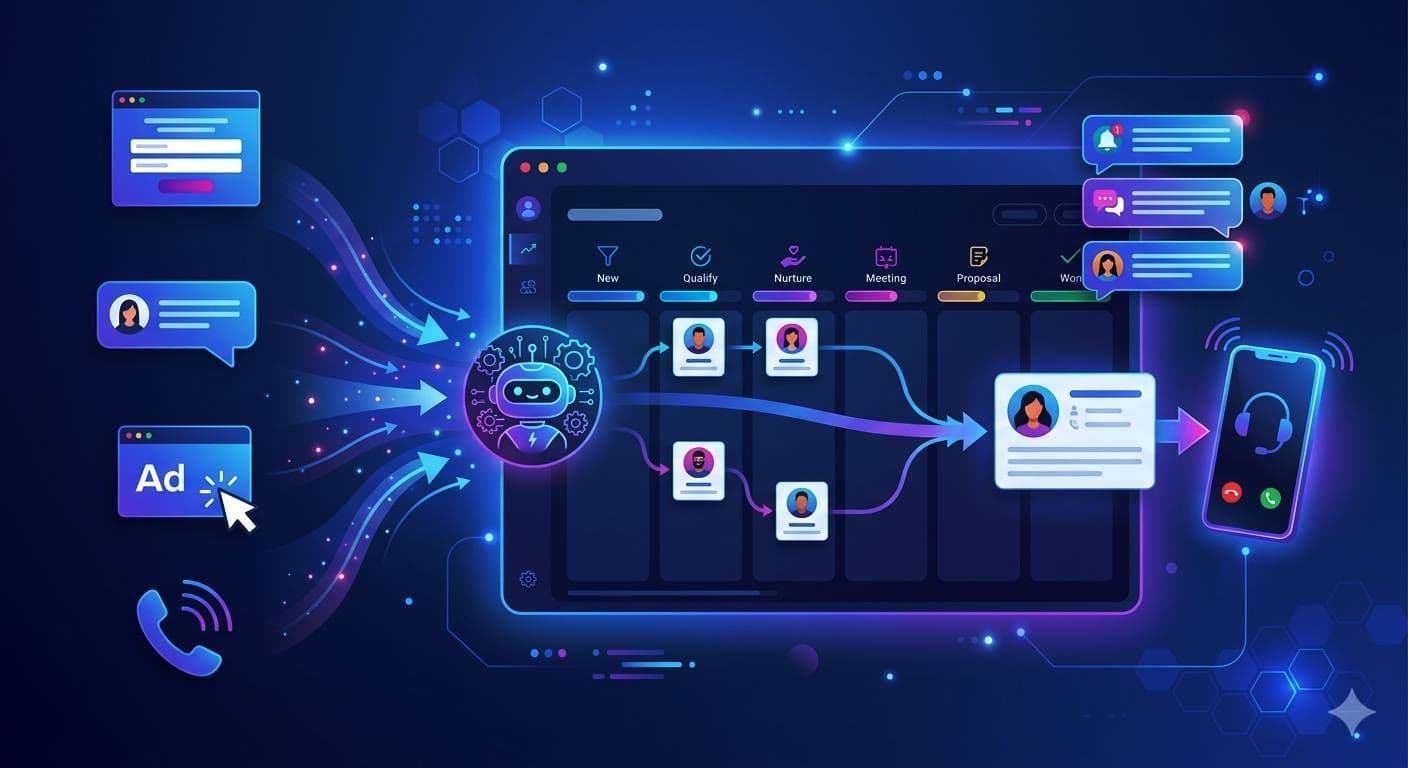
An AI-powered lead response workflow can:
- trigger an instant text acknowledgment
- place an immediate call
- ask a few qualification questions
- route the lead based on answers
- book an appointment automatically
- continue follow-up if the first attempt is missed
Notice what this fixes.
Not generic sales inefficiency.
Not broad "process improvement."
It fixes the timing gap between buyer intent and business response.
That is the exact gap where conversions are lost.
FusionSync's category advantage fits here naturally. AI is not replacing the sales conversation. It is protecting the first few minutes when the opportunity is most alive.
For companies trying to understand why inbound leads go cold, this is usually the core answer. The delay itself is the deal risk.
Key Takeaways
- Website leads are most valuable in the first few minutes after they inquire.
- The best way to respond is to engage while the buyer's intent is still active.
- Timing usually matters more than polishing the perfect message.
- Delayed outreach breaks continuity and lowers contact, qualification, and booking rates.
- Manual workflows struggle because they are built around availability, not immediacy.
- Automation and AI solve the exact problem by collapsing response time from hours to seconds.
Conclusion
The Best Way to Respond to Website Leads is simple, even if operationally it requires change: respond immediately.
Not later that morning.
Not after the team meeting.
Not when a rep has a spare minute.
Immediately.
Because website conversions are often decided before the real sales process even starts. They are decided in the narrow gap between form submission and first contact.
If you want more appointments, better lead qualification, and stronger return from the traffic you already have, do not start by asking how to get more leads.
Start by asking how fast your system responds to the ones you already earned.
That is the real answer to the Best Way to Respond to Website Leads.
FAQ
What is the best first response to a website lead?
The best first response is the fastest one that creates real engagement. In most cases, that means an immediate text, call, or both within minutes of the form submission.
Why do website leads stop replying so quickly?
Because website leads are often driven by immediate intent. If your response comes after that moment passes, the buyer has lost context, urgency, or availability.
Is email enough for responding to website leads?
Usually not by itself. Email can confirm receipt, but the best way to respond to website leads is often a faster, more direct channel like phone or SMS, especially in the first few minutes.
Next step
Want to fix slow lead response?
See how FusionSync responds in seconds, qualifies inbound leads, and moves them toward a booked next step automatically.
Where it works
View all use cases