
Why Response Time Is a Sales KPI
Learn why response time should be tracked as a key sales metric.
At 8:12 a.m., a homeowner submits a “request an estimate” form to a local HVAC company.
By 8:14, they are back at work.
By 8:27, they are in a meeting.
By 9:10, the urgency that pushed them to fill out the form has already softened into a background task.
The sales manager checks the CRM around lunch, sees the inquiry, and messages a rep to follow up. The rep calls at 1:43 p.m. No answer. An email goes out later that afternoon. No reply.
On paper, that lead looks untouched by anything dramatic. No obvious objection. No pricing conversation. No bad experience.
But the real failure happened much earlier.
The company treated response time like a courtesy instead of a metric.
That is the core reason this topic matters. Why Response Time Is a Sales KPI is not just a question about process hygiene. It is a question about whether sales leaders are measuring the exact moment pipeline is either captured or lost.
A lead does not only need a response. It needs a response within a measurable window that reflects buyer intent. If your team is not tracking that window as a performance metric, you are not really managing inbound sales. You are just hoping people reply later.
Here is the sharper way to frame it:
Response time is not an activity metric. It is a revenue protection metric.
Why Response Time Is a Sales KPI, Not Just a Workflow Detail
Many teams track the familiar sales numbers:
- meetings booked
- opportunities created
- close rate
- pipeline value
- revenue per rep
Those are all important.
But response time sits earlier in the chain. It measures whether your sales process engages demand while that demand still exists.
That is what makes it a KPI.
A key performance indicator should reflect a measurable behavior that strongly influences an outcome the business cares about. Response time does exactly that. It tells you, with no ambiguity, how quickly your team acts on inbound intent.
If a prospect fills out a form at 10:03 and gets the first real outreach at 2:41, that is not a vague operational issue. It is a recorded sales performance result.
The problem with treating response speed as a side metric is that it becomes invisible until conversion rates drop. By then, leadership is often looking at the wrong layer of the funnel. They review ad performance, lead quality, rep scripts, or close rates when the real issue happened hours earlier.
That is why response time belongs on the sales dashboard, not buried in CRM admin reports.
If you want a baseline definition, this guide on what lead response time actually measures is a useful starting point.
The Real Problem: Unmeasured Response Time Creates False Confidence
The most dangerous thing about slow follow-up is not just the delay itself.
It is that many teams do not feel the delay.
A manager sees 120 inbound leads for the month. Reps say they contacted most of them. Marketing sees healthy volume. Leadership sees activity in the CRM.
Everything looks functional.
But if average first response time is four hours, the team may be underperforming long before anyone notices a pipeline problem.
This is why unmeasured response time creates false confidence. You can believe the team is working leads when the timing says otherwise.
A contact attempt logged later in the day still counts as activity. But from the buyer’s point of view, the moment has passed.
That gap between internal reporting and external reality is where leads go cold.
This is also a big part of why inbound leads go cold. The issue is not merely that a response eventually happened. It is that the business failed to measure whether it happened inside the buyer’s decision window.
Why This Happens: Sales Teams Track Outcomes but Not Response Windows
Most sales organizations are set up to measure later-stage outcomes.
They ask:
- How many calls were made?
- How many meetings were booked?
- How many opportunities were created?
- How much pipeline did each rep generate?
Those are lagging indicators.
Response time is different. It is an early indicator.
It tells you whether the system is behaving correctly at the precise moment new demand enters the funnel.
When teams do not track it as a KPI, a few predictable things happen.
First, ownership gets blurry.
If no one is responsible for first-response speed, everyone assumes someone else is handling it.
Second, urgency becomes subjective.
One rep thinks 15 minutes is fast. Another thinks same-day follow-up is acceptable. A manager thinks “we got to it” is good enough. Without a defined KPI, there is no shared standard.
Third, the CRM captures timestamps but the business does not operationalize them.
This is common. The system has the data. The company just does not use it to coach performance, trigger alerts, or enforce service levels.
In other words, teams often have visibility without accountability.
That is why response time problems persist even in companies with decent headcount, a solid CRM, and plenty of lead volume. The issue is not always effort. It is that the metric has not been promoted to KPI status.
What Happens When Response Time Is Not Managed Like a KPI
When response time is not treated as a sales KPI, three things happen quietly.
1. Conversion loss gets misdiagnosed
Leads fail to progress, so teams blame quality.
Sometimes quality is the issue.
But often the lead was good enough to start a conversation, and the real breakdown was timing. If the first outreach happened after intent faded, the lead appears weak when the actual problem was delayed engagement.
2. Pipeline becomes less predictable
Inbound pipeline looks noisy when response speed varies widely.
One lead gets contacted in two minutes and books. Another waits three hours and disappears. Another gets touched the next morning and asks to “circle back next quarter.”
Without a response-time KPI, those outcomes look random. With the KPI, the pattern becomes obvious.
3. Rep performance analysis becomes distorted
If one rep receives routed leads during working hours and another gets more after-hours submissions, their results may differ for reasons unrelated to selling ability.
Tracking response time exposes whether performance differences come from skill or timing.
That is a major leadership benefit. A KPI should help you see where the system is helping or hurting performance. Response time does that clearly.
For a broader view of how timing changes downstream results, this article on lead response time and sales performance is worth reading.
The Business Impact: Missed Speed Compounds Across the Funnel
A lot of teams think of response time as a top-of-funnel issue.
It is not.
It compounds all the way down.
A slower first response means fewer live conversations.
Fewer live conversations mean fewer qualified opportunities.
Fewer qualified opportunities mean less pipeline coverage.
Less pipeline coverage means more pressure on conversion rates later.
So when response time slips, the damage does not stay isolated at the first touch.
It affects:
- contact rate
- qualification rate
- meeting volume
- pipeline creation
- revenue efficiency
This is why sales leaders should view response time the same way support leaders view first-response SLA.
If your company spends heavily to generate inbound demand, then the time between form submission and first contact is not a soft operational detail. It is the handoff point where marketing investment either becomes pipeline or starts decaying.
That is especially true for paid acquisition, where every delayed response makes customer acquisition less efficient.
A Better Way to Measure It
If you want response time to function as a KPI, it cannot remain a vague average sitting in a report nobody checks.
It needs a clear definition and a visible target.
At minimum, sales leaders should track:
- median first-response time
- percentage of leads contacted within 5 minutes
- percentage of leads contacted within 15 minutes
- response time by source
- response time by rep or team
- response time during business hours vs after hours
Median matters because averages can hide ugly delays.
For example, if several leads get instant replies while a chunk waits six hours, the average may still look acceptable. Median first-response time gives a more truthful picture of what a typical lead experiences.
The most useful reframing is this:
Do not ask whether leads were contacted. Ask whether they were contacted in time.
That is the KPI mindset.
And once you measure it that way, coaching becomes much more specific. Instead of telling reps to “follow up faster,” you can identify exactly where the response window breaks.
If you need a tactical framework, this post on how companies measure lead response time lays out the mechanics in more detail.
How to Improve a KPI You Can Actually See
Once response time is treated as a measurable performance metric, improvement becomes far more practical.
Start with standards.
Define what counts as first response. Is it a call attempt, a personalized SMS, an email, or any logged activity? Be precise.
Then define target windows.
For high-intent inbound leads, many teams use sub-5-minute response as the benchmark. Not because it sounds impressive, but because buyer intent is strongest immediately after submission.
Next, assign accountability.
A KPI without ownership is just a number. Someone should own response-time performance at the team level, and reps should be able to see their own results.
Then review the metric daily.
Not monthly. Daily.
Response-time failures happen in real time, so the feedback loop needs to be short. A weekly or monthly review is too late to shape behavior.
Finally, connect the KPI to downstream outcomes.
Show the team how faster first response correlates with contact rate, meetings booked, and qualified pipeline. The point is not to create pressure around speed for its own sake. The point is to show that speed is measurable sales execution.
How Automation Solves the KPI Gap
Here is the hard truth: most teams cannot consistently hit aggressive response-time targets with manual processes alone.
Not because they are lazy.
Not because they do not care.
But because inbound lead timing is unpredictable.
Leads arrive during meetings, after hours, during lunch, while reps are on calls, or when assignment queues are backed up.
This is where automation becomes more than a convenience. It becomes the system that protects the KPI.
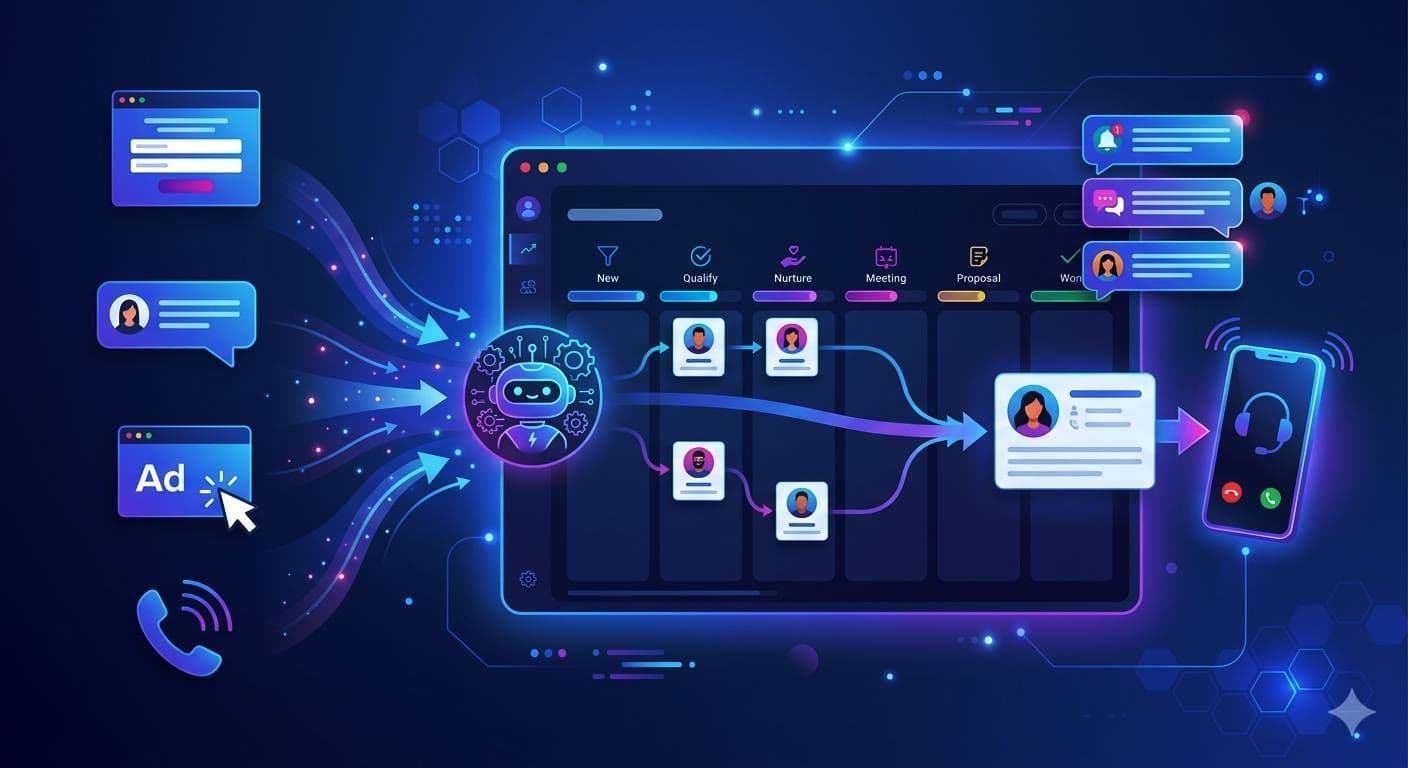
A modern lead response setup can:
- detect a new inbound lead instantly
- trigger a call or text within seconds
- ask qualifying questions automatically
- route based on rules or availability
- book appointments without waiting for a rep
- log every step for reporting
That last part matters.
Automation does not just make response faster. It makes response time measurable and enforceable.
Instead of hoping reps check notifications quickly, the business creates a process where the first-touch window is consistently met and fully tracked.
That is especially powerful with AI-driven systems. AI can engage the lead immediately, gather intent data, and move qualified prospects toward a booked meeting while human reps focus on live selling.
In that model, response time stops being an aspiration and becomes an operational standard.
Key Takeaways
- Response time should be treated as a sales KPI because it measures how fast your team acts on active buyer intent.
- If response time is not tracked, teams often misread conversion problems as lead-quality problems.
- A logged follow-up is not enough. The critical question is whether the response happened inside the buyer’s decision window.
- Median first-response time and percentage of leads contacted within target windows are more useful than vague activity counts.
- Automation and AI help businesses enforce response-time standards consistently, even when inbound volume or timing is unpredictable.
The big insight is simple:
What gets measured gets managed, but what gets timed gets converted.
Conclusion
The answer to Why Response Time Is a Sales KPI is not theoretical.
It is practical, measurable, and financial.
Response time tells you whether your sales operation is capturing demand while that demand is still alive. If you do not measure it like a KPI, you leave one of the most important parts of inbound performance unmanaged.
And when that happens, lost pipeline gets blamed on everything except the timing failure that caused it.
The companies that improve inbound conversion are often not the ones with radically better leads. They are the ones that treat first-response speed as a core performance standard, then build systems to hit it consistently.
That is ultimately Why Response Time Is a Sales KPI. It is the clearest measurement of whether your team is present at the exact moment a buyer is ready to talk.
FAQ
1. Why should sales teams track response time as a KPI?
Because it directly measures how quickly the team acts on inbound intent. Unlike broad activity metrics, response time shows whether leads are being engaged while they are still most likely to respond.
2. What is a good KPI target for lead response time?
For high-intent inbound leads, many teams aim for under 5 minutes. The exact target can vary by channel and business model, but the KPI should be specific, visible, and tied to contact and conversion outcomes.
3. Can AI really improve response-time KPI performance?
Yes. AI and automation can trigger immediate outreach, qualify leads, route conversations, and book appointments without waiting for manual action. That makes response-time performance more consistent and easier to measure.
Next step
Want to fix slow lead response?
See how FusionSync responds in seconds, qualifies inbound leads, and moves them toward a booked next step automatically.
Where it works
View all use cases