
Inbound Lead Management
How to Stop Losing Sales Leads From Instagram and WhatsApp

Updated
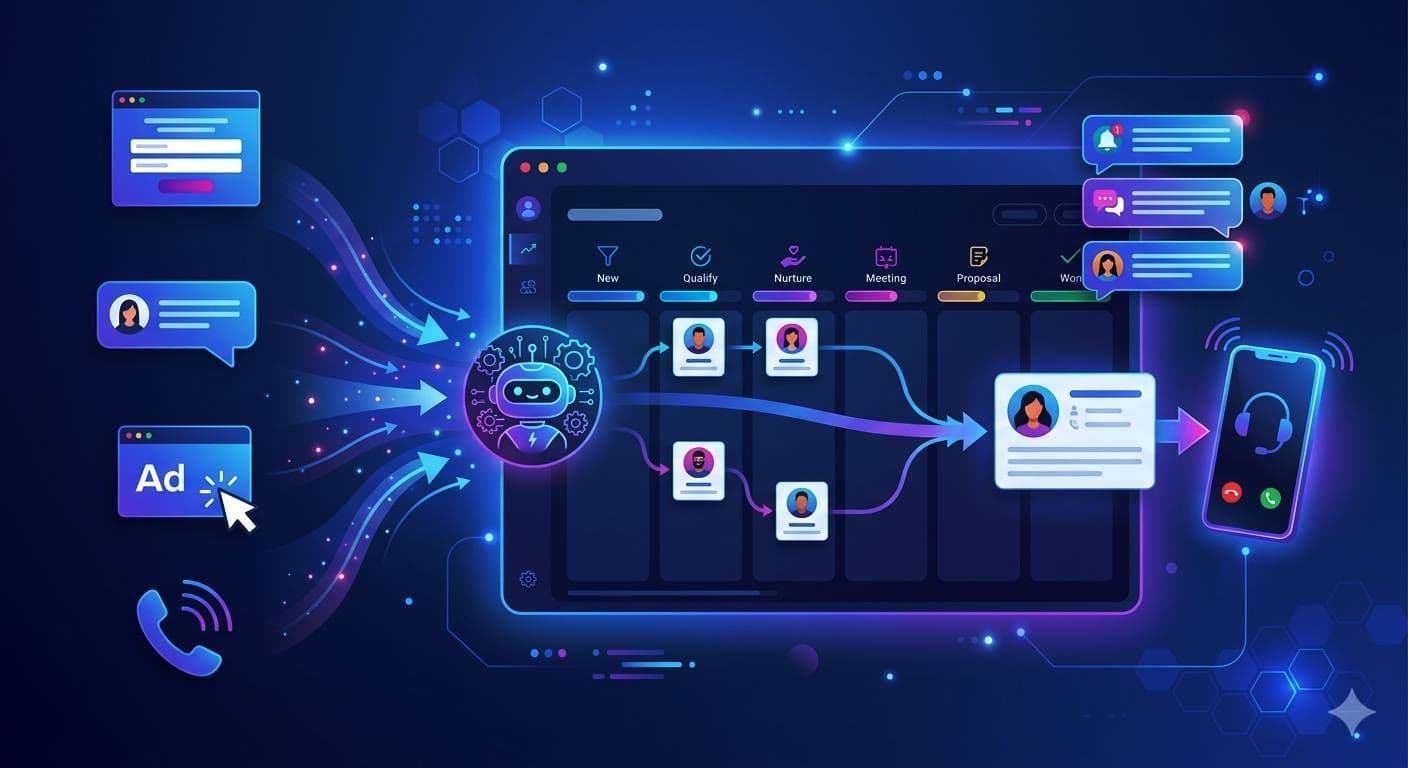
Most teams lose sales leads after the lead arrives, not before. Here is the diagnostic and the inbound architecture that plugs the leaks.
Where leads actually get lost
When founders say "we are losing leads", they usually mean one of two things. Either the marketing is bringing the wrong leads, or the marketing is bringing the right leads and the team is dropping them after the form is submitted. Most of the time, it is the second one.
Five places where post-marketing leakage happens:
| # | Leak | What it looks like |
|---|---|---|
| 1 | Missed first reply | Lead lands at 3 PM Saturday, team replies Monday morning |
| 2 | First reply is a non-response | Auto-responder that says "we will get back to you" |
| 3 | No structured qualification | Team asks the same five questions on every call |
| 4 | Lost handoff between channels | Instagram DM converts to a "share your number" message, prospect ghosts |
| 5 | CRM learns about the lead too late | Lead enters CRM on Wednesday for a Saturday inbound |
Each leak compounds. A lead that survives leak 1 (someone replied) but hits leak 4 (cold handoff) still drops. To stop losing leads, you have to plug them all, in order.
The diagnostic: 5 questions to ask your team
Before any system change, run this diagnostic on your last 30 days of inbound. The answers tell you which leak is biggest.
1. What is the median time from a new Instagram DM to the first qualifying reply?
Under 60 seconds: leak 1 and 2 are healthy. 1 to 5 minutes: leak 2 is partially active (auto-responders, not real replies). Over 5 minutes: leak 1 is your biggest problem.
2. By the time a closer takes a call, how many qualifying fields are already filled in?
3 or more (date, headcount, venue type for event companies): qualification is working. 1 or 2: qualifier is missing or only collecting contact info. 0: there is no qualifier; closers are starting from scratch.
3. When an Instagram DM moves to WhatsApp, does the prospect have to repeat themselves?
Never: handoff state is preserved. Sometimes: handoff is partial; some fields move, others do not. Always: cold handoff; you are losing prospects at the channel boundary.
4. When was the last time you discovered a lead in your CRM that you did not know about?
Never: real-time sync is working. Every couple of weeks: sync is delayed but eventually correct. Often: CRM sync is broken; lead leakage is invisible.
5. What happens to leads that do not qualify in the first conversation?
Tagged and added to a nurture flow: leak 5 (no nurture) is closed. Sit in a list someone "should" follow up on: nurture is theoretical, leak 5 is open. Forgotten: this is the most expensive of the five leaks for high-ticket businesses.
The fix, leak by leak
Leak 1: Missed first reply
The fix is an automated qualifying reply that fires within seconds of the inbound. Not an auto-responder. A qualifying message. For an event company, that is "Hi {{name}}, what date are you looking at?". The architecture is in the Instagram OS and the speed-to-lead post.
If you only fix one leak, fix this one. It is the highest-impact change and usually the easiest to ship.
Leak 2: Non-response first reply
Audit your current auto-reply. If it contains the phrase "will get back to you" or "our team will reach out", it is a non-response. Replace it with a single qualifying question. Same delivery latency, completely different downstream behaviour.
This is a wording change, not an architecture change, but the impact is real. Founders are usually surprised by how much it shifts qualifying rates.
Leak 3: No structured qualification
The qualifier should extract structured fields in conversation, not in a form. For an event company:
Each conversation extracts those fields in the natural flow of messages. By the time a closer joins, the fields are in the CRM. The closer does not interview; they close.
Leak 4: Lost handoff between channels
Most Instagram-to-WhatsApp handoffs lose the thread. The right pattern is a single WhatsApp template message auto-sent the moment the conversation is closer-ready, containing the prospect's name and the qualifying fields already collected. The prospect taps one button and the closer's WhatsApp opens with the full context.
Read the event-companies WhatsApp post for the full handoff template set.
Leak 5: Late CRM sync
Write to the CRM at every conversational event, not at the end. New lead, qualifying answer captured, label change, handoff sent. The CRM becomes the source of truth at minute one, not week three. Reporting becomes a query, attribution becomes accurate, nothing is forgotten.
For event companies specifically, the GoHighLevel custom-fields layout we use is in the inbound playbook.
The cost of doing nothing
Some teams convince themselves the leakage is small. The math says otherwise. For a typical event company with 100 inbound enquiries per month:
| Stage | Status quo | Leak-plugged system |
|---|---|---|
| First reply inside 5 min | 30 leads | 100 leads |
| Reach the qualifying stage | 20 leads | 70 leads |
| Closer-ready handoff | 10 leads | 35 leads |
| Booked discovery call | 5 leads | 18 leads |
The booking-rate delta is 3.6x on the same monthly traffic. Lead volume did not change. The leak did. At even modest event-booking economics (1 to 5 lakh ticket size), the delta is one or two bookings per month, which usually pays for the system at the first pilot review.
Why "train the team to be faster" does not work
This is the most common reaction we see from founders: "we will just commit to faster replies". It does not work, for three structural reasons.
Concurrency. A team that can reply to 5 messages an hour cannot reply to 40 in 2 hours. The math is fixed.
Timing. Inbound is not predictable. Saturday afternoon is a high-volume window. Tuesday at 11 AM is dead. Your team is at a venue on Saturday afternoon.
Cognitive load. Replying to a DM is a context switch. A team that handles 30 context switches in a morning is unable to do anything else well that day. Burnout is the second-order effect.
The router has to be infrastructure. The team does the work that infrastructure cannot do: closing, judgement calls, edge cases. See the why service businesses lose leads post for the human-side framing of the same problem.
What good looks like
When the inbound system is healthy, you can answer these questions instantly:
- How many inbound leads did we get this week?
- What was our median time to first reply?
- How many made it to closer-ready?
- Which source / Reel / ad was the highest-converting?
- Which leads need nurture follow-up this week?
If you cannot answer those without opening five tools and one spreadsheet, leak 5 is active and you are working with bad data.
What this is not
- It is not a chatbot. Chatbots fix leak 1 and 2. They do nothing for 3, 4, or 5.
- It is not a CRM project. The CRM is the downstream beneficiary, not the source of the leak.
- It is not "more marketing". Marketing is fine. The leak is post-marketing.
- It is not a one-time fix. Meta changes the WhatsApp Cloud API and Instagram Graph API regularly. The system needs maintenance.
FAQ
Which leak should I fix first? Leak 1: the missed first reply. It is the highest-impact change and usually the easiest to ship. Most teams move from 30-minute median first-reply time to sub-60-second after this fix alone.
Will fast follow-up annoy prospects who expect a human? No, if the first reply is a real qualifying question and not a "thanks for reaching out" message. Prospects expect responsiveness; they react badly to fake responsiveness.
Does this work for non-event businesses? Yes. The five leaks are the same for any inbound-heavy SMB: clinics, mortgage brokers, real estate, high-ticket service businesses. The qualifying fields change; the architecture does not.
Will fixing these leaks let me cut my team? Usually no. The system removes the inbox-triage and field-extraction work, but closers still close. Most teams end up with the same headcount doing higher-value work and handling more leads.
How long until I see the impact? First reply latency drops within hours of going live. Booking rate impact shows up over the next 30 days as the leads that would have leaked now stay in the pipeline.
The bottom line
Most teams lose sales leads after the lead arrives, not before. The marketing side delivers; the inbound side leaks. Five leak points to look for: missed first reply, non-response auto-reply, no qualification, cold cross-channel handoff, late CRM sync. Run the diagnostic on your last 30 days of leads and the biggest one is usually obvious.
- Most teams lose leads after the marketing, not because of the marketing.
- Five leak points: missed first reply, non-response first reply, no qualification, cold handoff, late CRM sync.
- Run the 5-question diagnostic. The answer to which leak is biggest is usually obvious.
- The architecture is one system: webhook + qualifier + handoff template + CRM orchestrator.
- "Train the team to be faster" does not survive a Saturday afternoon spike.
If your inbound is leaking at one or more of the five points, the next step is a 7-day production pilot on one campaign. We install the system, you watch the numbers, you decide.
White-label tech partner
Your agency has the clients. I have the tech layer.
You don't need to build a technical team before you can take on technical work. Whether you're an established agency or just getting started, I can provide the technical layer behind your delivery, from building the system to getting it into production.
PolarBuild case study →You only sell once
We never compete for your end clients. One partnership conversation. You fulfil for every account in your base.
Free POC before big builds
A three-day sales demo on the proven stack before any large software investment. You pitch to your prospects or existing clients. Implementation starts only when someone pays.
Geography replication
UK dental becomes US dental with a new local partner and new integration targets. Same playbook, new market.