
How Companies Achieve Sub-5-Minute Lead Response
Learn how top companies respond to leads in minutes.
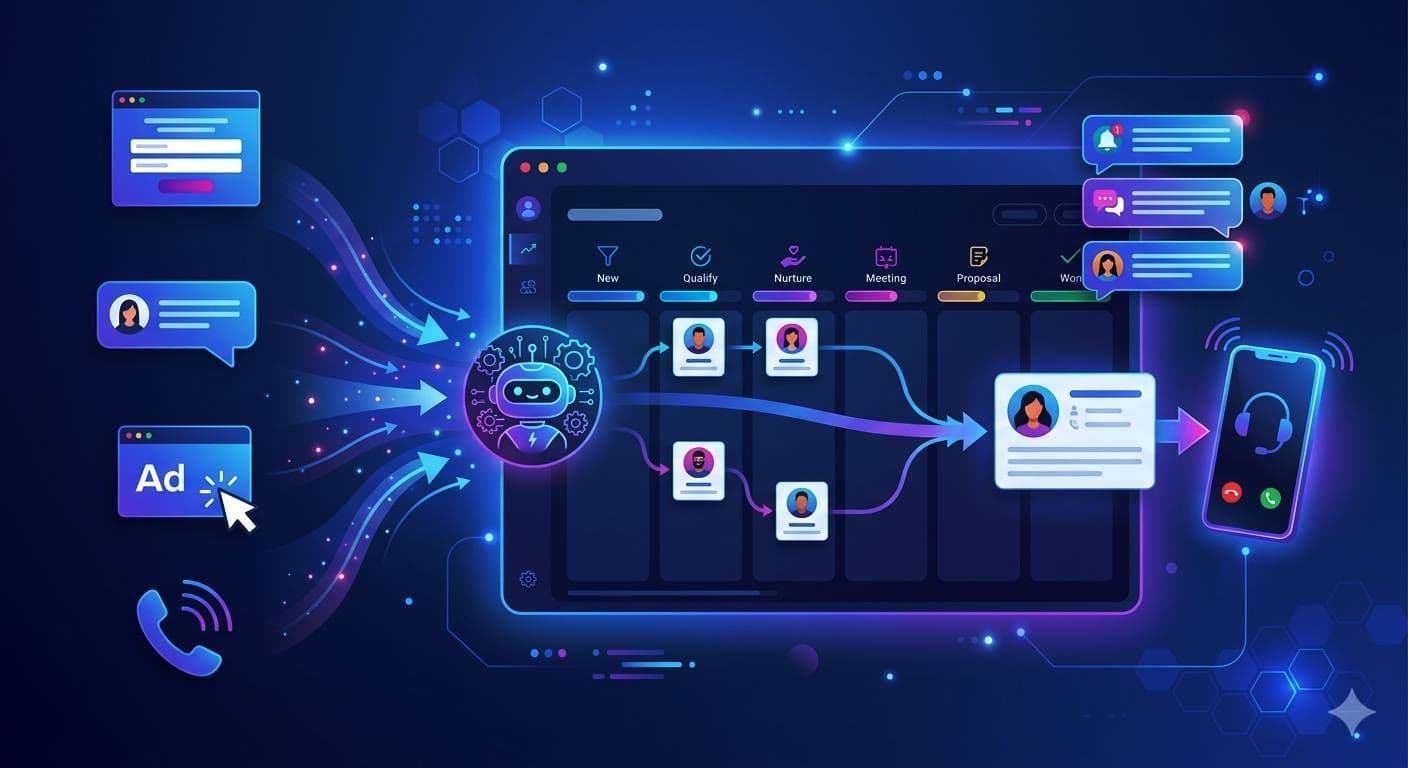
At 8:12 p.m., a regional home services company gets a high-intent form fill from a homeowner with a burst pipe.
The lead does not want a newsletter.
They do not want a brochure.
They want help now.
The company has already done the hard part. Their Google Ads campaign worked. The landing page converted. The form was submitted.
But the real test starts after the click.
The companies that win these moments are not always the ones with the biggest ad budget or the best-looking website. They are the ones with the best response system.
That is the core of How Companies Achieve Sub-5-Minute Lead Response. They do not rely on heroics from sales reps. They build infrastructure that makes speed automatic.
This is the part many teams miss.
Fast response is not a people problem first. It is a systems problem first.
That is the sharpest way to understand modern inbound sales: speed is not operational, it is architectural. If your response depends on someone noticing a notification, checking a CRM, deciding who owns the lead, and then reaching out, you do not have a fast-response process. You have a delay engine.
The real problem is the absence of a response system
When companies fail to respond within five minutes, it often looks like a rep issue on the surface.
Maybe someone was in a meeting.
Maybe the office was closed.
Maybe the CRM notification got buried.
But those are symptoms.
The deeper issue is that the business has no system designed for immediate action.
A lead comes in.
It sits in a form tool.
Then it syncs to the CRM.
Then a notification is sent.
Then someone reads it.
Then someone decides whether to text, call, or email.
Every handoff adds friction.
Every manual decision adds time.
Every tool gap creates silence.
This is exactly why inbound leads go cold. Not because businesses do not care, but because most inbound workflows were built to collect leads, not to react to them instantly.
Companies that achieve sub-5-minute response do one thing differently: they treat lead response like a system event, not a task on someone's to-do list.
How Companies Achieve Sub-5-Minute Lead Response with system design
The fastest companies do not simply ask reps to move faster.
They remove the need for human delay at the beginning of the process.
That usually means building a chain of events that starts the second a lead submits a form.
A practical sub-5-minute system often includes:
- instant form-to-CRM sync
- automatic lead enrichment if needed
- routing rules based on geography, service line, or availability
- immediate SMS confirmation
- automatic outbound call or callback attempt
- qualification logic
- calendar booking link or direct scheduling
- follow-up sequence if no answer
Notice what is missing from that list: waiting.
This is the difference between a workflow and a queue.
In slower companies, leads enter a queue and hope someone gets to them.
In faster companies, the workflow starts itself.
For teams trying to understand the mechanics, articles on automatic lead assignment for sales teams and how AI can respond to leads instantly are useful because they break down the components behind this speed.
Why manual-first workflows cannot reliably hit the five-minute window
A lot of businesses believe they are close to fast response because reps are told to call quickly.
But manual-first workflows are fragile by design.
They depend on perfect timing.
A rep has to be available right when the lead arrives.
The notification has to be seen immediately.
The lead has to be assigned correctly.
The rep has to have enough context to reach out.
The prospect has to still be available by then.
That might work sometimes.
It does not work consistently.
Consistency is what matters.
Sub-5-minute response is not about having a few fast follow-ups. It is about making fast follow-up the default outcome.
That requires specific mechanisms.
1. Trigger-based response
The moment a form is submitted, the next action fires automatically. No inbox monitoring. No spreadsheet. No Slack ping that someone might miss.
2. Predefined routing logic
The system already knows who should get the lead. It does not pause for a manager to decide ownership.
3. Channel orchestration
The company does not debate whether to call, text, or email after the lead comes in. The sequence is prebuilt.
4. Built-in fallback paths
If the first call is missed, the system sends a text. If the text is ignored, it triggers another touchpoint. Speed is preserved because the next step is already mapped.
The hidden truth is simple: most companies do not have a response-time problem. They have a dependency problem. They depend on people to initiate what the system should initiate.
What ultra-fast response systems change in the business
When a company installs this kind of system, the impact goes beyond speed.
It changes what happens in the first ten minutes after a lead arrives.
Instead of silence, the prospect gets confirmation.
Instead of waiting, they get a call or text.
Instead of confusion, they get a clear next step.
That matters because lead intent is strongest right after submission.
A homeowner requesting emergency service at night is available now.
A SaaS buyer requesting a demo during a pricing comparison is engaged now.
An agency prospect filling out a contact form after clicking an ad is evaluating now.
The system does not create intent. It captures the intent that already exists before it dissipates.
This is why teams that improve infrastructure often see better outcomes without changing their traffic volume. Better response architecture increases the percentage of leads that actually turn into conversations.
If you want to connect this to broader performance, how lead response time impacts conversion rates is a helpful companion topic.
The business cost of not having the right system
A weak response system creates invisible leakage.
Not dramatic failure.
Not obvious disaster.
Just small delays, repeated hundreds of times.
A lead waits 12 minutes instead of 2.
A form sits unassigned until the next check-in.
A rep follows up after finishing another task.
A callback happens when the buyer is no longer available.
Most businesses never see this as a system issue because the CRM still shows the lead was contacted.
But timing changes the value of contact.
A call placed two minutes after submission is not the same as a call placed forty minutes later, even if both count as outreach.
That is why sub-5-minute companies measure more than contact volume. They measure time-to-first-action.
And that metric reveals whether the system is actually working.
The cost shows up in several places:
- fewer live conversations
- lower appointment rates
- wasted ad spend
- lower lead-to-opportunity conversion
- uneven rep performance caused by routing and timing gaps
When teams say their leads are low quality, the problem is often less about quality than about timing infrastructure. A good lead contacted too late can look like a bad lead.
The systems top companies use to stay under five minutes
The most effective setups are usually not complicated. They are just intentional.
Here are the core building blocks.
Instant capture and sync
The lead should move from form submission into the CRM or automation layer immediately.
If there is a delay between collection and action, the clock is already working against you.
Rules-based routing
Ownership should be assigned automatically using territory, product line, office hours, or round-robin logic.
No lead should wait for a human to decide where it goes.
Immediate acknowledgment
A text or email sent instantly reassures the lead that the request was received.
This does not replace human conversation, but it holds attention in the critical first moments.
Automatic call initiation
For high-intent inbound leads, the best systems do not wait for a rep to remember to call. They trigger an outbound call instantly or offer an immediate callback path.
Fast qualification layer
If the buyer answers, the system can ask a few basic questions to capture urgency, service type, budget fit, or timeline before handing off or booking.
Booking built into the first response path
The faster the lead can move from interest to scheduled conversation, the less opportunity there is for momentum to disappear.
Persistent follow-up logic
If the lead does not answer immediately, the next touches should already be scheduled.
This is where many teams lose speed after the first attempt.
Together, these components create a response engine rather than a response habit.
How automation and AI solve this exact issue
Automation matters because it removes the delay between lead creation and first action.
AI matters because it can do more than notify. It can engage.
That distinction is important.
A notification tells your team that a lead exists.
An AI-powered system can text the lead, place the first call, ask qualification questions, capture answers, and help book the appointment before a rep is free.
This is where companies move from “we try to respond fast” to “we are built to respond fast.”
For example, if a prospect submits a form after hours, a manual team is already at a disadvantage. An AI system can respond in seconds, confirm the request, ask one or two contextual questions, and either book the meeting or prepare the handoff for the morning.
That is not about replacing sales.
It is about protecting the first five minutes.
And those first five minutes are where most of the value sits.
FusionSync's category exists because businesses need systems that close this gap. Not more reminders. Not stricter rep coaching. A real-time response layer that acts the second inbound intent appears.
Key takeaways
- Sub-5-minute response is usually the result of system design, not individual rep effort.
- Manual-first workflows are too inconsistent to protect the first few minutes after form submission.
- Fast companies use trigger-based automation, routing rules, channel sequencing, and built-in follow-up paths.
- The biggest gain is not just speed. It is preserving live buyer intent while it still exists.
- AI helps because it can take action immediately, not just alert a human to take action later.
The central lesson behind How Companies Achieve Sub-5-Minute Lead Response is straightforward: they engineer speed into the workflow. They do not hope for it.
FAQ
1. What is required to achieve sub-5-minute lead response consistently?
You need a system that automatically captures, routes, and initiates outreach the moment a lead comes in. That usually includes CRM sync, routing logic, instant messaging, and automatic call or follow-up triggers.
2. Can sales reps alone maintain sub-5-minute response?
Not reliably. Individual reps can be fast sometimes, but consistent sub-5-minute performance usually requires automation because leads arrive at unpredictable times and reps are often busy.
3. How does AI help companies achieve faster lead response?
AI can respond immediately through text, phone, or qualification workflows. It reduces the time between form submission and first interaction, which helps companies capture intent before it fades.
Next step
Want to fix slow lead response?
See how FusionSync responds in seconds, qualifies inbound leads, and moves them toward a booked next step automatically.
Where it works
View all use cases