
Service Business Lead Leakage
Why Service Businesses Lose Leads (And It Is Not Marketing)

Updated
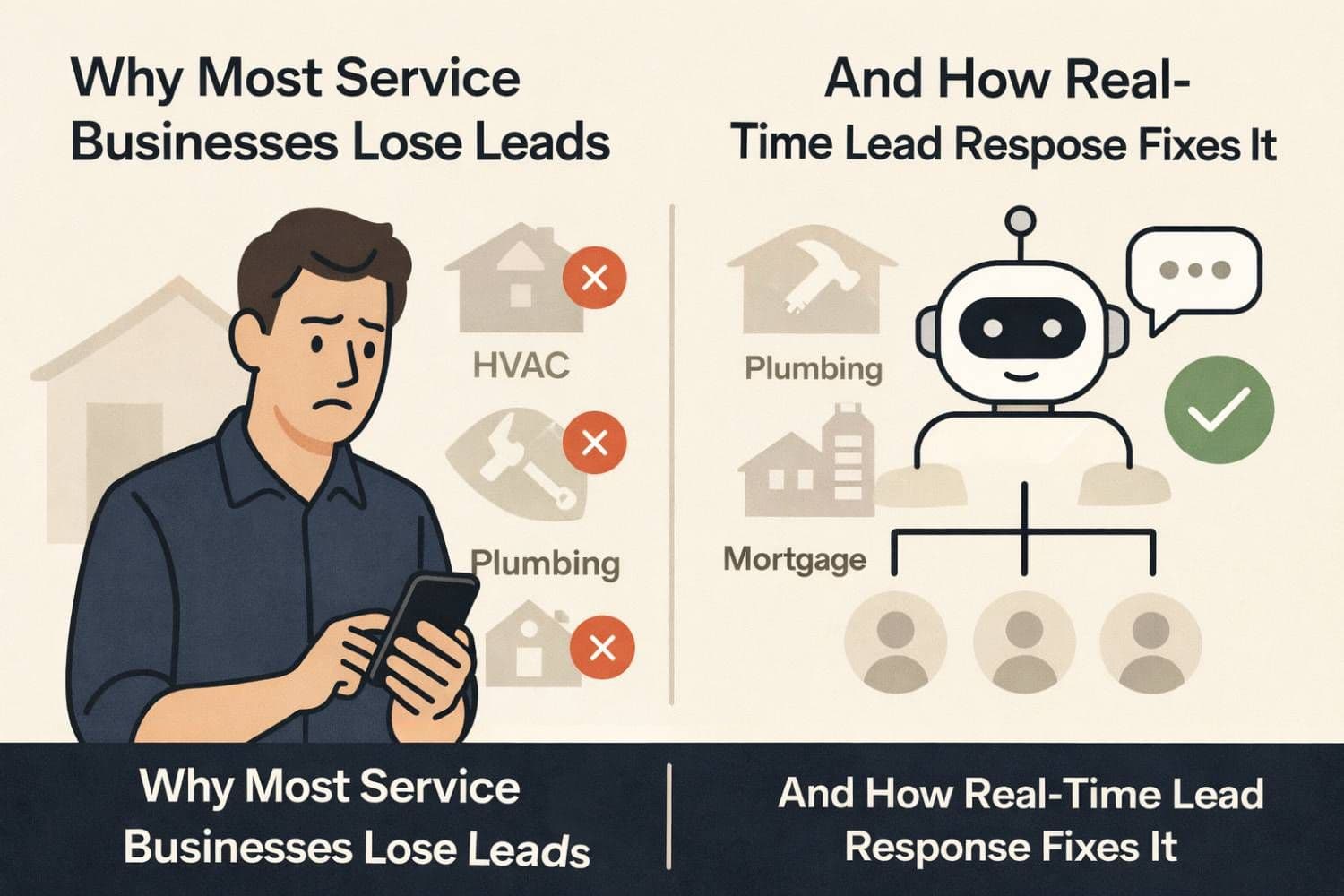
Service businesses lose leads after the lead arrives, not because of bad marketing. Here is what is actually broken and how to fix the handoff.
The diagnosis founders never want to hear
If a service-business founder is asked "why are you losing leads?", they usually answer with one of three things:
- "Our marketing is not bringing the right leads"
- "The leads we get are tire-kickers"
- "Our closers cannot keep up with the volume"
The first two are almost always wrong. The third is the symptom of the real problem, not the cause.
The real cause: the inbound flow is built on a person sitting near a phone. That person was the bottleneck even at 10 leads a week. At 30, the team is breaking. At 100, the leakage rate exceeds 70%.
The math is structural. It does not get better by hiring. It gets better by changing the shape of who handles the first 5 minutes of every conversation.
The four structural reasons
1. The inbound is on Instagram, WhatsApp, and phone at the same time
Modern service-business inbound is multi-channel. A wedding venue gets DMs on Instagram, WhatsApp messages from referrals, missed calls during venue visits, and contact-form submissions from the website. Each of those is a different inbox. A team that triages one inbox cannot keep up with three.
The fix is not "hire someone for each inbox". The fix is to unify the inbound at the architecture level. One pipeline, three (or four) capture surfaces. The inbound operating system is exactly that.
2. Inbound volume is spiky, not flat
A typical service business gets 60% of its weekly inbound in roughly 20% of the working hours. For event companies, that is Saturday afternoon and Sunday evening. For HVAC, it is the first heat or cold wave of the season. For mortgage, it is the day after a rate change.
A team sized for the median hour is destroyed by the peak hour. A team sized for the peak hour is unaffordable in the median hour. Infrastructure does not have this problem; it scales to zero and to a thousand for the same cost. Teams cannot.
3. The first message a prospect expects has changed
In 2010, a service-business prospect was willing to wait for a same-day callback. In 2026, they expect a response in the time it takes to scroll Instagram once. The expectation shift is not optional and not negotiable. Prospects who expect a 60-second reply do not stay engaged at 30-minute reply.
| Year | Median expected first response |
|---|---|
| 2010 | Same-day callback |
| 2016 | 1-hour reply |
| 2020 | 15-minute reply |
| 2026 | Under 5 minutes on chat, under 60 seconds on DM |
The 5-minute rule is the upper bound. For DMs and WhatsApp it is now closer to 60 seconds. A human team cannot hold that threshold across a real working week. See the speed-to-lead architecture for the underlying numbers.
4. The handoff between channels is cold
This is the leak that is hardest to see. Your team is responding (slowly) on Instagram, then says "let us WhatsApp you". The WhatsApp message arrives three hours later, has no context, and the prospect has to re-explain everything. Most drop out at this point. The CRM logs it as "no response on WhatsApp", which makes it look like a lead-quality issue. It is not. It is a handoff issue.
State has to survive across channels. When the conversation moves from Instagram to WhatsApp, the prospect's name, the qualifying fields, and the source thread have to move too. The closer who opens WhatsApp should see five fields already filled, not start with "tell me about your event". The Instagram-to-WhatsApp handoff pattern is the architecture for that.
The shape of a typical leaky week
Made concrete, here is what a 100-lead week looks like in a leaky service business:
| Stage | Count | What is happening |
|---|---|---|
| New inbound (DM, WhatsApp, missed call, form) | 100 | Mixed channels, spiky distribution |
| First reply within 24h | 60 | Some weekend leads get lost entirely |
| First reply within 5 min | 20 | Only the ones the founder personally caught |
| Qualified in conversation | 30 | Mostly the ones reached fast |
| Closer-ready handoff | 15 | Many qualified leads ghost on the handoff |
| Booked discovery call | 8 | The 15 turn into 8 booked calls |
| Showed up | 6 | No-shows on cold handoffs |
Six showed-up calls from 100 leads is a 6% conversion. Founders accept this as "our inbound rate" and try to spend more on ads. Spending more brings more leads through the same leaky pipeline and produces 12 showed-up calls. The percentage does not change. The cost per call does not change.
The same week through an inbound operating system, with the same 100 leads:
| Stage | Count | What is happening |
|---|---|---|
| New inbound | 100 | Same volume |
| First reply within 5 min | 100 | Every channel covered, every hour |
| Qualified in conversation | 65 | Tight qualifying questions in-thread |
| Closer-ready handoff | 40 | Warm handoff, no re-asking |
| Booked discovery call | 22 | Auto-booking from inside the conversation |
| Showed up | 19 | Closer-ready means low no-show |
19 showed-up calls vs 6. Same ad spend. The system did not buy more leads; it stopped leaking the ones that were already there.
"Just train the team"
This is the universal first response. It does not work. We have run the numbers on dozens of service-business pilots and the structural reasons are:
- A person cannot maintain sub-60-second first-reply latency for an inbox that is sometimes silent for 4 hours and sometimes lands 30 messages in 90 minutes. The cognitive load is impossible.
- A person who is also the closer cannot be the message router. Context switching from a venue visit to a Reel DM to a contract negotiation to a callback breaks focus to the point that they do all three badly.
- Training does not survive a peak. Saturday afternoon at 3 PM, when the team is on-site, no amount of training matters.
The router has to be infrastructure. The closers do the closing. The qualifying conversation is the boundary between the two.
Why this is not a chatbot problem either
A common second response: "we should put a chatbot on Instagram". A chatbot fixes part of the first reply problem. It does not fix:
- The cold WhatsApp handoff (chatbots live on one channel)
- The CRM sync (chatbots write to their own inbox, not your CRM)
- The qualifying ruleset (most chatbots ask the wrong questions or no real questions)
- The 4 PM Saturday spike (chatbots can handle volume, but only if they actually qualify, which most do not)
You can install a chatbot in two hours and watch your leakage rate drop 10%. You can install a proper inbound operating system in 4 to 7 days and watch your leakage rate drop 70%. Different scope, different result.
The fix, by industry
The architecture is the same; the qualifying ruleset is industry-specific.
| Industry | Qualifying fields | Closer-ready rule |
|---|---|---|
| Event companies | event date, headcount, venue type, budget band, decision maker | all three of first three plus one of last two |
| HVAC / plumbing | service type, urgency, address, property type, ownership | service type plus urgency plus address |
| Mortgage | loan type, property type, loan amount, timeline, employment | loan type plus loan amount plus timeline |
| Real estate | property type, price band, area, timeline, buyer or renter | property type plus price band plus area |
| Clinics | service requested, urgency, location, insurance status | service requested plus location plus urgency |
The structure is identical. The thresholds are unique. We tune them with the founder in a one-hour conversation during the pilot setup.
What this is not
- It is not a sales coaching engagement. We do not retrain your closers; they are usually fine. We fix the work that happens before they get the call.
- It is not a chatbot installation. Chatbots are a component, not the system.
- It is not an ad agency replacement. Marketing brings the lead. The system stops it from leaking.
- It is not magic. The lift is large but not infinite. Bad creative still produces bad-fit leads, just delivered faster.
FAQ
Will the system feel impersonal to my prospects? The right architecture asks structured questions in plain conversational tone, one question per turn. Most prospects do not realise the first reply is automated; they realise the response was fast. The closer, who joins after qualification, is the personal touch.
Do my closers need to learn new tools? No. The closer keeps using WhatsApp on their phone or web. The system feeds qualified threads into their existing WhatsApp. There is no new tool for the closer.
Will Meta or Instagram ban my account? The DM volume after the system is the same as before; it is just answered faster. We avoid the patterns that trigger Meta scrutiny: unsolicited DM blasts, aggressive comment-to-DM, marketing-template misuse. The Instagram OS architecture is designed to avoid those.
What does the pilot cost? The 7-day pilot has no cost to you. We set up the system, run it on one campaign, and you evaluate. If it works, we move into a maintenance arrangement. If it does not, you walk away.
Will this work if I am the only person in my business? Yes, and the lift is larger for solo operators. The system removes the inbox-triage work, which is the highest-cognitive-load part of a solo founder's day. Closers (which is you) still close. Everything before that is the system.
The bottom line
Service businesses (event companies, HVAC, plumbing, mortgage, real estate, clinics) almost never lose leads because of bad marketing. They lose them after the lead arrives, in the gap between an inbound DM, WhatsApp message, or missed call landing and a real human conversation starting. Four structural reasons: multi-channel inbox, spiky volume, shifted response expectations, cold cross-channel handoffs. The fix is infrastructure, not more hiring.
- Service businesses lose leads after the lead arrives, not because of marketing.
- Four structural reasons: multi-channel inbox, spiky volume, shifted response expectations, cold cross-channel handoffs.
- The math is structural; it does not get better by hiring. Infrastructure scales; teams do not.
- A chatbot fixes 10% of the leakage. A full inbound operating system fixes 70%.
- The qualifying ruleset is industry-specific; the architecture is not.
If your service business is losing leads at one or more of the four points, the next step is a 7-day production pilot on one campaign. We install the system, you run real traffic through it, and you decide.
White-label tech partner
Your agency has the clients. I have the tech layer.
You don't need to build a technical team before you can take on technical work. Whether you're an established agency or just getting started, I can provide the technical layer behind your delivery, from building the system to getting it into production.
PolarBuild case study →You only sell once
We never compete for your end clients. One partnership conversation. You fulfil for every account in your base.
Free POC before big builds
A three-day sales demo on the proven stack before any large software investment. You pitch to your prospects or existing clients. Implementation starts only when someone pays.
Geography replication
UK dental becomes US dental with a new local partner and new integration targets. Same playbook, new market.