
Business Automation
AI Automation for Clinics & Appointment Businesses in Chandigarh

Updated
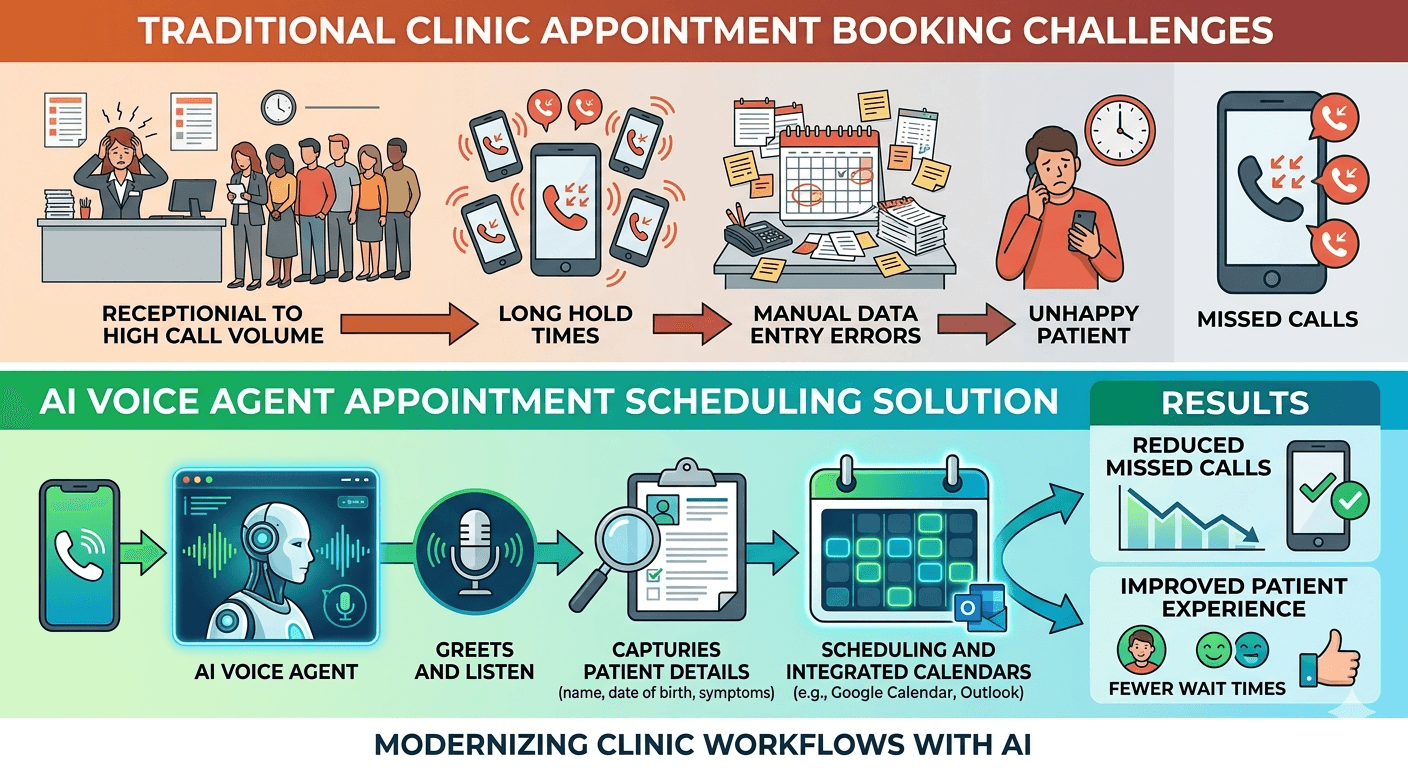
Clinics miss patient enquiries daily. Learn how AI automation captures patient enquiries and books appointments automatically.
A clinic in Chandigarh can do everything right clinically and still lose revenue operationally.
A patient calls during lunch hours, but the front desk is busy. Another enquiry comes through the website after closing time. A third person messages on WhatsApp asking for availability, but nobody replies fast enough. By the time someone from the clinic responds, the patient has already booked elsewhere or simply moved on. This is not a medical problem; it is an operations problem.
For appointment-based businesses, missed calls and delayed responses directly turn into lost bookings. And in a city like Chandigarh, where patients compare options quickly and expect convenience, response speed matters as much as service quality. That is why AI appointment automation Chandigarh is becoming a practical advantage for clinics, dental practices, diagnostic centres, physiotherapy clinics, cosmetic clinics, and specialist consultation businesses.
In this article, we will break down the appointment-booking challenges clinics face, explain how an AI receptionist clinics workflow works, and show how AI voice agents can answer calls, capture patient details, and schedule appointments automatically through integrated calendars and CRM systems.
The Problem Clinics Face When Enquiries Come In
Most clinics do not struggle because they lack demand. They struggle because demand arrives in fragmented ways.
A single patient can enquire through:
- phone calls
- website forms
- Google Business Profile calls
- WhatsApp messages
- Instagram or Facebook DMs
- referral follow-ups
Each of these channels creates a small operational burden. Someone has to answer, collect information, check availability, and log the interaction correctly. The issue is that appointment businesses are usually built around human reception capacity, not enquiry volume.
This creates several common bottlenecks:
1. Missed calls during busy hours
Reception teams often handle walk-ins, payments, rescheduling, and in-clinic coordination. Calls get missed when the team is occupied.
2. Slow callback cycles
If a clinic calls back 20 to 60 minutes later, the patient may already have booked with a competitor or lost urgency.
3. Inconsistent enquiry capture
Some staff collect full details. Others only capture a name and phone number. That inconsistency affects follow-up and booking quality.
4. Calendar confusion
When availability is managed manually, staff may double-book slots or spend time checking schedules across multiple doctors.
5. Weak follow-up discipline
Many clinics receive enquiries that are not converted on the first contact. Without automated follow-up, these leads go cold.
This is why automation is not just a nice-to-have. For appointment businesses, it becomes part of the front desk infrastructure.
Why Traditional Front Desk Handling Breaks Down
Human reception works well until volume, timing, or complexity increases.
A traditional front desk setup depends on someone being available at the exact moment a patient reaches out. That assumption fails frequently.
Manual response delays
If a patient calls and nobody picks up, the opportunity is already at risk. In healthcare and appointment-based services, intent is strongest in the first few minutes. Delay reduces conversion.
Repetitive conversations consume staff time
Receptionists often spend a large part of the day answering the same questions:
- What are your timings?
- Is Dr. X available tomorrow?
- What is the consultation fee?
- Do you accept walk-ins?
- Can I book for this evening?
These are necessary questions, but they are also highly automatable.
Data entry errors create downstream problems
When enquiry details are written manually, mistakes happen:
- wrong spelling of patient name
- incorrect phone number
- missed preferred time slot
- wrong service selected
That leads to poor CRM data and confusing callbacks.
No after-hours coverage
Patients often search for healthcare options after work, at night, or on weekends. A human-only workflow cannot respond instantly outside office hours.
Limited scalability
If enquiry volume doubles, front desk stress doubles too. Automation scales more cleanly because it standardizes the first response.
This is also why businesses that already care about speed-to-response often look at systems discussed in AI missed call automation Chandigarh and broader response workflows. The lesson is simple: if you cannot respond quickly, you cannot reliably convert enquiries.
How the AI Appointment Automation System Works
An effective clinic automation system does not try to replace the clinic team. It handles the first layer of response, qualification, and scheduling so humans can focus on exceptions and in-person care.
Here is the typical workflow:
1. Patient enquiry enters the system
The enquiry may come from:
- a phone call
- a website form
- a WhatsApp click-to-chat
- a missed call
- a Google Business Profile request
That trigger starts the automation process.
2. AI voice agent responds instantly
If the patient calls and the clinic misses it, the AI voice agent can call back or answer the incoming call depending on the setup.
The agent can:
- greet the patient professionally
- identify the clinic/service
- ask what they need
- collect preferred timings
- capture name and contact number
- confirm urgency or appointment purpose
3. Qualification happens automatically
The system can ask basic qualifying questions such as:
- Which department or specialist do you need?
- Is this a new appointment or follow-up?
- What time window works for you?
- Are you looking for today, tomorrow, or this week?
This is not about diagnosis. It is about routing and booking.
4. Calendar availability is checked
The agent then checks connected calendars or booking rules.
Examples:
- Doctor A is available 4 PM to 7 PM on weekdays
- Diagnostic slot capacity is limited by equipment availability
- Certain services require longer appointment windows
5. Appointment is booked
If a suitable slot exists, the system confirms the appointment and stores it in the calendar.
If the schedule is full, it can offer alternate slots or route the enquiry to staff for manual handling.
6. CRM record is created or updated
The patient data, appointment time, service requested, and lead source are logged into the CRM.
This is important because it turns an enquiry into a trackable record rather than a forgotten phone call.
7. Confirmation and reminders are sent
The automation can send:
- booking confirmation
- appointment reminders
- follow-up messages
- rescheduling links if needed
A workflow like this often becomes more effective when connected to broader CRM automation workflows, because the appointment is only one part of the patient journey. The record must also stay organized for future follow-up.
Practical Implementation for a Clinic in Chandigarh
Let’s look at a realistic setup for a multi-practitioner clinic in Chandigarh.
Example use case
A clinic receives around 40–60 enquiries a week across phone and WhatsApp. Some are new patients, some are follow-ups, and some want same-day consultation. The front desk is busy from 10 AM to 2 PM and again from 5 PM to 8 PM. Missed calls happen daily.
Goal
Build a system that:
- answers or returns missed calls quickly
- captures patient intent
- books available slots automatically
- updates the CRM
- notifies staff only when needed
Tools involved
A common stack may include:
- AI voice agent for call handling
- GoHighLevel or a similar CRM for lead storage and workflows
- calendar integration for doctor schedules
- SMS/WhatsApp messaging for confirmations
- webhook automation to connect systems together
Workflow logic
A practical workflow could look like this:
- Incoming call is missed or answered by AI.
- AI identifies the caller and asks the reason for the visit.
- The system asks whether this is for a consultation, follow-up, or diagnostic service.
- It checks calendar availability for the selected doctor or service.
- If a slot is available, it books the appointment.
- If not, it offers the nearest alternatives.
- The CRM record is created with tags like:
- new patient
- follow-up
- dental inquiry
- same-day request
- A reminder sequence is scheduled automatically.
Why this structure works
It reduces front desk friction without removing human oversight. The clinic team still controls service quality, but the repetitive administrative part becomes machine-assisted.
If the clinic wants deeper call handling logic, the integration patterns are similar to what is used in AI voice agent GoHighLevel integration, where calls, pipeline updates, and reminders are connected into one operational flow.
Best practices for implementation
- Keep the opening script short and natural
- Ask only the minimum necessary qualification questions
- Define clear booking rules for each doctor or service
- Ensure fallback to human staff when a case is complex
- Track every call outcome in the CRM
The best automation systems do not feel robotic because they are designed around operational clarity, not over-automation.
What Clinics Gain from AI Reception and Booking Automation
The value of this system is not just “saving time.” It changes the economics of enquiry handling.
1. Faster speed-to-lead
When a patient gets an immediate response, conversion odds improve because urgency is still high.
2. Fewer missed opportunities
Missed calls are no longer dead leads. They become callbacks or automated booking attempts.
3. Better patient experience
Patients prefer fast, clear, and frictionless booking. A quick response signals professionalism.
4. Reduced front desk overload
Staff spend less time repeating the same booking questions and more time helping in-clinic patients.
5. Cleaner data
Every enquiry is captured in a structured way, making follow-up, reporting, and reactivation much easier.
6. Better visibility into demand
When enquiry data is tracked properly, clinic owners can see:
- which channels produce the most bookings
- what times of day generate the most missed calls
- which services receive the most demand
- where drop-offs happen
That visibility supports better staffing and scheduling decisions.
For clinics that also rely on reactivation and recall campaigns, this becomes even more powerful when paired with AI lead response automation Chandigarh, because old enquiries, incomplete bookings, and missed callbacks can be recovered systematically.
Related Systems That Strengthen Clinic Automation
Appointment automation works best when it is part of a larger operating system rather than a standalone tool.
AI voice agents for incoming calls
Voice agents handle the first conversation, especially when the clinic misses calls or gets overflow volume. This is useful not only for clinics but for other appointment-driven industries too. For example, the same logic applies in AI voice agents real estate Chandigarh, where intent capture and rapid response matter just as much.
Lead qualification before booking
Not every enquiry should be booked the same way. Some require triage, some need service-specific routing, and some are ready to schedule immediately. Businesses that use AI lead qualification Chandigarh typically see better pipeline hygiene because the system filters and routes inquiries before human follow-up.
CRM automation and patient record updates
A clinic’s CRM should not be a passive database. It should reflect call outcomes, booking status, missed-call follow-ups, and reminders. This is where operational discipline matters. A good workflow also supports broader business process automation, similar to what is discussed in CRM automation Chandigarh companies.
Missed-call follow-up and reactivation
Many clinics underestimate how many bookings can still be recovered from missed calls. Automated follow-up can send a callback prompt, a booking link, or a reminder message. This makes the overall system more resilient and reduces lead leakage.
Why these systems belong together
A clinic that only uses one automation layer will still have gaps. For example:
- voice agent without CRM = poor tracking
- CRM without scheduling rules = manual bottlenecks
- reminders without qualification = low-quality bookings
The strongest approach is a connected stack, which is why many businesses start with the broader AI automation agency in Chandigarh model and then deploy workflows by use case.
Frequently Asked Questions
1. What is AI appointment automation for clinics?
It is a workflow where AI systems answer enquiries, qualify patients, check availability, and schedule appointments automatically using integrated calendars and CRM tools.
2. Can an AI receptionist handle clinic calls?
Yes, for standard booking and information requests. It can answer common questions, capture patient details, and route complex cases to staff when needed.
3. Will AI replace clinic reception staff?
No. It reduces repetitive admin work and helps the team handle more enquiries efficiently. Human staff remain important for in-person service, exceptions, and patient care.
4. What kinds of clinics benefit most from this?
Dental clinics, dermatology practices, physiotherapy centres, diagnostic labs, cosmetic clinics, and multi-specialty clinics all benefit because they rely heavily on appointment scheduling.
5. Does AI appointment automation work after business hours?
Yes. That is one of its biggest advantages. It can respond to after-hours enquiries, capture details, and schedule or queue the lead for follow-up.
Conclusion
For clinics and appointment businesses in Chandigarh, the issue is rarely lack of demand. The real problem is that enquiries arrive faster than manual processes can handle them.
AI automation solves this by creating a structured front-desk workflow: answer calls, capture patient details, qualify the request, check calendar availability, book appointments, and update the CRM automatically. The result is fewer missed opportunities, better patient experience, and more predictable operations.
If your clinic depends on enquiry speed, appointment consistency, and organized follow-up, then AI appointment automation Chandigarh is not just a technology upgrade. It is an operational system that helps the business convert more enquiries with less friction.
To explore how this fits into a broader automation strategy, it helps to look at the larger ecosystem of AI automation services in Chandigarh and build from there.
AI-native business systems
Bring a niche, or bring a workflow.
If you run the business, we build the system around it. If you sell into a niche, we build the system behind your offer.
PolarBuild case study →You sell the niche. We build the system.
We never compete for your end clients. One partnership conversation. You fulfil the same system across the accounts in your niche.
Free POC before dedicated software
A three-day sales demo of the system for your vertical before any large software investment. Implementation starts only when someone in that niche pays.
Replicate the niche, not a one-off build
UK dental becomes US dental with a new local partner and new integration targets. Same system thesis, new market.