
Business Automation
AI Automation for Immigration Consultants in Chandigarh

Updated
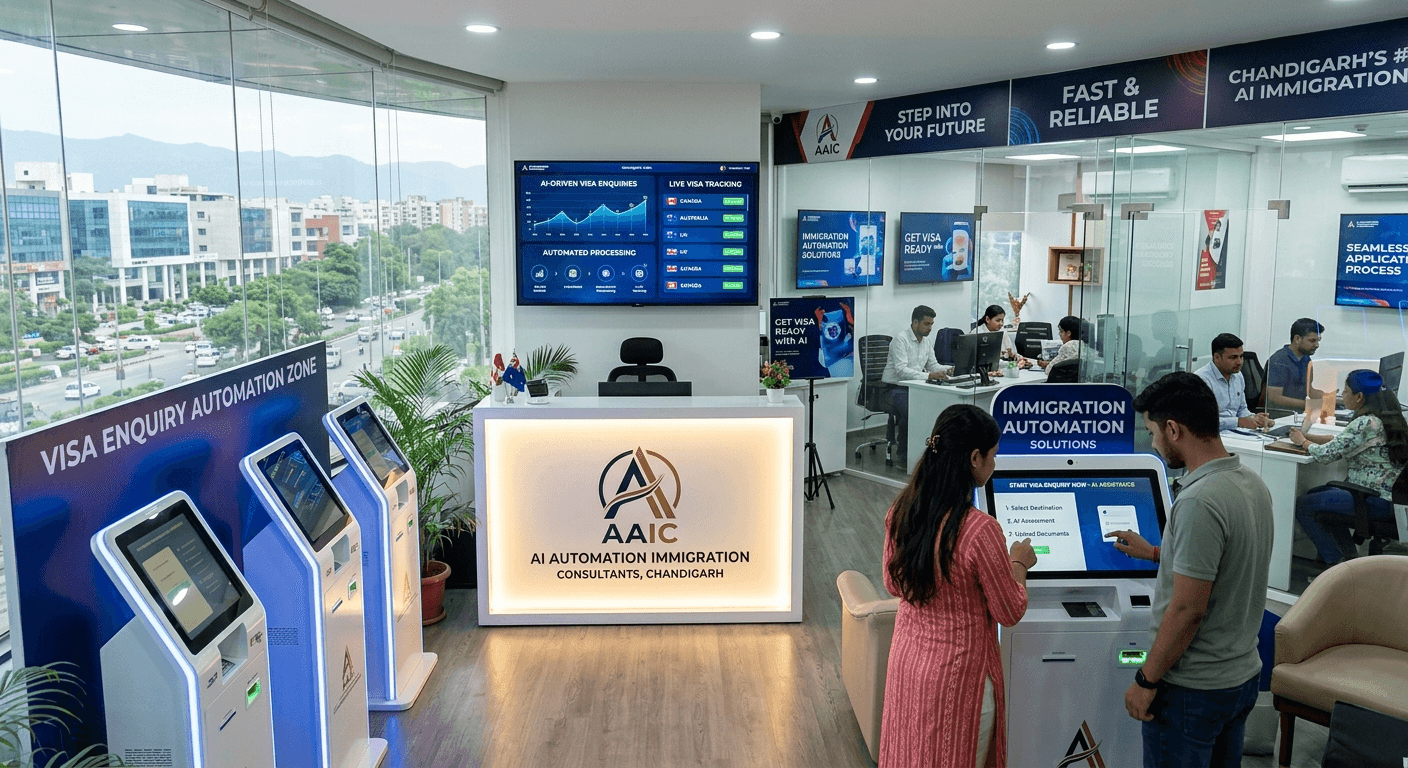
Immigration consultancies in Chandigarh receive thousands of enquiries. Learn how AI automation filters serious applicants before counselors talk.
Immigration consultancies in Chandigarh often have the same operational problem: the lead volume is high, but the lead quality is uneven. Ads, landing pages, WhatsApp campaigns, walk-in forms, and referral inquiries can all generate interest, but not every enquiry is ready for a counselor conversation. Many applicants are still comparing countries, unsure about eligibility, or missing basic criteria like IELTS score, budget, or work experience.
That creates a very real bottleneck. Counselors end up spending time on repetitive pre-screening instead of focusing on serious applicants. Meanwhile, genuine prospects expect fast responses. If the first reply is delayed, they often move to another consultant who responds faster. This is exactly where AI automation for immigration consultants in Chandigarh becomes operationally useful.
Instead of treating every enquiry the same, an automation system can immediately classify, qualify, and route leads. A typical workflow looks like this: enquiry arrives → AI call or chat engagement → qualification questions → CRM tagging → counselor booking. The result is a cleaner pipeline, better follow-up discipline, and lower workload for the team. In this article, we’ll break down how visa enquiry automation works, why manual qualification fails, and how to build a system that improves both response speed and sales efficiency.
The Operational Problem Immigration Consultants Face
Immigration and visa consultancies are not dealing with simple lead intake. They are managing a high-intent, high-friction decision process where prospects need guidance, reassurance, and structured qualification before any meaningful consultation can happen.
A single Chandigarh consultancy may receive enquiries for:
- Canada study visas
- Australia skilled migration
- work permits
- tourist visas
- spouse visas
- PR pathways
- IELTS support and profile assessments
At first glance, that sounds like a healthy demand engine. In practice, it creates several operational issues:
1. Too many unqualified enquiries
A large portion of leads may be:
- not eligible yet
- missing documentation
- comparing multiple countries
- unable to afford the process
- looking for general advice rather than conversion
2. Counselors spend time on repetitive questions
Before booking a real consultation, the team often has to ask the same questions again and again:
- Which country are you targeting?
- What is your IELTS score?
- What is your highest qualification?
- Do you have work experience?
- What is your budget?
- Are you applying alone or with family?
This is valuable information, but doing it manually wastes counselor time.
3. Poor lead sorting affects the sales pipeline
When all enquiries land in the same bucket, the team cannot quickly distinguish between:
- hot leads ready for appointment
- medium-intent prospects needing follow-up
- low-fit leads that should enter nurture sequences
Without proper sorting, follow-up becomes inconsistent.
4. Speed matters more than most teams realize
Immigration prospects are comparison shopping. If one consultancy replies in 2 minutes and another replies in 2 hours, the faster business often wins the conversation. That is why a proper speed-to-lead Chandigarh business strategy matters so much in this category.
Why Traditional Lead Handling Fails
Many immigration consultancies still rely on a familiar process:
- lead comes in from ads or website form
- sales executive checks the contact manually
- someone calls later to ask screening questions
- notes are entered into CRM after the call
- counselor schedules a consultation if the lead seems qualified
This approach looks organized on paper, but it breaks down when lead volume increases.
Delayed response means lower conversion
Manual callbacks are often delayed because teams are busy handling current walk-ins, existing clients, or documentation tasks. By the time the first conversation happens, the prospect may already be talking to another consultant.
Qualification is inconsistent
Different team members ask different questions, in different orders, with different standards. One executive may book a consultation too early. Another may reject a lead too quickly. That inconsistency damages pipeline quality.
CRM data becomes unreliable
If the CRM is updated after the call, some fields may be skipped or entered incorrectly. Over time, this creates a messy database that is difficult to segment or automate against.
Counselor workload becomes the bottleneck
The most expensive team member in the process should be doing high-value advisory work, not spending time on first-response screening. When counselors are pulled into basic qualification, productivity drops.
This is why many firms eventually move toward AI lead qualification in Chandigarh to separate routine screening from human consultation.
How the AI Automation System Works
A good visa enquiry automation system is not just a chatbot. It is a structured workflow that collects lead data, scores intent, filters eligibility, and moves qualified prospects into the right next step.
Here is the typical architecture.
Step 1: Enquiry is captured
The lead may come from:
- Facebook or Google ads
- website inquiry form
- WhatsApp click-to-chat
- missed call
- landing page lead magnet
- call center transfer
As soon as the lead enters the system, automation triggers immediately.
Step 2: AI engages the prospect
The AI can respond through:
- phone call
- voice agent
- WhatsApp message
- SMS follow-up
- website chat
For immigration consultancies, voice often works better for qualification because it feels closer to a real intake conversation. An AI voice agent can ask structured questions in a polite, consistent manner.
Step 3: Qualification questions are asked
The system can ask only the questions needed to determine fit, for example:
- Which country are you interested in?
- What is your IELTS score?
- What is your highest qualification?
- How many years of work experience do you have?
- What is your budget range?
- Do you want student visa, PR, work permit, or visitor visa?
- Are you looking to consult this week?
These questions help determine whether the lead should be booked, nurtured, or rejected.
Step 4: Eligibility is filtered
The automation can classify leads into categories such as:
- qualified and ready for counselor booking
- qualified but needs documentation
- not ready yet
- low fit / informational only
- incomplete profile
This step is important because not every enquiry deserves the same follow-up intensity.
Step 5: CRM is updated automatically
The system then pushes the lead into the CRM with tags such as:
- country interest
- score band
- lead status
- consultation priority
- source channel
This makes it much easier for the team to segment leads and run follow-up sequences.
Step 6: Booking is triggered for qualified leads
If the lead matches the rules, the automation can:
- assign it to the right counselor
- book a consultation slot
- send reminders
- notify the sales team instantly
This turns a messy inbound flow into a structured sales process.
Practical Implementation: A Mini Playbook for Immigration Consultancies
Let’s look at what this could actually look like for an immigration consultancy in Chandigarh.
Example scenario
A prospect clicks a Google ad for Canada study visa consultation and fills out a web form. The form includes only basic fields:
- name
- mobile number
- country of interest
That is enough to start the process.
Automation workflow
1. Lead form submission triggers a webhook
The form submission sends data into the automation platform immediately.
2. AI voice agent or chatbot starts contact
Within seconds, the system sends a WhatsApp message or initiates a call:
“Thanks for contacting us. I’m here to help check your profile for the right visa pathway. May I ask you a few quick questions?”
3. Qualification logic runs in sequence
The AI asks for:
- destination country
- IELTS score
- education level
- work experience
- available budget
- target timeline
If the lead is applying for Canada and has a strong profile, the system can move toward booking. If the score is low or the budget is unclear, the lead can be tagged for nurture.
4. CRM fields are updated
Each answer is written into the CRM automatically. This may include:
- lead status
- consultation readiness
- profile strength
- assigned counselor
- next action date
5. Booking link is sent only when criteria are met
If the lead qualifies, they receive a booking link or get assigned to the next available counselor.
Recommended tools and logic
A practical stack may include:
- CRM for lead management
- automation platform for workflows
- AI voice agent for qualification
- calendar booking system
- SMS/WhatsApp follow-up system
The exact stack depends on the firm, but the logic should remain the same: capture, qualify, tag, route, and book.
For firms already using CRM automation in Chandigarh companies, this workflow is especially effective because the qualification data becomes useful immediately inside the pipeline.
What Makes This Different from Simple Auto-Reply Systems
A lot of teams confuse automation with a simple “thank you for your inquiry” message. That is not lead qualification. That is just acknowledgment.
Simple auto-reply does this:
- confirms receipt
- sends a generic response
- does not assess lead quality
- still leaves manual work to the team
Lead qualification automation does this:
- engages the prospect
- asks structured questions
- interprets answers
- updates CRM
- routes the lead based on fit
That difference is what makes the system valuable.
If a consultancy wants to build a stronger conversion engine, it often needs more than one automation layer. Many firms combine qualification with AI lead response automation in Chandigarh so every new enquiry is handled instantly, even outside office hours.
Strategic Benefits for Immigration Businesses
The value of this system is not just “saving time.” It changes how the business operates.
1. Faster response to every enquiry
Immediate engagement improves the chance that the lead stays active and responsive.
2. Better counselor productivity
Counselors spend more time on serious applicants and less time on preliminary screening.
3. Cleaner CRM data
Each lead is tagged with useful qualification details that support follow-up and reporting.
4. More predictable pipeline management
Management can see how many leads are:
- qualified
- pending documentation
- booked
- unqualified
- nurture-stage
5. Better use of marketing spend
If ads are generating leads but only a portion are fit, the team can see patterns and refine targeting. This creates a tighter feedback loop between marketing and sales.
6. Reduced missed opportunities
Even when the office is busy, the system can respond instantly. That matters in high-intent categories like visas, where timing affects conversion.
Related Systems That Strengthen the Workflow
Lead qualification works best when it is part of a broader automation stack rather than a single isolated tool. In many cases, the most useful next layer is voice-based intake, especially if the consultancy receives a high volume of inbound enquiries. This is why AI voice agents for real estate in Chandigarh is a relevant adjacent use case: the same voice-first qualification pattern can be adapted to other high-volume service businesses.
Another useful layer is automated reactivation. Not every lead will be ready on day one. Some need to be nurtured over time, especially in immigration where timelines, documentation, and financial readiness vary. A structured follow-up system such as AI CRM reactivation in Chandigarh can bring back older leads who did not book initially but may now be ready to proceed.
Finally, firms that want to build a complete inbound engine should think beyond qualification alone. The best systems connect enquiry capture, response speed, CRM routing, and counselor booking into one chain. That is the same broader automation philosophy behind an AI automation agency in Chandigarh, where the goal is to turn scattered lead handling into a measurable operating system.
Frequently Asked Questions
1. What is AI automation for immigration consultants in Chandigarh?
It is a workflow that automatically responds to visa enquiries, asks qualification questions, filters leads by fit, updates the CRM, and books consultations for serious prospects.
2. What questions should the AI ask during visa enquiry automation?
The most useful questions are country of interest, IELTS score, education, work experience, budget, and timeline. These fields help determine eligibility and consultation readiness.
3. Can AI replace a counselor in an immigration consultancy?
No. AI handles initial qualification and routing. Counselors still handle strategy, document review, and human advisory work. The goal is support, not replacement.
4. Which leads should be routed to counselors immediately?
Leads that match the target profile, have clear intent, and are ready to discuss next steps should be booked quickly. Lower-fit or incomplete leads can enter nurture workflows.
5. Is this only useful for large immigration firms?
No. Smaller consultancies often benefit even more because they have less staff capacity. Automation helps them respond quickly without increasing headcount.
Conclusion
Immigration consultancies in Chandigarh do not have a lead generation problem as much as a lead handling problem. When enquiry volume is high, manual qualification becomes slow, inconsistent, and expensive in terms of counselor time. AI automation solves that by turning every enquiry into a structured workflow: capture, engage, qualify, tag, and route.
For firms that depend on fast response times and clean pipeline management, this is not a luxury feature. It is an operating advantage. The businesses that build these systems can handle more enquiries without sacrificing quality, and they can keep counselors focused on high-value consultations instead of repetitive screening.
If you want to improve visa enquiry automation, reduce workload, and build a more reliable intake system, the next step is to explore how AI automation can be adapted to your current CRM and lead flow.
AI-native business systems
Bring a niche, or bring a workflow.
If you run the business, we build the system around it. If you sell into a niche, we build the system behind your offer.
PolarBuild case study →You sell the niche. We build the system.
We never compete for your end clients. One partnership conversation. You fulfil the same system across the accounts in your niche.
Free POC before dedicated software
A three-day sales demo of the system for your vertical before any large software investment. Implementation starts only when someone in that niche pays.
Replicate the niche, not a one-off build
UK dental becomes US dental with a new local partner and new integration targets. Same system thesis, new market.