
Automation
AI Automation Strategy for Businesses Around Chandigarh IT Park

Updated
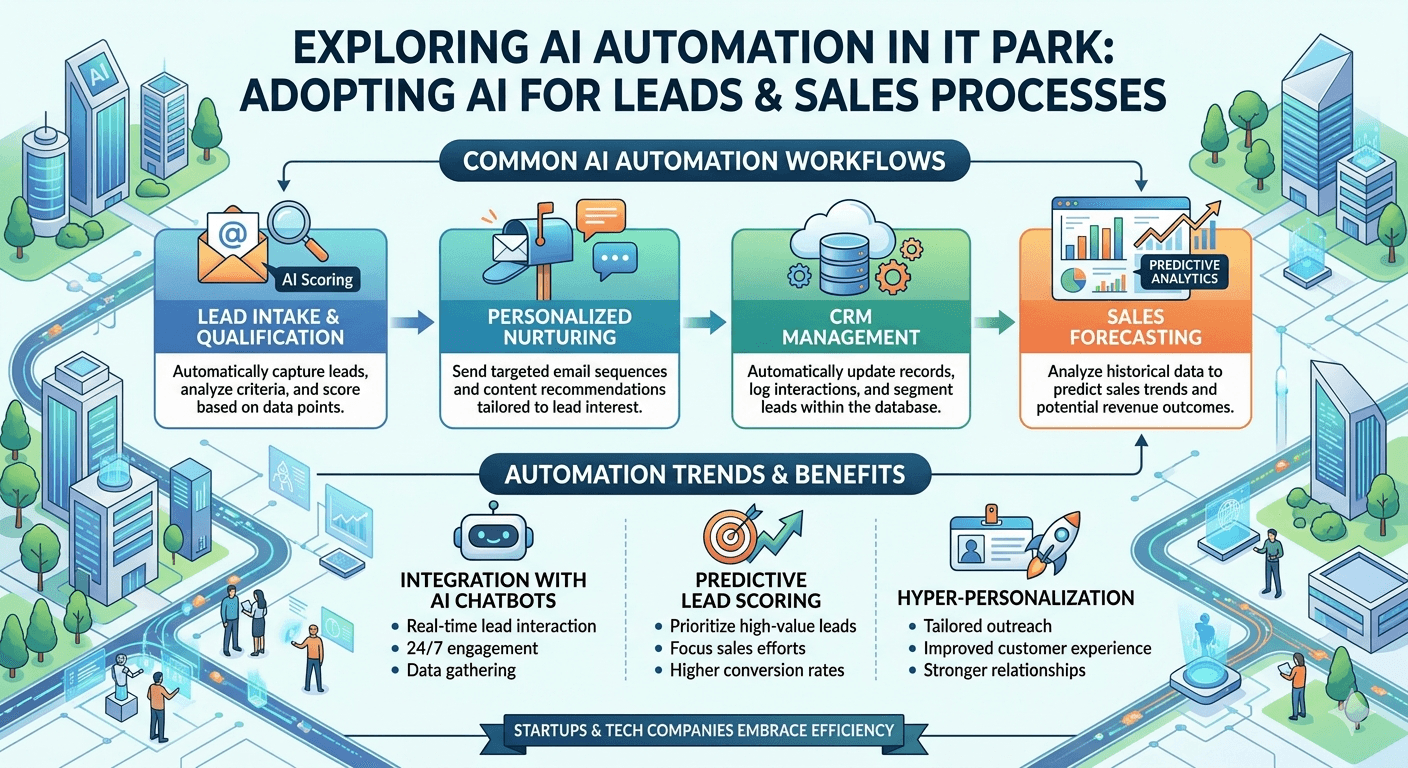
Companies around Chandigarh IT Park are rapidly adopting automation to manage sales pipelines and operations.
Companies around Chandigarh IT Park are under the same pressure that every modern B2B team feels: leads arrive from multiple channels, response times vary by person and shift, and CRM records often lag behind reality. A startup may capture demo requests from a landing page, calls from a business listing, and inbound messages from social ads, but if those enquiries are handled manually, the sales pipeline quickly becomes messy. The result is familiar: missed follow-ups, weak qualification, and deals that stall before a sales rep ever speaks to the prospect.
That is why AI automation IT Park Chandigarh is becoming more than a trend. For tech companies, agencies, SaaS teams, and service businesses around the area, automation is now a practical way to handle lead intake, qualification, routing, reminders, and CRM updates without adding unnecessary headcount. The goal is not to replace sales teams. The goal is to make the sales system faster, cleaner, and more predictable.
In this article, we will break down the operational problems businesses face around IT Park, why manual workflows fail, and how a practical AI automation system can manage leads and sales processes with far more consistency.
The Problem Businesses Face Around Chandigarh IT Park
Businesses around Chandigarh IT Park often operate in a hybrid growth environment. Some are early-stage startups trying to win their first serious pipeline. Others are established service companies with active inbound demand but limited sales operations maturity. In both cases, the same bottlenecks show up.
1. Lead intake comes from too many sources
A prospect may arrive through:
- website forms
- phone calls
- WhatsApp messages
- Facebook or Google ads
- referral links
- demo booking pages
- email enquiries
If these channels are not unified, leads get scattered across inboxes, personal phones, and spreadsheets. Even strong teams struggle to keep up.
2. Response ownership is unclear
In many companies, the first person to notice the lead is not always the person responsible for responding. A marketer sees the form submission. A coordinator sees the call. A sales rep sees the CRM entry later. This delay creates uncertainty and wastes time.
3. Qualification is inconsistent
Not every lead is worth the same effort. Some are ready to buy. Some are just browsing. Some are poor-fit leads that should be filtered early. Without a standard qualification process, teams end up overinvesting in unqualified conversations.
4. Follow-up depends on human memory
The biggest leak in many sales pipelines is not lead generation. It is follow-up. A rep may intend to call back later, send a quote, or schedule a second meeting, but without automation, tasks are easy to forget.
5. CRM data becomes unreliable
If the CRM is not updated in real time, management cannot trust the pipeline. Forecasts become weak, lead sources are unclear, and rep activity is hard to measure.
For teams in and around IT Park, these problems matter because the business environment is competitive and response time can decide whether a lead becomes a conversation or a lost opportunity.
Why Traditional Approaches Fail
Manual sales operations work when lead volume is low. They fail when demand becomes inconsistent or when the business grows beyond the capacity of one person remembering everything.
Slow response time hurts conversion
A lead that waits 30 minutes, 2 hours, or overnight before getting a response is often already lost. In many categories, the first business to respond has the highest chance of booking the call or closing the enquiry. This is especially true for service businesses, B2B consultants, and startup-led sales teams where buyer intent is fresh and short-lived.
This is why speed-to-lead Chandigarh business conversations have become so important. Fast response is not just a convenience; it is an operational advantage.
Manual qualification creates inconsistency
One rep may ask five important questions. Another may skip half of them. One person may mark a lead as “hot” even if the budget is unclear. Over time, the pipeline becomes noisy. Automation creates a more repeatable qualification layer, which is essential for growing teams.
CRM updates happen too late
Sales teams often treat CRM work as admin work, not revenue work. But stale CRM data makes it impossible to know:
- how many leads came in today
- which lead sources convert best
- which reps are actively following up
- which prospects need reactivation
Without disciplined automation, the CRM becomes a storage tool instead of an operating system.
Human follow-up is not scalable
A rep can only make so many calls, send so many emails, and remember so many reminders in one day. Once activity rises above a certain point, quality drops. Automation does not eliminate the need for humans; it handles repetitive tasks so humans can focus on high-value conversations.
How the AI Automation System Works
A practical AI automation system for businesses around Chandigarh IT Park usually follows a simple but powerful workflow.
Step 1: Lead arrives
The lead enters through a source such as:
- website form
- inbound call
- landing page submission
- WhatsApp inquiry
- ad form
- chatbot interaction
At this point, the system captures the contact details, source, and basic context.
Step 2: Trigger starts the workflow
A webhook, automation platform, or CRM trigger fires instantly. This trigger tells the system that a new lead has arrived and needs action.
Step 3: AI contacts the lead
Depending on the business model, the automation may:
- send an SMS or WhatsApp message
- place an AI voice call
- send an email
- notify a human sales rep
- assign the lead to a pipeline stage
For businesses that rely heavily on phone-based qualification, AI voice handling can make a major difference. Teams often compare this layer with workflows used in
AI lead response automation, especially when timing and first contact are critical.
Step 4: Qualification happens automatically
The AI asks structured questions such as:
- What service are you looking for?
- What is your budget range?
- When do you want to start?
- Are you the decision maker?
- Which location or use case applies?
The answers are logged into the CRM so the sales team has context before speaking to the prospect.
Step 5: Lead is routed or booked
Based on qualification data, the lead can be:
- routed to the correct salesperson
- moved into a specific CRM stage
- assigned a follow-up task
- booked into a calendar slot
- marked as nurture or disqualified
Step 6: CRM updates automatically
Every meaningful action is written back to the CRM. This keeps records current and helps managers see the real state of the pipeline.
A system like this is especially valuable when combined with broader
CRM automation for Chandigarh companies, because CRM becomes the central source of truth rather than a passive database.
Practical Implementation: A Mini Playbook for IT Park Teams
Let’s look at a realistic implementation example for a small B2B software company or service firm near Chandigarh IT Park.
Example business flow
Imagine a company gets demo requests from its website and paid ads. The current process is manual:
- Lead submits form
- Sales rep receives email notification
- Someone checks the CRM later
- Rep calls the lead when available
- If no answer, follow-up gets delayed
- The prospect books with a competitor or goes cold
Now compare that to an automated version.
Recommended tool stack
A practical stack might include:
- CRM: GoHighLevel, HubSpot, or another pipeline system
- Automation layer: workflow builder, webhooks, or native automations
- Voice layer: AI voice agent for calls
- Messaging layer: SMS, email, WhatsApp
- Calendar tool: booking link or embedded scheduler
- Notification layer: internal alerts to sales reps
For teams already exploring conversational systems, an
AI voice agent GoHighLevel integration
is often a clean way to tie intake, qualification, and scheduling together.
Workflow design
Here is a clean operational sequence:
- Form submission
- Trigger captures name, phone, email, service interest, and source
- Lead scoring
- Automation checks basic fit:
- service type
- geography
- urgency
- budget signal
- Immediate outreach
- AI sends an instant message or calls within a minute
- Qualification logic
- If the lead qualifies → move to sales contact stage
- If unsure → route to nurture sequence
- If unqualified → store for retargeting
- Rep handoff
- Sales rep receives a summary:
- need
- timeline
- objections
- history
- CRM update
- Status, tags, notes, timestamps updated automatically
Decision rules worth adding
- If lead responds within 5 minutes → prioritize human callback
- If no answer → send SMS + email
- If low budget → nurture
- If urgent → escalate
- If repeat lead → trigger reactivation
Reactivation workflows often perform well when combined with
AI CRM reactivation.
Benefits and Strategic Impact
Faster response times
Cleaner pipeline visibility
Better use of sales time
More consistent qualification
Stronger follow-up discipline
Better scalability
Related Systems and Workflows
Frequently Asked Questions
What businesses benefit most?
Startups, B2B services, agencies, consultancies.
Only for high volume?
No.
Replace sales reps?
No.
First workflow to build?
Lead response.
Works with existing CRM?
Yes.
Conclusion
Businesses around Chandigarh IT Park are not adopting AI automation simply because it is fashionable. They are doing it because manual lead handling creates avoidable revenue leakage. Slow responses, inconsistent qualification, and poor CRM hygiene all weaken the sales process. A well-designed automation system solves those problems by creating a fast, repeatable, and measurable workflow from lead capture to handoff.
For startups and service businesses in the area, the opportunity is clear: build a system that responds instantly, qualifies intelligently, and updates the CRM without friction. That is how sales teams stay focused on real opportunities instead of administrative noise.
If you are planning the next step, it usually makes sense to start with lead response, qualification, and CRM automation, then expand into voice, reactivation, and pipeline workflows as the system matures. For businesses looking to build that foundation, working with an AI automation agency in Chandigarh can make implementation faster and far more structured.
AI-native business systems
Bring a niche, or bring a workflow.
If you run the business, we build the system around it. If you sell into a niche, we build the system behind your offer.
PolarBuild case study →You sell the niche. We build the system.
We never compete for your end clients. One partnership conversation. You fulfil the same system across the accounts in your niche.
Free POC before dedicated software
A three-day sales demo of the system for your vertical before any large software investment. Implementation starts only when someone in that niche pays.
Replicate the niche, not a one-off build
UK dental becomes US dental with a new local partner and new integration targets. Same system thesis, new market.