
Automation
AI Sales Automation for Indian Agencies

Updated
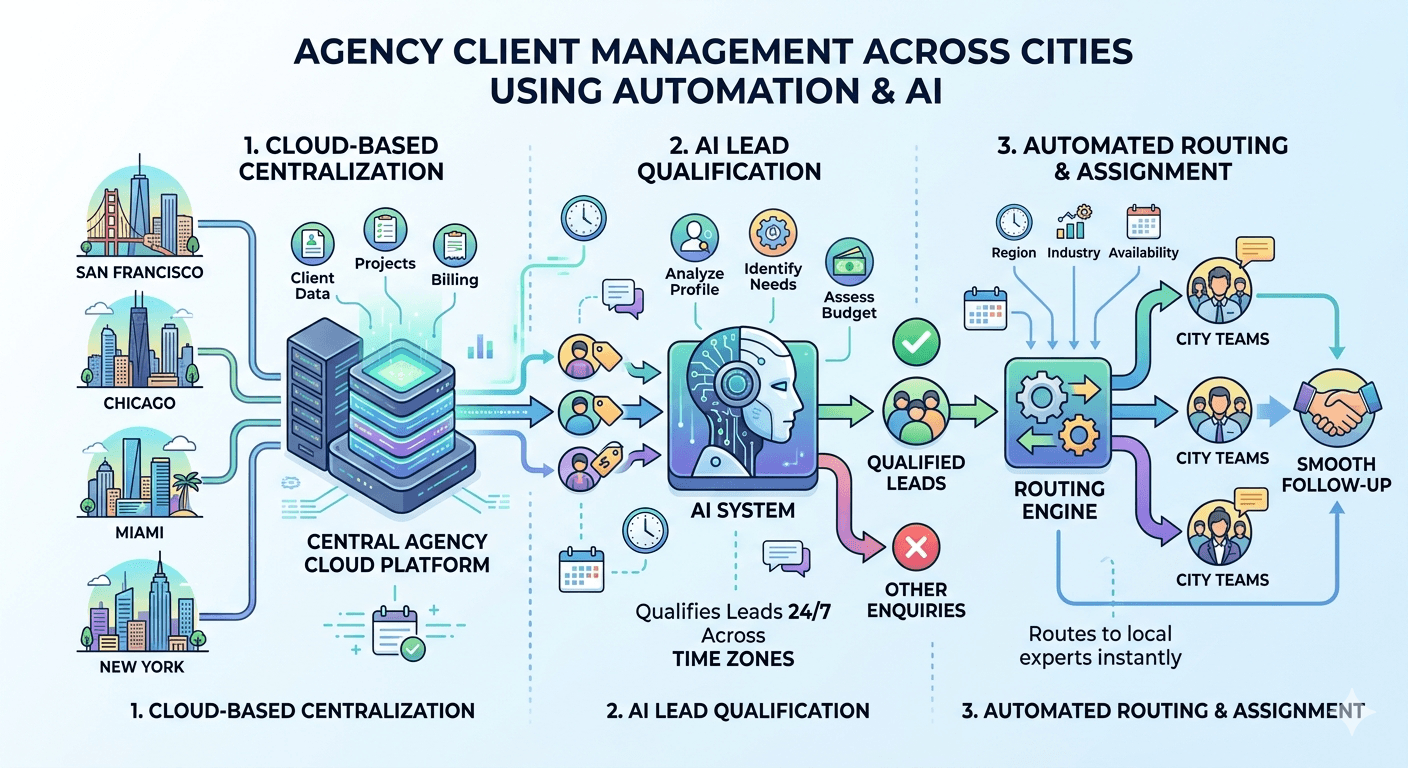
Agencies in Chandigarh often serve national clients. Learn how AI automation helps manage distributed lead pipelines.
Agencies in Chandigarh increasingly work with clients who are not limited to one city. A single team may handle enquiries from Delhi in the morning, Bengaluru around midday, and Mumbai late in the evening. That creates a practical problem: the sales process no longer fits neatly inside office hours, and manual follow-up becomes difficult to maintain at scale.
When leads arrive from different regions, the real challenge is not just volume. It is timing, qualification, routing, and consistency. A lead from one state may need immediate call-back, while another should be sent to a specific consultant, sales rep, or branch based on service area, urgency, or budget. If the response depends on someone noticing a form submission in time, the pipeline quickly becomes unreliable.
That is where AI sales automation becomes valuable. For agencies serving clients across India, AI systems can capture enquiries, qualify them instantly, route them to the right owner, and update the CRM without manual intervention. In this article, we will break down how that workflow works, why traditional lead handling fails, and how agencies can use automation to manage distributed pipelines more effectively.
The Operational Problem for Agencies Serving National Clients
Agencies in Chandigarh often support businesses with customers across multiple Indian cities. This is especially common for service businesses, consultancies, education firms, healthcare providers, and B2B agencies. These companies may generate leads from ads, landing pages, WhatsApp, missed calls, website forms, and inbound calls.
The operational problem is simple: every lead needs a fast, relevant response, but the team handling it is usually working inside a local schedule and a fixed process.
Common pain points include:
- leads coming in outside business hours
- enquiries from different states needing different sales owners
- poor visibility into lead status across channels
- manual routing based on spreadsheets or inbox checks
- inconsistent qualification criteria across team members
- slow handoff between marketing and sales
For agencies, this becomes a service delivery issue as much as a sales issue. If they are managing lead generation or sales operations for multiple clients, they need systems that can scale across time zones, sales teams, and business categories.
This is why the phrase AI automation agency workflow India matters operationally, not just as a keyword. Agencies need a process that can handle lead intake, qualification, routing, and CRM updates in a consistent way no matter where the enquiry originated.
Why Traditional Lead Management Breaks Down
Manual systems work when lead volume is small and the market is local. They break down when agencies begin handling clients across India.
1. Response delays reduce lead quality
A lead from a different city may not wait for a callback the next morning. By then, they may have contacted another provider or lost interest. In many sectors, the first responsive business has the best chance of progressing the conversation.
2. Human qualification is inconsistent
One sales rep may ask three questions, another may ask seven, and a third may skip qualification entirely. That creates uneven CRM data and makes it hard to measure lead quality.
3. Routing becomes messy
Without automation, enquiries often sit in a shared inbox or land in a generic CRM queue. Someone still has to decide whether the lead belongs to sales, support, a branch office, or a specialist consultant.
4. Multi-city operations create handoff gaps
If a prospect from Jaipur needs to be routed to a regional manager, the delay between capture and assignment can make the lead go cold. Agencies serving national clients cannot depend on manual triage for every enquiry.
5. CRM data quality gets worse
When updates are entered after the fact, statuses become inaccurate. Follow-up tasks are missed. Duplicate records appear. Forecasting becomes unreliable.
Agencies that want to scale need more than response speed. They need a structured system that can convert raw enquiries into organized pipeline activity automatically.
How the AI Automation System Works
A well-designed AI sales automation workflow is not one tool. It is a sequence of connected actions that turns an enquiry into a routed, qualified sales opportunity.
Typical flow:
Lead source → Trigger → AI response layer → Qualification logic → Routing → CRM update → Follow-up
Here is how that works in practice.
1. Lead capture
The lead enters through a form, landing page, ad click, missed call, WhatsApp message, or inbound call. The system captures the source, contact details, campaign information, and any custom form fields.
2. Immediate trigger
Once the lead is captured, a trigger fires instantly. This may happen through a webhook, CRM event, or automation platform such as GoHighLevel, Make, or Zapier.
3. AI response
The AI layer responds through SMS, WhatsApp, email, or voice. This can be especially useful when the lead is high intent and expects a quick call. In some use cases, the automation can initiate an AI voice conversation to ask qualifying questions and confirm interest.
For businesses that rely on conversational intake, this approach often works well alongside
AI voice agents, especially when enquiries need to be handled before a human rep is available.
4. Qualification
The system asks the right questions based on the campaign or business type. Examples include:
- What service are you looking for?
- Which city are you based in?
- What is your expected timeline?
- What budget range are you working with?
- Are you looking for a consultation or direct service?
The point is not to replace human sales judgment. It is to gather enough structured information to route the enquiry correctly.
5. Routing
Once the lead is qualified, the system sends it to the right owner. This might be based on:
- city
- service category
- lead score
- language preference
- urgency
- business hours
- source campaign
6. CRM update
The CRM is updated automatically with the qualification details, source data, notes, tags, status, and next action. This gives the sales team a clean handoff with context already attached.
7. Follow-up and booking
If the lead is qualified, the system can book a meeting, notify the rep, or send a reminder sequence. If the lead is not ready, it can enter a nurture workflow.
This is the difference between a collection of disconnected tools and a functioning sales automation engine.
A Practical Implementation Example for a Multi-City Agency
Let’s say an agency in Chandigarh manages inbound lead generation for a consulting client that serves customers in Delhi, Pune, Ahmedabad, and Hyderabad.
The agency wants every lead to be contacted within minutes, regardless of when the enquiry arrives.
Tool stack
A practical setup might include:
- landing page or lead form
- GoHighLevel or CRM platform
- webhook or automation tool
- AI voice or chat layer
- routing rules
- calendar booking system
- notification system for sales reps
Workflow logic
Here is a simplified version of the automation:
- A visitor submits a form with name, phone number, city, and service interest.
- The CRM receives the lead and tags the source campaign.
- An automation checks the city field.
- If the city matches a priority territory, the lead is assigned to the corresponding rep.
- The AI sends an SMS or WhatsApp message immediately.
- If the lead responds, the AI asks qualifying questions.
- If the lead is high intent, a meeting link is sent or a rep is notified.
- The CRM updates the stage automatically.
Example routing logic
A useful rule set might look like this:
- Delhi NCR leads → Senior sales rep
- Tier 1 city leads → Regional manager
- Enterprise leads → Sales director
- Low-budget leads → nurture sequence
- After-hours leads → AI follow-up + next-day callback task
Why this matters
This approach lets agencies standardize lead handling across India while still preserving flexibility. A lead from one region does not get treated the same as a lead from another region. The automation makes the process scalable without making it generic.
This is also where broader systems such as
CRM automation workflows
become essential. The CRM is not just a storage tool; it becomes the operational layer that ensures every lead is tracked, assigned, and followed up on correctly.
Benefits and Strategic Impact
The value of AI sales automation is not just faster responses. It changes how an agency manages revenue operations.
1. Better speed-to-lead
2. More consistent qualification
3. Stronger pipeline visibility
4. Less operational load
5. Better handling of distributed demand
6. Improved team accountability
The strategic effect is important: agencies can take on more clients and manage more lead volume without proportionally increasing headcount.
Related Systems and Workflows That Strengthen the Stack
AI sales automation works best when it is part of a connected system rather than a standalone feature.
AI SDR workflows
For B2B agencies or companies with longer sales cycles, AI can act like a first-line sales development layer. It can qualify, segment, and route leads before a human rep takes over. If your team is comparing this model with outreach-based sales systems, the article on
AI SDR workflows for Chandigarh sales teams
is a useful companion.
Lead response automation
A large share of conversions are won or lost in the first few minutes after inquiry. That makes follow-up automation critical. Immediate acknowledgement, qualification, and next-step messaging often work together as a sequence rather than separate tasks. This is why
AI lead response automation
is so often paired with routing logic in high-volume campaigns.
Lead qualification and conversion systems
Not every enquiry should go directly to sales. Some should be nurtured, some should be filtered out, and some should be fast-tracked. That is where
AI lead qualification
and
AI conversion automation
fit into the workflow.
Speed-to-lead systems
Many agencies know they need faster responses, but they do not always have a structured process behind that speed. A proper
speed-to-lead system
combines instant capture, prioritization, and automated outreach.
When these workflows are connected, the result is a much stronger operational stack. That stack is also what supports the broader positioning of an
AI agency in Chandigarh,
because it shows how the agency can build systems that serve clients beyond a single local market.
Frequently Asked Questions
1. Can AI sales automation handle leads from different Indian cities?
Yes. Routing logic can use city, region, service type, or lead score to assign enquiries to the correct rep or workflow.
2. Do agencies need a voice agent for every lead?
No. Voice works best for high-intent leads, missed calls, or cases where qualification needs to happen immediately.
3. What CRM is best for this kind of automation?
There is no single best CRM. The important factor is whether the CRM supports automation, tagging, workflows, and integrations.
4. How does automation help outside office hours?
It can respond instantly, qualify the lead, and either book a call or create a callback task for the next business day.
5. Is this useful only for large agencies?
No. Smaller agencies benefit too.
Conclusion
For agencies serving clients across India, the main challenge is not just generating leads. It is handling them quickly, consistently, and in the right order. Manual processes struggle when enquiries come from different cities, different time zones, and different channels.
AI sales automation solves that problem by turning lead intake into a structured workflow: capture, qualify, route, update, and follow up. When implemented well, it improves speed-to-lead, reduces admin work, and gives the sales team a cleaner pipeline to work from.
For agencies in Chandigarh managing national demand, this is becoming less of a nice-to-have and more of an operational requirement. If you want to understand how these systems fit into a broader automation strategy, start with the cluster around AI automation and build from there.
AI-native business systems
Bring a niche, or bring a workflow.
If you run the business, we build the system around it. If you sell into a niche, we build the system behind your offer.
PolarBuild case study →You sell the niche. We build the system.
We never compete for your end clients. One partnership conversation. You fulfil the same system across the accounts in your niche.
Free POC before dedicated software
A three-day sales demo of the system for your vertical before any large software investment. Implementation starts only when someone in that niche pays.
Replicate the niche, not a one-off build
UK dental becomes US dental with a new local partner and new integration targets. Same system thesis, new market.