
AI Voice Assistant
AI Voice Agents for Real Estate Leads in Chandigarh

Updated
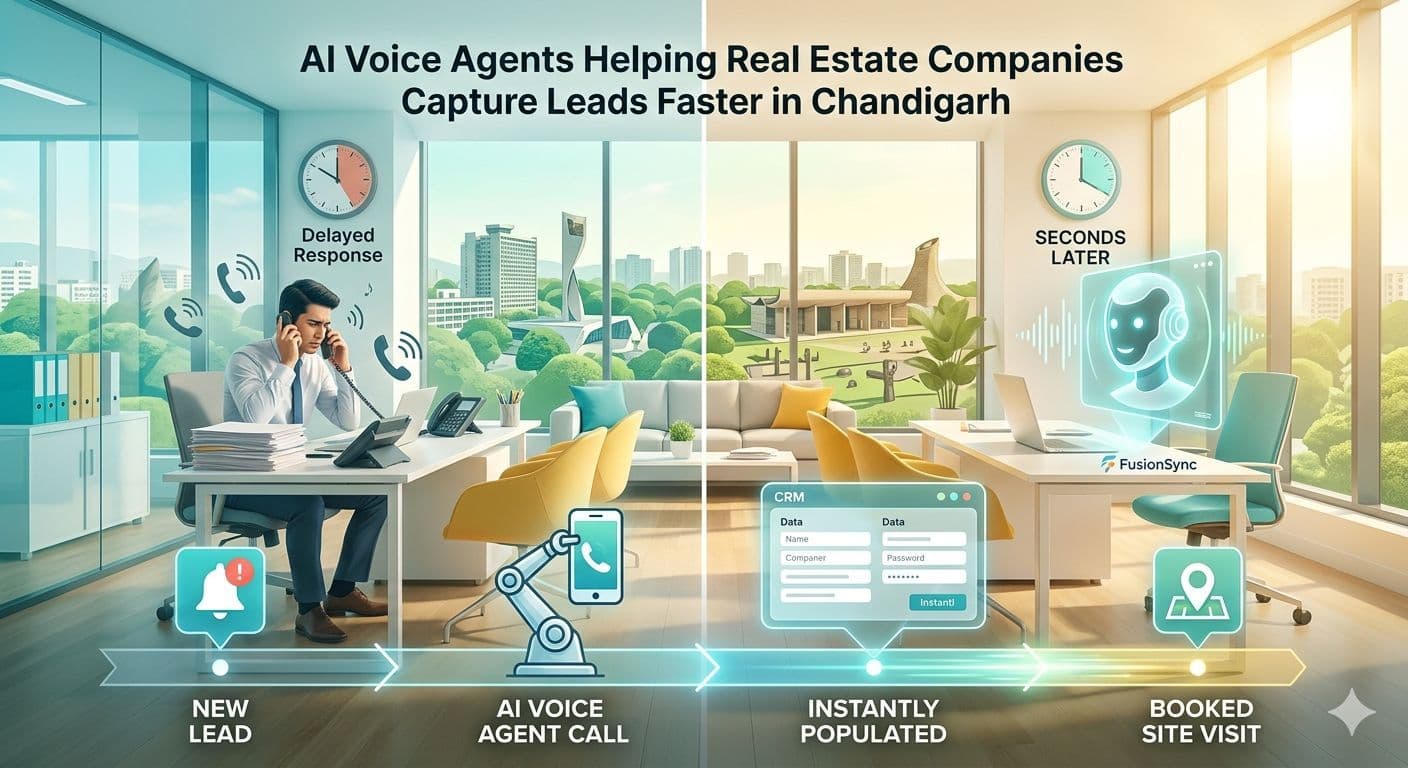
Real estate leads in Chandigarh disappear quickly. Learn how AI voice agents instantly qualify property buyers and book site visits automatically.
A real estate enquiry in Chandigarh is often a race against time. A buyer fills out a form on 99acres, MagicBricks, or a Meta ad at 11:12 a.m., expecting a call almost immediately. If the sales team responds 20 minutes later, that lead may already be talking to two other brokers, a project marketer, or a competitor who called first. In property sales, the first meaningful conversation often decides whether the lead becomes a site visit or disappears into a long list of “warm” enquiries that never convert.
That is why AI voice agents real estate Chandigarh has become a practical automation use case rather than a futuristic idea. Instead of waiting for a human caller to become available, the lead is contacted within seconds, qualified on budget, locality, property type, and timeline, and then pushed into the CRM with the next action already scheduled. In a market where response time is often more important than ad spend, this kind of real estate lead automation can materially improve pipeline quality.
This article explains why fast response matters, why manual systems fail, and how an AI voice workflow can turn incoming property leads into booked site visits automatically.
The Real Estate Lead Problem in Chandigarh
Real estate teams in Chandigarh, Mohali, and the wider Tricity market typically manage leads from multiple sources:
- property portals like 99acres and MagicBricks
- Meta lead ads
- Google search campaigns
- WhatsApp click-to-chat
- website enquiry forms
- walk-in follow-up lists
- broker referrals
The issue is not lead generation alone. The real bottleneck is lead handling.
A typical sales desk may have:
- one or two telesales people
- field agents in the market
- project-specific follow-up lists
- CRM records that are updated late
- missed calls that are never returned fast enough
This creates a structural delay. Even a strong lead can go cold if nobody speaks to the prospect at the right moment. In real estate, timing matters because buyer intent is often short-lived. A person searching for a 2BHK in Zirakpur, a plot in New Chandigarh, or a rental property near Airport Road may contact multiple sellers in a single afternoon. Whoever responds first gets the better chance to qualify the need and book a site visit.
The same problem appears across many service businesses, which is why speed-to-lead automation is becoming a core part of the broader AI automation services in Chandigarh ecosystem.
Why Chandigarh teams feel the pain more sharply
Chandigarh real estate businesses often operate in a competitive radius where prospects compare many options very quickly. They may be looking at:
- ready-to-move apartments
- under-construction projects
- SCOs and commercial spaces
- plots and builder floors
- rental and resale inventory
Because the inventory is broad and price-sensitive, the first call has to do two jobs at once:
- qualify whether the lead is real
- guide the person toward a site visit or meeting
When that process is slow or inconsistent, marketing spend becomes less efficient. You may generate more leads, but not more qualified appointments.
Why Traditional Follow-Up Systems Fail
Most real estate teams rely on manual calling, WhatsApp follow-up, or a basic CRM reminder system. These methods can work in small volumes, but they fail as lead volume grows.
1. Human response time is unpredictable
A sales representative may be:
- on another call
- driving between site visits
- busy with a walk-in customer
- unavailable after hours
- delayed by manual admin work
Even a 5–10 minute delay can reduce connection rates significantly. If the lead came from a paid source, that delay also reduces return on ad spend.
2. Qualification is inconsistent
Different team members ask different questions. One caller may ask about budget first. Another may start with location. Another may try to pitch a project too early.
This causes problems such as:
- incomplete lead data
- poor segmentation
- misaligned site visits
- wasted time for the sales team
Without a standard qualification workflow, the CRM becomes a storage place rather than a decision system.
3. CRM updates happen too late
Many teams still update the CRM at the end of the day or after a few calls. That means no one has a live view of:
- which lead responded
- who is interested in which project
- which visitors are confirmed
- who needs a callback tomorrow
This is where CRM automation workflows make the biggest difference. When lead data is updated automatically, managers can actually operate from current information instead of stale notes.
4. Follow-up is fragmented
A property lead often needs multiple touchpoints:
- initial qualification call
- WhatsApp confirmation
- brochure or inventory sharing
- site visit scheduling
- post-visit follow-up
If these steps are handled manually, the process breaks at the seams. The team may have the intent to follow up, but the execution depends on memory and discipline.
How the AI Voice Agent Workflow Works
An AI voice agent fixes the response gap by making the first call instantly and consistently. It does not replace your sales team; it filters, qualifies, and routes leads so the human team spends time only on better opportunities.
Here is the basic workflow for real estate lead automation:
Step 1: Lead enters from an ad or form
A prospect submits details from:
- 99acres
- MagicBricks
- Meta lead form
- website form
- landing page
- click-to-call ad
The lead enters the CRM or automation platform immediately through a webhook or integration.
Step 2: Trigger launches an AI call within seconds
The system detects the new lead and triggers an outbound AI voice call. This happens automatically, usually within a very short window after form submission.
The speed matters because the prospect is still mentally engaged. They remember the project, the budget, and the inquiry context.
Step 3: The AI voice agent qualifies the lead
The voice agent asks structured questions such as:
- What type of property are you looking for?
- What is your budget range?
- Which location do you prefer?
- Are you looking for immediate possession or under-construction inventory?
- When would you like to visit the site?
- Are you buying for self-use or investment?
The system can be tuned to sound professional, polite, and local-market appropriate. The goal is not to “sell hard.” The goal is to identify intent and capture actionable information.
This is closely related to the logic used in broader AI lead qualification workflows, where the system collects only the data needed to determine next action.
Step 4: CRM is updated automatically
Once the conversation is complete, the automation writes the outcome to the CRM:
- lead source
- budget
- preferred location
- project interest
- lead status
- best callback time
- qualification notes
This removes manual entry and gives the sales manager a live view of the pipeline.
Step 5: Site visit is booked or handed off
If the lead is qualified, the agent can:
- offer available site visit slots
- transfer the lead to a human executive
- send a confirmation message
- create a calendar event
- assign the lead to the right salesperson
If the prospect is not ready yet, the lead can be placed into a nurture sequence for later follow-up.
Practical Implementation for a Chandigarh Real Estate Team
Let’s look at a realistic setup for a builder, channel partner, or brokerage team.
Example scenario
A Meta ad promotes a residential project in Mohali. A prospect submits the form asking for a 3BHK in the ₹80 lakh to ₹1.2 crore range. They want a Sunday site visit and prefer a location close to schools and daily convenience.
Suggested automation stack
A practical stack may include:
- lead capture from Meta or portal feeds
- a CRM such as GoHighLevel, HubSpot, or a custom pipeline
- an AI voice agent for outbound calling
- workflow automation for routing and notifications
- WhatsApp or SMS for confirmation
- calendar scheduling for site visits
- internal task assignment for sales reps
If the project already uses GoHighLevel, this becomes even smoother, because the calling logic, pipeline stage changes, and follow-up automations can sit inside one system. That is why many teams explore AI voice agent GoHighLevel integration before building separate tools.
Suggested workflow logic
A solid implementation could look like this:
- Lead captured
- Lead lands in CRM from ad or portal.
- Immediate call trigger
- AI voice agent calls in under a minute.
- Qualification
- Budget, location, possession type, and timeline are recorded.
- Scoring
- Lead is marked hot, warm, or nurture.
- Routing
- Hot leads are assigned to a human executive.
- Booking
- Site visit is booked or proposed.
- Confirmation
- WhatsApp/SMS goes out with the appointment details.
- Manager visibility
- Team sees the lead status in real time.
What to automate first
If you are implementing this for the first time, start with the highest-value automation:
- instant call on new enquiry
- budget and location qualification
- CRM field update
- lead assignment
- site visit booking request
Do not overcomplicate the first version. The objective is to reduce response delay and standardize qualification.
Common implementation mistakes
Many teams fail because they try to automate everything at once. Better to avoid these mistakes:
- using too many qualification questions
- making the call script sound robotic
- not syncing the CRM fields properly
- failing to define what counts as a qualified lead
- not creating a handoff path to a human executive
- ignoring follow-up after the first call
In other words, the system should simplify the sales desk, not create another layer of complexity.
Why Speed-to-Lead Matters More Than Ad Spend
In property sales, more ad spend does not automatically mean better results. If your team is slow to respond, the incremental leads only increase leakage.
Speed-to-lead changes the economics because it improves:
- connection rates
- qualification rates
- appointment rates
- sales team productivity
- attribution clarity
A fast response also creates a better buyer experience. Many property buyers are contacting multiple vendors. A quick, useful call signals professionalism. The lead feels handled, not forgotten.
Strategic impact for real estate teams
An AI voice system can help the business in several ways:
- less manual calling
- more consistent qualification
- better CRM hygiene
- faster site visit booking
- lower dependence on a large inside-sales team
- better visibility into lead quality by source
This matters especially when comparing organic, portal, and paid traffic. Once you can measure which channel produces the best booked visits, you can improve campaign decisions rather than only tracking raw lead count.
The same principle is why many teams also invest in speed-to-lead systems in Chandigarh businesses beyond real estate alone.
Related Systems That Strengthen the Workflow
An AI voice agent works best when it is part of a larger automation system, not a standalone tool.
CRM automation
Once the call ends, the CRM should automatically reflect the outcome. That means your sales team can instantly see:
- who answered
- who requested a callback
- who is site-visit ready
- who should enter a nurture sequence
This is where CRM automation workflows are essential. Without them, the voice agent creates data, but the team still has to organize it manually.
Lead response automation
The first call is only one part of the system. If the lead does not answer, the automation should move to a backup path:
- second call attempt after a delay
- WhatsApp message
- SMS with brochure or project details
- reminder task for a salesperson
That is why AI lead response automation is a useful companion topic. The goal is not simply “call fast,” but “respond intelligently across channels.”
AI SDR workflows for complex sales
When a property conversation becomes more consultative, the AI voice agent can act like a pre-sales assistant and pass context to a human closer. This is similar to how AI SDR workflows for sales teams operate in other industries: automate the first layer of qualification, then hand off the serious opportunity.
Why this cluster approach matters
These systems are connected. A property lead workflow often depends on:
- lead qualification
- CRM sync
- missed call recovery
- conversion automation
- reactivation for old leads
That is why this article sits naturally inside a broader topical map around the AI automation agency in Chandigarh and its cluster posts. Search engines can see that the site covers the full lead lifecycle, not just one isolated use case.
Frequently Asked Questions
1. How do AI voice agents help real estate companies in Chandigarh?
They call new leads immediately, qualify budget and location, and book site visits or route leads to the right salesperson faster than manual follow-up.
2. Can AI voice agents work with leads from 99acres and MagicBricks?
Yes. If the lead source can push data into your CRM or automation platform, the AI voice workflow can be triggered automatically.
3. Will an AI voice agent replace the sales team?
No. It handles the first response, qualification, and routing. Human sales reps still handle relationship building, site visits, negotiation, and closing.
4. What information should the AI collect from a property lead?
At minimum: budget, preferred location, property type, timeline, and whether the buyer wants self-use or investment. That is usually enough to decide the next step.
5. Is this useful for smaller real estate teams too?
Yes. Smaller teams often benefit even more because they have less bandwidth to respond instantly to every enquiry. Automation helps them act like a larger team without hiring immediately.
Conclusion
For Chandigarh real estate businesses, the core problem is rarely lead generation alone. The real challenge is responding fast enough to turn interest into a qualified conversation and a site visit. AI voice agents solve that bottleneck by calling new leads within seconds, collecting the right qualification details, updating the CRM, and routing the opportunity into the next step automatically.
When implemented properly, this is not just a convenience feature. It becomes a revenue operation tool that improves speed-to-lead, increases consistency, and gives managers cleaner visibility into pipeline quality. And because it works alongside CRM automation, missed-call recovery, and follow-up workflows, it strengthens the entire sales process rather than patching one small gap.
If you are building a more reliable property lead engine, start with the first response layer. That is where AI automation creates the biggest practical advantage.
AI-native business systems
Bring a niche, or bring a workflow.
If you run the business, we build the system around it. If you sell into a niche, we build the system behind your offer.
PolarBuild case study →You sell the niche. We build the system.
We never compete for your end clients. One partnership conversation. You fulfil the same system across the accounts in your niche.
Free POC before dedicated software
A three-day sales demo of the system for your vertical before any large software investment. Implementation starts only when someone in that niche pays.
Replicate the niche, not a one-off build
UK dental becomes US dental with a new local partner and new integration targets. Same system thesis, new market.