
Lead Response Time
B2B SaaS Lead Response Benchmarks: 2026 Team Playbook

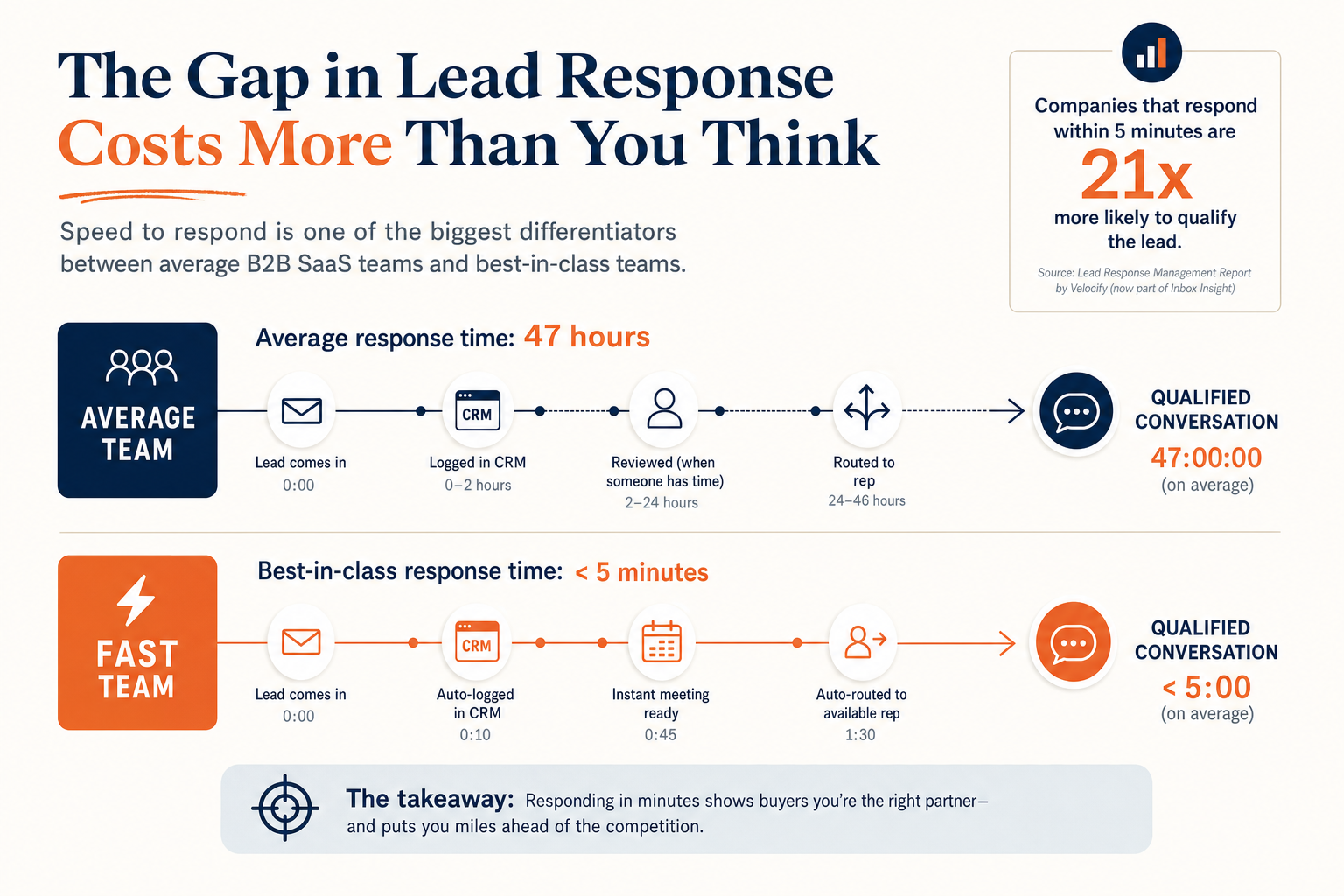
B2B SaaS lead response benchmarks show the gap between 47-hour teams and sub-5-minute systems. Here is what to fix first.
The benchmark is not five minutes. It is the gap.
The B2B SaaS lead response benchmark most teams quote is "respond within five minutes."
That is useful, but it is not the real story.
The real benchmark is the gap between what buyers experience and what fast teams have engineered. In 2026, current benchmark reports still put average B2B response time in hours, not minutes. Optifai's 2026 benchmark across 939 B2B companies puts the overall average at 47 hours, with B2B SaaS specifically at 38 hours and only 28 percent of SaaS companies responding within five minutes.
That is the opportunity.
If you are a small SaaS team, the win is not to become a giant SDR floor. The win is to remove the dead air between "demo request submitted" and "qualified conversation started." That can be a booked meeting, a smart routing decision, a short qualification thread, or a human call. It just cannot be a two-day wait followed by a generic "thanks for reaching out."
I have been running inbound systems long enough to see the same leak repeatedly: companies pay for demand, capture the form, celebrate the MQL, then let the lead sit while the buyer opens five tabs. The lead does not go cold because the product is weak. The lead goes cold because the operating layer is missing.
This post is the benchmark version of the 60-second response architecture. The architecture post shows how to build the system. This one shows what to measure, where the benchmark numbers come from, and why B2B SaaS teams should stop treating speed-to-lead as a rep discipline problem.
It is an infrastructure problem.
What the current B2B SaaS numbers say
The cleanest current benchmark I found is Optifai's 2026 Sales Ops Benchmark, which says it is based on 939 B2B companies with CRM and marketing automation timestamp data. Treat it like vendor research, not scripture, but the methodology is at least specific: response time is measured from lead creation to first sales activity.
The headline numbers:
| Segment | Benchmark |
|---|---|
| Overall B2B average response time | 47 hours |
| B2B SaaS average response time | 38 hours |
| B2B companies responding in under 5 minutes | 23% |
| B2B SaaS companies responding in under 5 minutes | 28% |
| Companies taking over 24 hours | 42% |
| Close rate under 5 minutes | 32% |
| Close rate after 24+ hours | 12% |
The exact percentages will move by sample and methodology. The shape will not.
Fast teams are not a little faster. They are operating in a different time unit. Slow teams measure in business days. Fast teams measure in minutes. The buyer notices that difference immediately because they are still in the buying context when the fast team responds.
That is why the most useful benchmark is not "38 hours" or "47 hours." It is this:
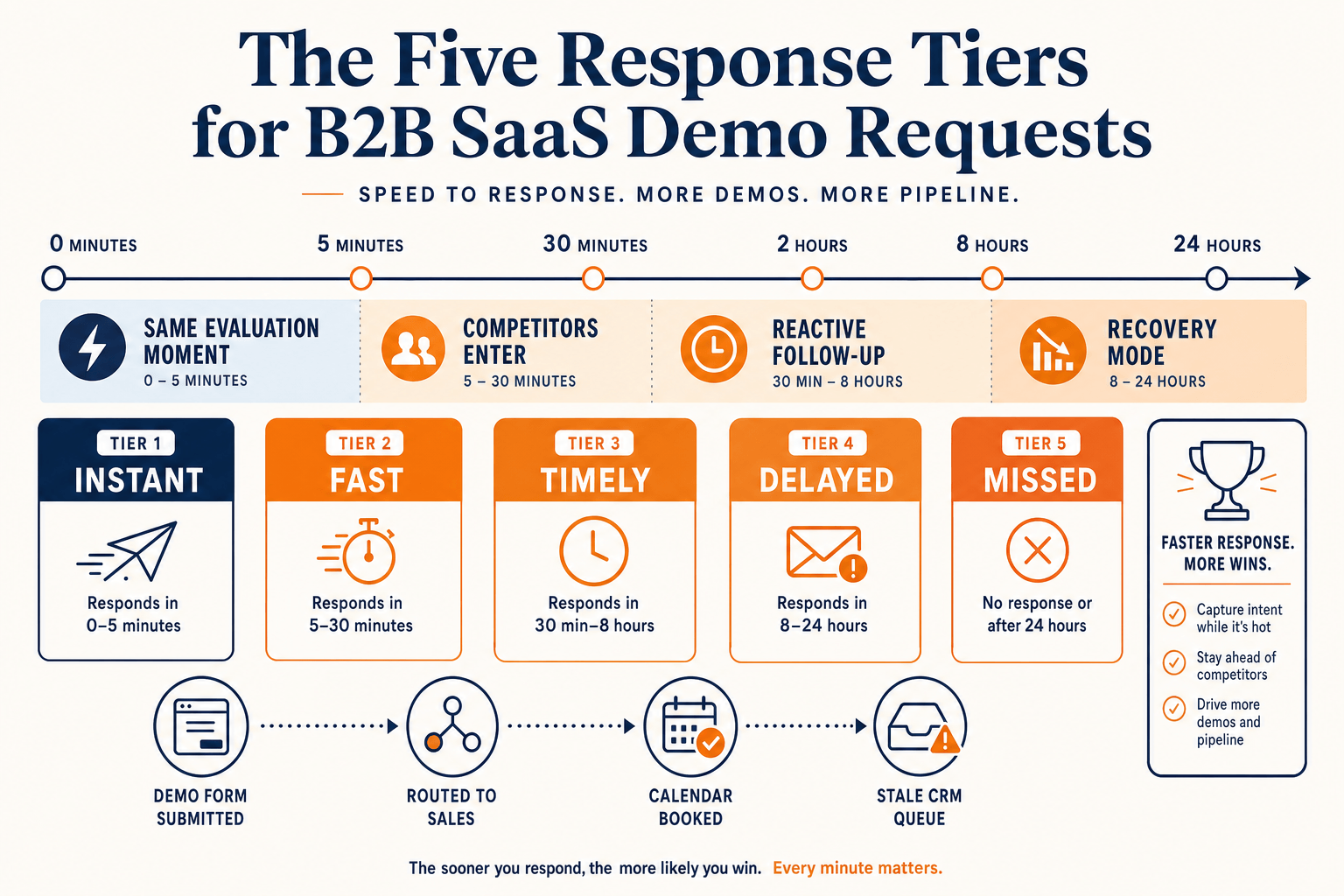
| Response tier | What it means operationally |
|---|---|
| Under 5 minutes | Buyer is still in the same evaluation moment |
| 5 to 30 minutes | Still alive, but competitor exposure has started |
| 30 minutes to 1 hour | The lead may already be talking to someone else |
| 1 to 24 hours | Follow-up feels reactive, not responsive |
| 24+ hours | You are often trying to recover a buyer who has moved on |
For B2B SaaS, the fastest practical target is not always a live human conversation in 60 seconds. It might be instant qualification plus a booked meeting with the correct owner. It might be a routed Slack alert with context and a rep call inside five minutes. It might be a product-qualified lead path that sends an implementation checklist instead of forcing a demo.
But the first useful action has to happen now.
The old studies still matter because the curve has not changed
The classic research is old, but the curve is still the same.
Harvard Business Review's 2011 article, The Short Life of Online Sales Leads, came from James Oldroyd, Kristina McElheran, and David Elkington. The public HBR page is thin now, but the Harvard Business School citation confirms the article and authors, and archived copies include the key audit details: 2,241 U.S. companies, average response time of 42 hours among responders, and 23 percent never responding to the test lead at all.
The same article also summarized a larger lead dataset: 1.25 million sales leads across 29 B2C and 13 B2B companies. Firms that contacted a lead within one hour were nearly seven times as likely to qualify the lead as firms that waited even one hour longer, and more than 60 times as likely as firms that waited 24 hours or longer.
Then the InsideSales.com / MIT Lead Response Management Study sliced the timing more tightly. It examined more than 15,000 web leads and over 100,000 call attempts, then found the famous five-minute cliff: calling in five minutes versus 30 minutes made contact odds 100 times higher and qualification odds 21 times higher.
Do not overfit those numbers. The MIT study was about first call attempts on web-generated leads, not every modern SaaS motion. A product-led team, an enterprise ABM team, and a founder-led SaaS business will not all see the same multiplier.
But do not ignore the pattern either.
Every version of the research says the same thing:
| Source pattern | What it teaches |
|---|---|
| HBR one-hour comparison | Waiting hours collapses qualification odds |
| MIT five-minute comparison | The first half hour is disproportionately valuable |
| 2026 benchmark reports | Most teams still do not hit the fast window |
| SaaS routing tools | The market exists because manual handoff is too slow |
The surprising part is not that fast response works. The surprising part is that so many teams still run a slow process around an obviously time-sensitive signal.
SaaS teams leak differently from service businesses
Service businesses lose leads in Instagram DMs, WhatsApp chats, missed calls, and quote forms. SaaS teams usually leak in a cleaner, more deceptive way.
The SaaS leak looks professional.
A buyer fills out a demo form. The CRM creates a lead. Enrichment runs. Ownership rules fire. Maybe a notification goes to Slack. An SDR receives an email. The rep checks later. A calendar link gets sent. The buyer books for tomorrow, or does not book at all.
Nothing looks broken.
That is the problem.
The system created a record, but it did not create momentum.
Here is the B2B SaaS version of the leak:
| Step | What the team thinks happened | What the buyer experienced |
|---|---|---|
| Demo form submitted | "Lead captured" | "I raised my hand" |
| CRM lead created | "Ops worked" | n/a |
| Rep assigned | "Routing worked" | n/a |
| Email sent later | "Follow-up started" | "They finally replied" |
| Calendar link sent | "Next step offered" | "Another task for me" |
The buyer never cared that the record was created correctly. They cared whether the next step appeared while they were still evaluating.
This is why B2B SaaS speed-to-lead should not be measured as "time to first email." That metric is too easy to game. A generic auto-email can fire in one second and still leave the buyer untouched.
The useful SaaS metric is time to first qualified next step.
That next step might be:
- A booked demo with the right account owner.
- A live call offer if the buyer is high-intent.
- A qualification question that captures use case, team size, urgency, and stack.
- A product walkthrough path for low-touch buyers.
- A routed internal alert with enough context for a rep to call intelligently.
That is the difference between an autoresponder and a speed-to-lead system.
The 2026 scorecard I would use
If I were auditing a B2B SaaS inbound motion, I would not start with conversion rate. I would start with timestamps.
The scorecard is simple:
| Metric | Good | Great | Why it matters |
|---|---|---|---|
| Time to record creation | Under 10 seconds | Under 3 seconds | Confirms capture is not delayed |
| Time to routing decision | Under 60 seconds | Under 10 seconds | Removes manual assignment |
| Time to first useful buyer action | Under 5 minutes | Under 60 seconds | Keeps buyer in context |
| Time to booked meeting for qualified demo requests | Under 10 minutes | Same session | Converts intent before it cools |
| Time to human owner visibility | Under 2 minutes | Under 30 seconds | Lets reps act with context |
| Percentage of leads with no response | Under 5% | 0% | No paid demand should disappear |
Notice what is missing: "time to first automated email."
That metric can be useful as a diagnostic, but it is not the business outcome. If the first email says "someone from our team will reach out shortly," the system has done almost nothing. It acknowledged the buyer without advancing the buyer.
For SaaS, the scorecard should split leads by intent:
| Lead type | Target path |
|---|---|
| Demo request | Instant qualify, route, book |
| Pricing request | Route to owner or show relevant package logic |
| Contact sales | Ask one qualifying question and offer meeting |
| Content download | Score and nurture unless firmographic fit is strong |
| Product signup | Trigger product-qualified path based on activation behavior |
| Existing account inquiry | Route by ownership, not round robin |
Most teams treat all of these as "new leads." That is why routing gets slow and follow-up gets generic.
Why "more SDR discipline" is the wrong fix
When a founder sees slow response time, the first instinct is to ask reps to move faster.
That works for about a week.
Then the real bottlenecks return:
- The lead landed in the wrong queue.
- The owner assignment depends on someone checking a view.
- The enrichment step failed silently.
- The territory logic needs a human exception.
- The lead score updates after the rep has already ignored the record.
- The calendar handoff adds another email loop.
- The rep is on another call when the hottest lead arrives.
None of those are solved by telling people to care more.
The correct fix is a sales operating layer around the inbound signal. This is where tools like Chili Piper's inbound scheduling product are directionally right: qualify, route, and book in seconds, directly after the form submission. I do not care whether a team uses Chili Piper, native HubSpot workflows, Salesforce routing, a custom n8n layer, or something else. I care that the buyer does not fall into a passive queue.
For smaller SaaS teams, the stack can be lightweight:
- Capture the lead and source context immediately.
- Enrich only the fields that affect routing.
- Decide the path: book, qualify, route, nurture, or suppress.
- Show the buyer the next action while they are still on the page.
- Notify the human owner with the exact context, not just "new lead."
- Start recovery if the buyer does not book or reply.
That is the same principle behind automated lead routing: speed only matters if the handoff includes context.
The small-team version: sub-5-minute without hiring SDRs
A founder-led or small SaaS team does not need to copy enterprise RevOps.
You need a minimum viable speed-to-lead system.
Here is the version I would build first:
| Layer | Minimum viable setup |
|---|---|
| Capture | Form submission writes to CRM and webhook endpoint at the same time |
| Classification | Rules or AI classify demo, pricing, support, partner, spam |
| Qualification | Ask one missing question or infer from form fields |
| Routing | Assign owner by ICP, geography, account ownership, or product line |
| Booking | Qualified demo request sees a calendar immediately |
| Alerting | Owner gets Slack, email, or SMS with context |
| Recovery | No booking or reply triggers a short multi-touch sequence |
The first version does not need to be clever. It needs to be fast and observable.
If the buyer is qualified, do not send "we will be in touch." Show the calendar.
If the buyer is not qualified yet, do not dump them into nurture. Ask one question.
If the buyer is already an account, do not round robin them. Route by ownership.
If the buyer does not book, do not wait three days. Send a context-aware follow-up while the original intent is still recent.
This is where a lot of "AI SDR" products miss the point. The problem is not sending more outbound-looking messages. The problem is making the inbound path behave like infrastructure. I wrote about that distinction in why AI SDRs fail service businesses, and the same principle applies to SaaS: inbound needs orchestration, not spray.
The copy problem hiding inside the ops problem
There is one more leak that does not show up in response-time dashboards.
The buyer's query and your page promise often do not match.
In Search Console, a query like "first response time benchmark b2b saas" is not asking for a generic lead response article. It is asking for a benchmark. A query like "automated lead routing and validation using ai" is not asking for a CRM feature page. It is asking whether routing and qualification can happen together.
That is why the content and ops work have to move together.
If a page ranks for "automated lead routing," the page should explain routing in terms of speed, validation, ownership, and handoff. If a page ranks for "availability checker," the page should say "availability checker," "availability tracker," and "availability scheduler" in the places Google and humans scan first.
The same principle applies to SaaS demo flows:
| Buyer phrase | System should answer |
|---|---|
| "Book a demo" | Can I get on the right calendar now? |
| "Pricing" | Am I a fit for the plan or package? |
| "Integrations" | Does this work with my stack? |
| "Implementation" | How hard is this to deploy? |
| "Security" | Can I safely evaluate this internally? |
Speed without message match still feels generic. Message match without speed still loses attention.
The best inbound systems do both.
A practical 30-day benchmark plan
If your team wants to improve this without turning it into a six-month RevOps project, run a 30-day benchmark sprint.
Week 1: instrument the current state.
Pull the last 90 days of form submissions. For each lead, calculate created time, first sales activity time, first human reply time, meeting booked time, and owner assigned time. Split by demo, pricing, content, product signup, and contact sales.
Week 2: remove the biggest passive queue.
Do not redesign everything. Find the biggest gap. If owner assignment takes two hours, fix routing. If booking requires three emails, fix scheduling. If reps miss alerts, change the alert. If qualified leads go to the wrong team, fix qualification.
Week 3: add one qualified next step.
For the highest-intent path, build an immediate next action. Demo request gets a calendar. Pricing request gets a route plus one question. Product signup gets activation-based owner alert. Do one path well before touching the rest.
Week 4: measure again.
You should be able to see the improvement in minutes, not vibes:
- Median time to first useful buyer action.
- P90 time to owner visibility.
- Meeting-booked rate from qualified demo requests.
- No-response percentage.
- Number of leads requiring manual triage.
If the system works, expand it to the next lead type. If it does not, the timestamp data will tell you where it broke.
FAQ
What is a good B2B SaaS lead response time in 2026?
For high-intent demo and pricing requests, under five minutes is the practical benchmark. Under 60 seconds is best-in-class when the first action is useful, such as qualification, booking, or routing with context. For lower-intent content downloads, the acceptable window is longer, but the system should still classify and route them immediately.
Is the 47-hour benchmark reliable?
Treat it as directional because it comes from vendor benchmark research. The exact number will vary by sample and methodology. The pattern is consistent with older HBR, MIT, InsideSales, and Drift-era findings: many B2B teams respond far too slowly, and fast responders create a large advantage.
Does an automated email count as lead response?
Only if it advances the buyer. "Thanks, we will be in touch" does not count as a useful response. A response that books a meeting, asks a qualifying question, sends a relevant next step, or routes the buyer to the correct owner is much stronger.
Should every SaaS lead get a live call in five minutes?
No. The response should match intent. A demo request may deserve instant booking or a call. A content download may deserve scoring and nurture. A support request should route away from sales. The benchmark is not "call everyone." It is "move the buyer to the right next step without delay."
What is the first thing to fix if response time is slow?
Find the passive queue. In most teams it is manual assignment, rep email checking, weak routing rules, or calendar back-and-forth. Fix the biggest timestamp gap first. Do not start by buying a broad platform if the real problem is one broken handoff.
How does this connect to automated lead routing?
Automated lead routing is the operating layer that turns a captured lead into an owned next step. The useful version does not just assign a rep. It validates fit, adds context, routes by real logic, and triggers booking or follow-up.
The bottom line
B2B SaaS lead response benchmarks are not interesting because the average is bad. They are interesting because the gap is so easy to see. If your team takes hours and a competitor responds with a qualified next step in minutes, the buyer feels the difference before they ever evaluates features.
- Use five minutes as the minimum benchmark for high-intent demo and pricing requests.
- Measure time to first qualified next step, not just time to first automated email.
- Split lead types before routing them. Demo, pricing, signup, support, and content leads need different paths.
- Fix the passive queue first: assignment, alerts, enrichment, calendar booking, or recovery.
- Treat speed-to-lead as inbound sales infrastructure, not a rep motivation problem.
FusionSync builds this kind of speed-to-lead system as a working inbound operating layer: capture, qualification, routing, CRM sync, closer-ready handoff, and recovery. If you want to see where your current inbound path leaks, start with a free AI audit or bring one live campaign into a free 7-day pilot.
AI-native business systems
Bring a niche, or bring a workflow.
If you run the business, we build the system around it. If you sell into a niche, we build the system behind your offer.
PolarBuild case study →You sell the niche. We build the system.
We never compete for your end clients. One partnership conversation. You fulfil the same system across the accounts in your niche.
Free POC before dedicated software
A three-day sales demo of the system for your vertical before any large software investment. Implementation starts only when someone in that niche pays.
Replicate the niche, not a one-off build
UK dental becomes US dental with a new local partner and new integration targets. Same system thesis, new market.