
Company Notes
Why AI SDRs Fail and What Service Businesses Need Instead

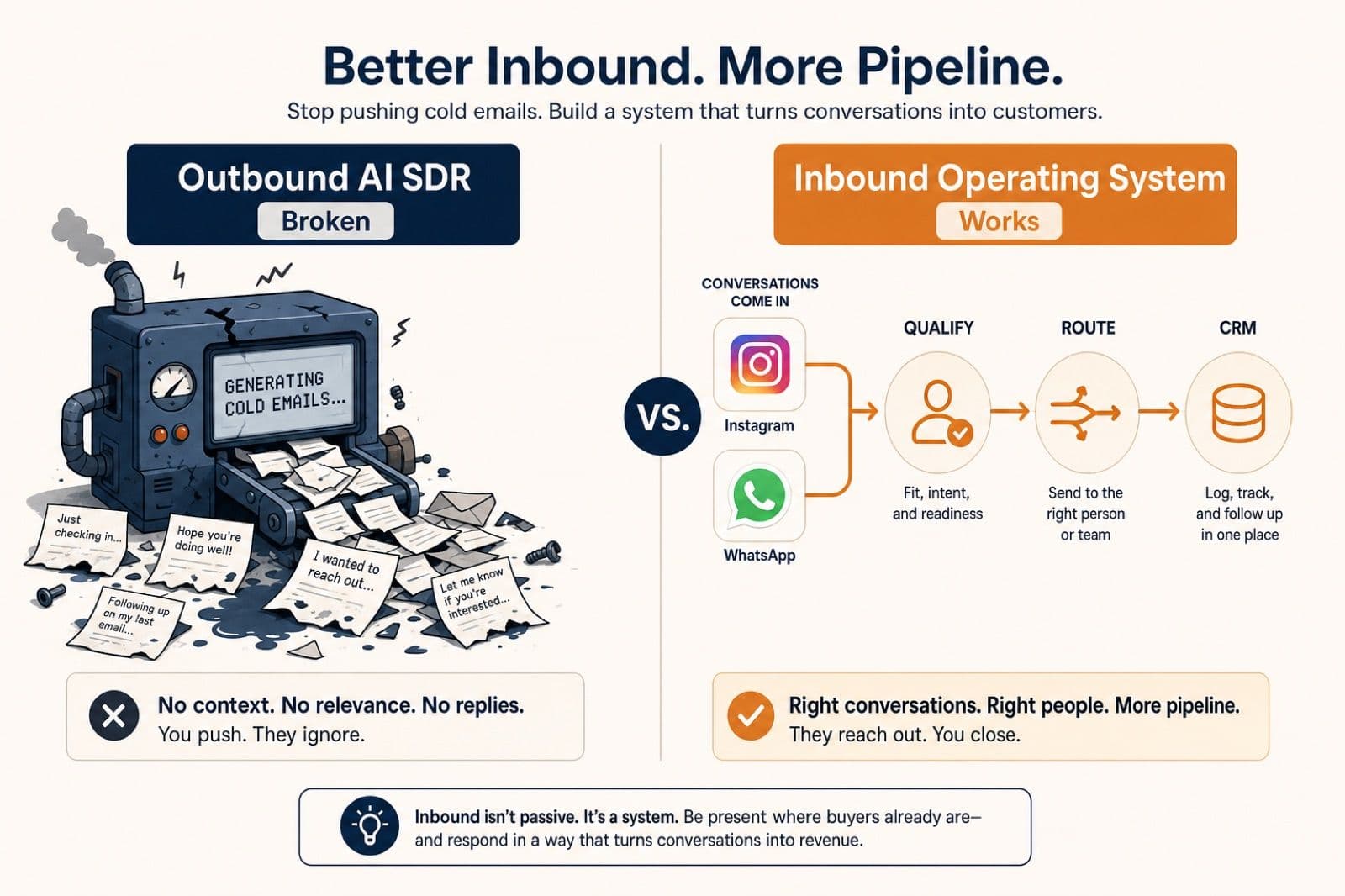
11x lost 70% of customers. Artisan got LinkedIn-banned. The AI SDR category is breaking. Here is what service businesses should run instead.
The AI SDR category is collapsing in public
I have been watching this car crash in slow motion for about eighteen months.
The short version, since most of it is now on the public record: 11x.ai lost an estimated 70 to 80 percent of its customers within months of signing them, after raising $74M at a $350M valuation. The same investigation found 11x had claimed $14M in ARR while the actual figure was closer to $3M, with ZoomInfo publicly stating that 11x had performed worse than its own SDR team and Airtable confirming it was never a customer at all.
Artisan, the other category darling that ran "Stop hiring humans" billboards across San Francisco, did not get off lighter. LinkedIn briefly suspended the company page and started rate-limiting Ava-driven activity in late 2025 into Q1 2026. The product sits at 3.8 out of 5 on G2 as of early 2026, the lowest score in the audited category.
This is not a single-vendor problem. The cancellation rate across managed AI SDR contracts now sits around 50 to 70 percent inside 90 days. UserGems reports AI SDR tool churn at roughly double the turnover rate of the human SDRs the tools were supposed to replace. The category that looked like a winner-take-most race in Q1 2025 has become a public procurement escape exercise.
I am writing this as someone who builds inbound sales infrastructure for service businesses, not as a hot-take account. The lesson the B2B SaaS world is learning right now does not apply to service businesses the way most of those vendors are pitching it. And the wrong lesson is the one most owners will absorb if no one says it out loud.
What actually broke inside the AI SDR architecture
There are three failure modes underneath the headlines, and they reinforce each other.
1. The data layer was the product, but no one priced it that way
Every monolithic AI SDR is a thin LLM wrapper around a third-party data layer like Apollo, ZoomInfo, or PDL. The model writes a great email personalized around stale data. The email still fails. The model gets blamed. The vendor gets churned. The data layer never gets audited.
That is the structural mechanic the Explorium piece captures cleanly: 11x's customers measured actual pipeline metrics 90 days into deployment and found the production behavior did not match the demo. The demos ran on curated lists. The production runs hit real CRM messiness, which is where signals get stale, match accuracy drops, and personalization turns into "I noticed you recently raised a Series" sent to companies that closed two years ago.
2. The monolith trying to do six jobs at once
A single agent trying to handle prospecting, research, personalization, outreach, deliverability, and reply handling all at the same time loses to a $300 a month multi-agent stack that does each piece narrowly. That is not my opinion. That is what the post-mortem on the monolithic AI SDR collapse documents. A founder-with-Clay setup is now outperforming a $74M-funded autonomous agent on real pipeline because it treats AI as specialized labor inside a human-orchestrated workflow.
3. Deliverability collapse caps about half of all deployments
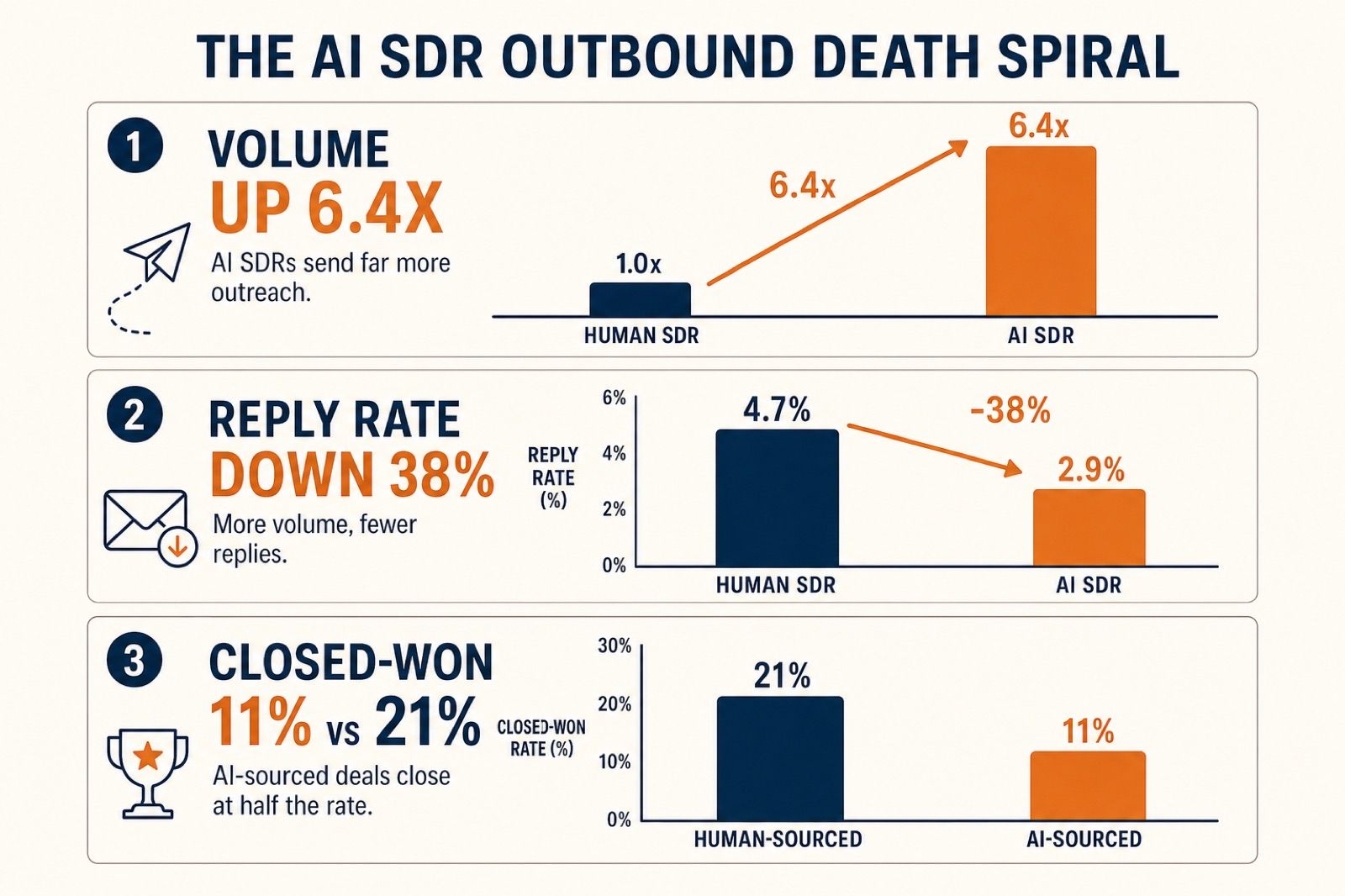
The math is brutal once you look at it. Per-rep monthly outbound volume jumped from a 1,150 human baseline to a 7,400 AI-augmented mean across the industry, but raw reply rates fell from 4.7 percent to 2.9 percent in the same window, according to aggregated 2026 outbound benchmarks. The volume goes up 6.4x. The reply rate falls 38 percent. The closed-won conversion rate on AI-sourced opportunities sits at roughly 11 percent versus 21 percent for human-sourced ones.
In plain language: more messages, fewer replies, worse quality on the replies you do get, and 47 percent of programs hit a deliverability wall inside the first 90 days that they cannot dig out of without burning the sending domain.
Service businesses were never the target of any of this
Here is the part that almost no one writing about the AI SDR collapse will say out loud.
The entire AI SDR pitch was built for one specific motion: outbound prospecting into B2B SaaS or B2B services accounts with named decision-makers, predictable enterprise titles, and multi-stakeholder enterprise sales cycles. ICP lists. Account scoring. Cold sequences. Open-track, click-track, reply-track. Account-based outreach across email and LinkedIn into companies of 50 to 5,000 employees.
That is a real motion. It is just not the motion service businesses run.
A wedding planner does not run cold outbound into a 5,000-employee ICP list. An events company does not sequence VPs of Marketing across LinkedIn. A boutique gym, an interior designer, a clinic, a tutoring service, a venue, an experience brand: none of them have the prospect-list problem the AI SDR was built to solve. They have the opposite problem.
The customer is already coming to them. They are sending Instagram DMs at 11pm on a Saturday. They are replying to a Click-to-WhatsApp ad with "is this still available." They are filling out a contact form and then disappearing because no one followed up for ninety minutes.
The "SDR job" service businesses actually need is not prospecting. It is inbound qualification at speed. That is a different unit of work, with different success metrics, and it requires a fundamentally different product.
Outbound AI SDR vs Inbound Operating System: the two are not the same product
I keep seeing service-business owners pitched on AI SDR tools because the vendors need new TAM and the consultancies need a story to retell. The pitch is dishonest by accident. The two products do not solve the same problem, do not measure the same way, and do not even live in the same software category. They share the letters "AI SDR" and almost nothing else.
| Dimension | Outbound AI SDR (11x, Artisan, AiSDR, etc.) | Inbound Operating System (what service businesses need) |
|---|---|---|
| Where the lead comes from | Cold list, third-party enrichment | Instagram DM, WhatsApp, ad form, website chat |
| Primary action | Send first message | Respond to first message in seconds |
| Success metric | Reply rate, meetings booked from cold | Time-to-first-reply, qualification rate, booking rate |
| Channel | Cold email, LinkedIn, sometimes phone | Instagram, WhatsApp, SMS, website chat, voice callback |
| Tone | Slightly pushy, "personalised" intro | Conversational, in-channel, customer-led |
| Failure mode | Domain blacklist, generic copy at volume | Missed reply, slow handoff, broken CRM sync |
| Who pays the cost of failure | Sender reputation, target list freshness | Lost booking, no recovery, dead deal |
| Buyer of the tool | VP Sales, RevOps lead, B2B SaaS | Owner, ops lead, service business founder |
When you put it like that, the question "should I buy an AI SDR" stops being interesting. The honest answer is: not the kind that 11x, Artisan, and the rest are selling. You need a different thing, and most of the vendors in this space cannot build it because their architecture was never designed to.
If you want to read more about why AI for inbound is a fundamentally different architecture from AI for outbound, I broke that down separately. It is the post that ends up doing most of the heavy lifting in conversations with founders who are mid-evaluation on the wrong category.
What service businesses should install instead
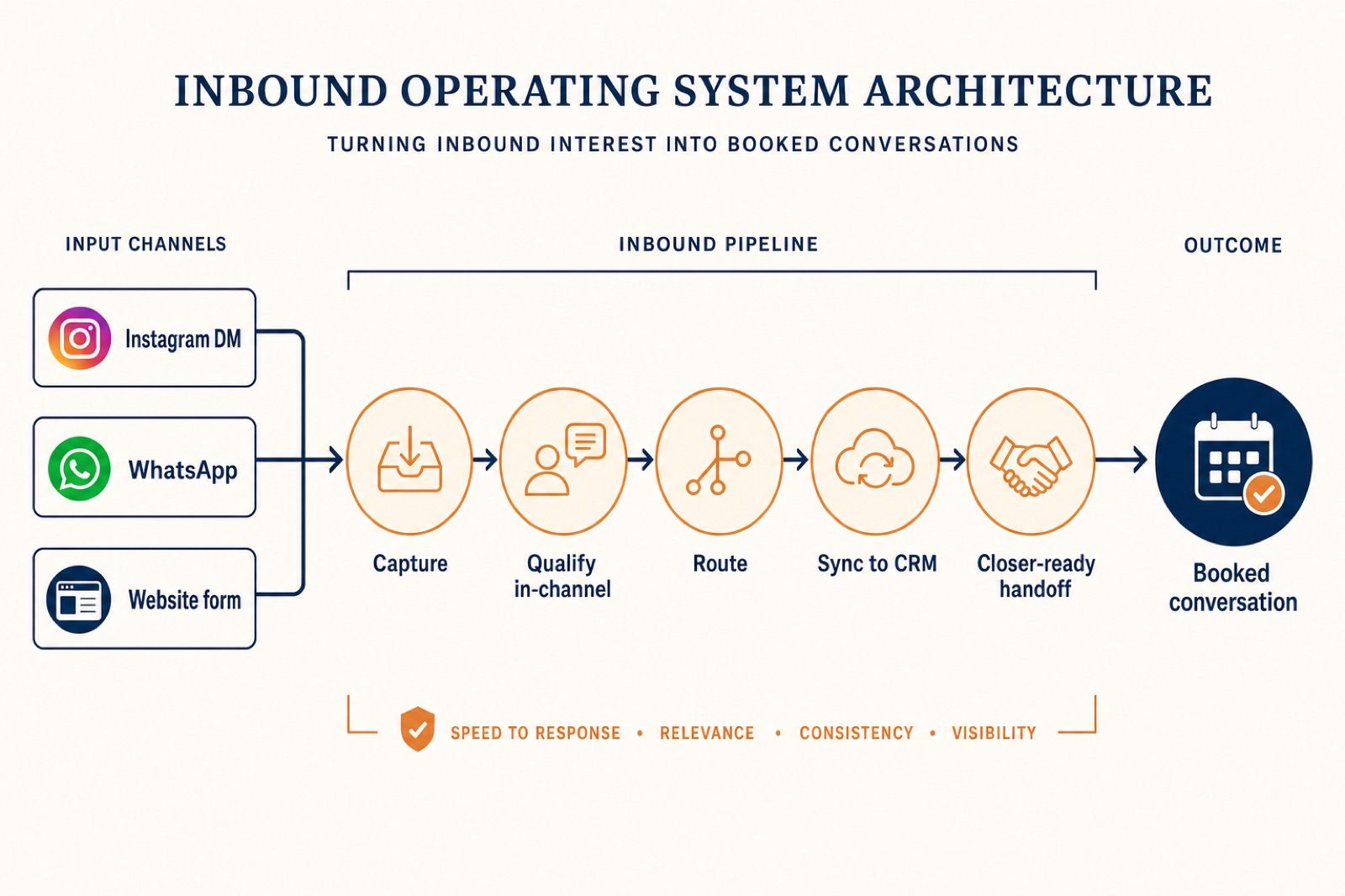
The model that works is not a "smarter SDR." It is an inbound operating system that takes the conversation a customer has already started and walks it through capture, qualification, routing, CRM sync, and a closer-ready handoff. The unit of work is the inbound thread, not the cold sequence.
Here is the operational shape, in five pieces.
1. Capture every inbound thread, not most of them
Most service businesses lose 30 to 50 percent of leads before any human touches them. DMs disappear under volume on Saturday nights. Click-to-WhatsApp ads route into a personal phone where messages stack up. Contact forms fire into an inbox that does not get checked until Monday. The first job of the operating system is to capture all of it into one place, in real time, with the original context attached.
2. Qualify in-channel, in the customer's voice
You do not need an AI cold-emailer for this. You need an AI that can ask three to five structured questions inside the same DM or WhatsApp thread the customer started, tag the answers, and decide whether this person is hot, warm, or noise. Speed matters: responding inside the first sixty seconds is a different conversion regime from responding in an hour, even at high volume.
3. Route hot leads to a human, route the rest into nurture
The closer never sees noise. They see leads that have already been qualified, tagged, and routed with the original thread attached. The rest go into a structured nurture path with periodic re-qualification, not into a junk folder where they slowly die.
4. Sync everything to the CRM as it happens, not as a batch job
The reason most service-business CRMs are useless is that they are out of date. Conversations live in WhatsApp. Bookings live in Cal.com or a calendar. The CRM is a graveyard of stale form submissions. An inbound OS writes back to the CRM in real time so the rest of the operation can act on truth, not on a 24-hour-old snapshot.
5. Hand off "closer-ready" conversations, not raw leads
The thing a service-business closer actually wants is not a lead. It is a conversation with context: who the customer is, what they want, when they want it, what they have already been told, and where they are stuck. That is a handoff, not a lead drop. The whole point of the inbound OS is to produce closer-ready conversations, not "interested" tags.
You can read the operational map for this in two adjacent places: the diagnostic for where inbound bookings actually die, and the inbound operating system playbook itself. I will not retell either one here.
What I would not do
The thing service-business owners get wrong most often is buying the wrong category because the marketing is louder. A short list of things I would not do in 2026:
- Buy an outbound AI SDR seat to "handle" your inbound. The product is not designed for inbound, the deliverability cost is real, and you will burn a domain or a personal phone number quickly.
- Buy a chatbot widget that lives on your website and not on Instagram or WhatsApp. The customer is on the channel they messaged you on. Forcing them onto your website is a friction tax.
- Pay an agency a retainer to "set up the AI." If you cannot see the system running on your account inside a week, you are paying for a slide deck.
- Run a 30-day pilot without an explicit kill switch. If it does not work, stop. The vendors that survived the AI SDR collapse are the ones who made stopping easy, per the AmpleMarket category audit and the Astra GTM reality check. Take the same posture.
The benchmark to internalize is simple. Top-performing outbound campaigns hit 8 to 12 percent reply rates under Apollo's 2026 cold prospecting numbers. Service business inbound, run correctly, hits 40 to 70 percent qualification-to-booking rates because the customer raised their hand first. They are not the same game. Stop comparing.
FAQ
Are AI SDRs worth it in 2026?
For B2B SaaS teams running outbound prospecting, the answer is: maybe, but only as one specialized agent inside a hybrid pod where humans approve copy and own escalations. The fully autonomous "replace your SDR team" pitch has lost in production. For service businesses, the honest answer is: that is not the right product category for you. Look at inbound operating systems instead.
What is the difference between AI for outbound and AI for inbound?
Outbound AI writes and sends cold messages at scale. Its hard problems are list quality, deliverability, and personalization at volume. Inbound AI responds inside an existing customer-initiated thread. Its hard problems are speed, in-channel context, qualification accuracy, and routing to the right human. They look similar from a vendor pitch deck and behave nothing alike in production. We have a longer breakdown of AI for inbound lead response that goes into the architecture.
My agency is pitching me on an AI SDR tool. Should I buy?
Ask one question: where are the leads you would put into this tool coming from. If the answer is "a cold ICP list we built", you are looking at an outbound AI SDR and the AmpleMarket and Astra audits above are the honest reading list. If the answer is "Instagram, WhatsApp, our website, our ad forms", the agency is pitching you the wrong category. Do not buy out of FOMO from the B2B SaaS conversation.
Do you replace human salespeople?
No, and the vendors who did pitch that lost. An inbound operating system replaces the part of the sales motion that should never have been done by a human in the first place: missing the DM at 11pm, copy-pasting the same five qualifying questions for the hundredth time, retyping context between WhatsApp and the CRM. The human work is what humans were always good at: closing the booking, handling the messy outlier, judging when to call instead of typing.
What does the 7-day pilot look like?
We pick one campaign you already run, install the full inbound operating system around it, and run it live for seven days at no cost. After setup (usually four to seven days) the path is fully live: capture, qualify, route, CRM sync, closer handoff. You see the metrics. You decide on day seven whether to keep it. If it does not improve how leads are handled, we stop. There is no rebuild later if you continue. You keep the same system, on the same campaign, running.
How is this different from a chatbot?
A chatbot answers questions inside a single channel and rarely writes to a CRM in a meaningful way. An inbound operating system covers the whole path from "first message arrived" to "closer is in the conversation with full context." Different scope, different category. We deliberately avoid the chatbot framing because the comparison is not flattering to either side.
The bottom line
The public collapse of the monolithic AI SDR is real, but it is a B2B SaaS story. Service businesses were never the target of that product category and most of the lessons being absorbed right now are the wrong ones. Service business inbound is a different unit of work, with different metrics, and it needs an inbound operating system. Not a smarter cold-emailer.
- The AI SDR category lost 50 to 70 percent of customers inside 90 days on average, and the closed-won rate on AI-sourced opportunities sits about half of human-sourced. The data layer broke first, then the deliverability story collapsed.
- Service businesses do not run cold prospecting. The job is inbound qualification at speed across Instagram, WhatsApp, ads, and the website. That is not what 11x, Artisan, or AiSDR were built for.
- The replacement is an inbound operating system: capture every thread, qualify in-channel, route hot leads, sync the CRM live, hand off closer-ready conversations. Five pieces, one path.
- The benchmark to internalize is not "8 to 12 percent reply rate on cold." It is "40 to 70 percent qualification-to-booking rate on inbound", because the customer raised their hand first.
- Pilot the right category, not the loud one. If your leads come from Instagram and WhatsApp, your tool should live there too.
If you want to see this running on your own inbound, we run a free 7-day production pilot on one campaign you choose, or a free AI audit if you want the diagnosis without the build. Both start with a short call. The pilot is the right path if you have meaningful Instagram or WhatsApp inquiry volume and you are ready to see the system run live. The audit is the right path if you want us to map where leads are leaking first and decide later. Either way, the conversation starts in the same place: where does inbound actually break for you today.
AI-native business systems
Bring a niche, or bring a workflow.
If you run the business, we build the system around it. If you sell into a niche, we build the system behind your offer.
PolarBuild case study →You sell the niche. We build the system.
We never compete for your end clients. One partnership conversation. You fulfil the same system across the accounts in your niche.
Free POC before dedicated software
A three-day sales demo of the system for your vertical before any large software investment. Implementation starts only when someone in that niche pays.
Replicate the niche, not a one-off build
UK dental becomes US dental with a new local partner and new integration targets. Same system thesis, new market.