
AI Revenue Infrastructure
The Instagram DM Revenue Leak: Where Event Bookings Die

Updated
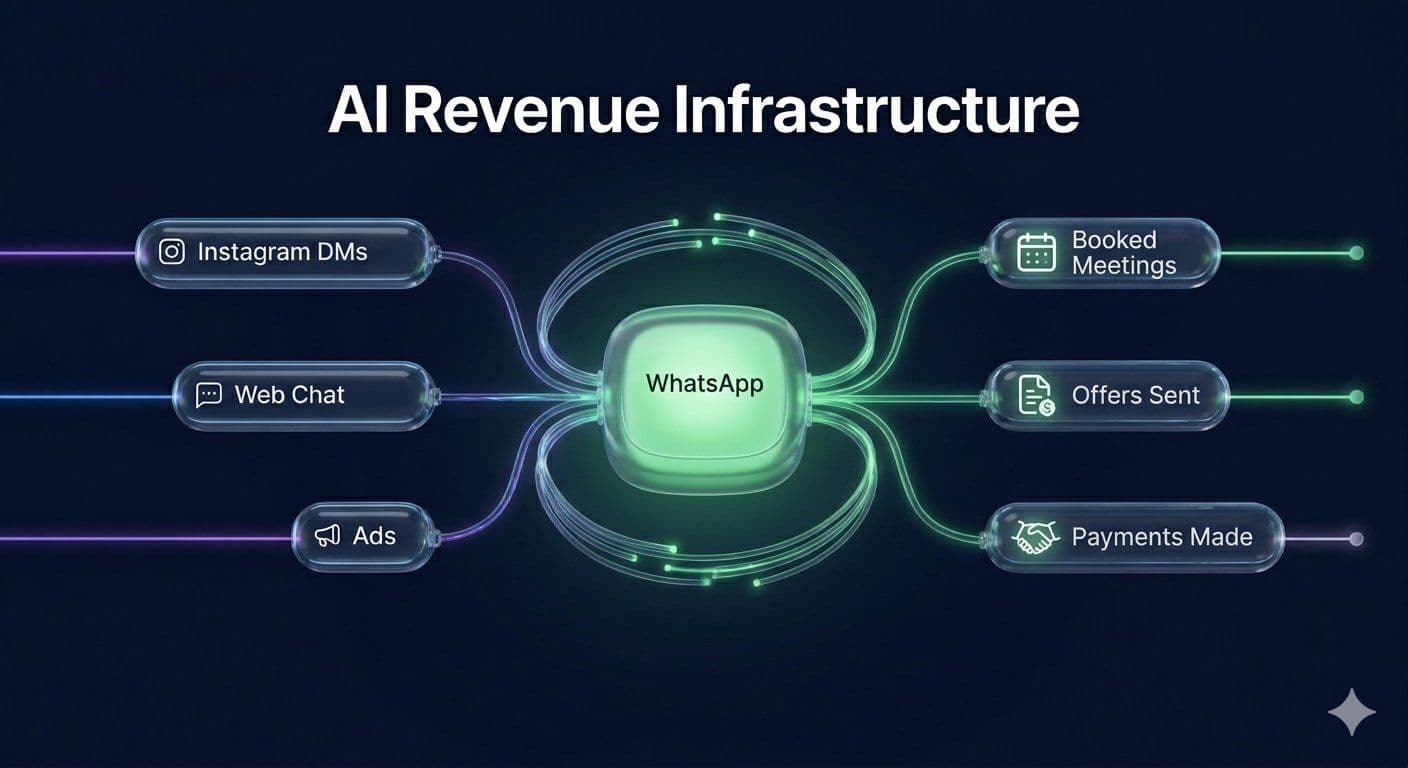
Your Instagram DMs are leaking revenue at five specific points. Here is the map of where bookings die and how to plug each leak.
The leak no one wants to name
Most event companies and SMBs running on Instagram do not have a marketing problem. They have a revenue leak problem. Marketing brings the lead. The leak is everything that happens between the DM landing and the closer picking up the deal.
The leaks are not random. They happen at five specific points. We have seen the same five at a Delhi event company doing 30 lakh weekend booking weeks, at a clinic running paid Reel ads, and at a mid-size mortgage broker in Australia. The exact same five points, with the exact same shape. This post is the map.
The five points
| # | Leak | Where it happens | What it costs |
|---|---|---|---|
| 1 | Missed DM hour | Saturday afternoon, your team is out | Hot leads go cold by Monday |
| 2 | Bot reply without qualification | First-reply auto-responder | Prospect drifts, stops replying |
| 3 | Disappearing comment intent | Reel comments with buying signals | Buying-intent followers never DM |
| 4 | Cold WhatsApp handoff | "Please share your number" message | Prospect re-explains everything, drops out |
| 5 | Late CRM sync | Lead enters CRM after the deal is dead | Reporting is wrong, attribution is wrong |
Below, what each one looks like in real life and how to plug it.
Leak 1: The missed DM hour
A Reel takes off Saturday afternoon. Forty DMs land in two hours. Your team is at a venue, in a car, eating dinner. By the time anyone opens the inbox on Sunday evening, the first DM was 30 hours ago. The prospect has already DMed three competitors. The fastest of them booked a discovery call.
This is the most expensive leak because it is the most invisible. You do not see it in reporting. The CRM does not know those 40 DMs ever existed. They just show up as missed bookings, vaguely, two weeks later when your closer asks where the leads went.
The fix
Capture every DM the instant it lands, not when a human opens the app. The Instagram OS does this with a webhook on the Instagram Graph API. The first reply is automatic. The qualification starts inside that first reply. The prospect feels seen at minute one, not at hour 30.
First reply latency on inbound DMs is the single metric most correlated with booking rate for inbound-heavy event companies. Sub-90 seconds is the threshold that matters.
Leak 2: Bot reply without qualification
This is the subtler version of leak 1. You did install a bot. The bot replies. But the reply is "Thanks for reaching out, our team will get back to you within 24 hours." That sentence has done more damage to inbound conversion than any other automated reply ever written.
The prospect reads it as "you are not important enough for a real answer". They DM your competitor. The bot did its job (it replied). The system did not (it did not qualify).
The fix
The first reply should ask the next-best question, not promise a follow-up. For an event company, the next-best question is almost always "what date are you looking at?" — because the prospect either has a date in mind (qualified) or they are a tire kicker. You learn that in one message. After the date, the next-best question is headcount. Then venue type. Three messages, three structured fields, one minute of conversation.
The bot has done useful work by minute two. The prospect feels like they are talking to a salesperson, not a queue ticket.
Leak 3: The disappearing comment intent
Half of your Reel viewers will not DM. They will comment. "Available on Dec 12?", "DM me prices", "interested 🙌". Those comments are gold. Most of them never make it into a conversation.
Why: the comments are buried among hundreds of compliments and emojis. Your team scrolls past them on Tuesday. Or the bot DMs everyone (including the compliments), gets rate-limited by Instagram, and now your account is flagged.
The fix
Treat comments as a separate intent surface from DMs. A small classifier labels each comment as buying_intent, question, compliment, or other. Only buying_intent gets a DM trigger. The trigger DM continues into the same qualification flow as a direct DM. The compliments stay as comments; you reply to those manually with care.
The result: every buying-intent comment becomes a qualified DM thread, and your IG account stays clean.
Leak 4: The cold WhatsApp handoff
Your bot does qualify. Great. Then it sends "share your number and our team will WhatsApp you." The prospect shares it. Two hours later your team WhatsApps them: "Hi, this is X from Company Y, can you tell me a bit about your event?"
The prospect has now told you the date, headcount, and venue type already. They are being asked to repeat. They drop out. Your CRM logs a "no response on WhatsApp" event. The leak is invisible because it looks like the lead lost interest. They did not. You asked them to start over.
The fix
State has to survive the handoff. The right pattern is a WhatsApp template message auto-sent the moment the conversation is closer-ready, containing the prospect's name, event date, headcount, and a one-tap button to continue. When they tap, the closer's WhatsApp thread opens with the full transcript pre-loaded. The closer says "Hey Priya, looks like Dec 12, 220 guests, outdoor mandap, is that right?" — not "tell me about your event".
That single change is worth more than any AI feature.
Leak 5: The late CRM sync
Your team works through DMs on Monday morning, sorts the good ones into a list, and on Tuesday afternoon the marketing manager updates the CRM. By then half the leads are dead and the other half are misattributed. You think the wedding-page ad performed badly, but actually it brought 8 of the 14 weekend leads; you just cannot tell because the source Reel ID was never written to the CRM at the right time.
The fix
Sync to the CRM at every conversational event, not at the end. New DM = lead created with source Reel ID. Qualifying answer = custom field updated. Label change = stage advanced. Handoff = activity logged with timestamp. The CRM becomes the source of truth at minute one, not at week three.
When you do this, your weekly numbers stop being a guess. You know which Reel converted, you know which ad budget was wasted, you know which closer is fastest on Monday morning. Reporting becomes a query, not an interpretation.
The leak in numbers
To make this concrete, here is what a typical Saturday looks like for an event company with each leak unfixed vs. plugged:
| Stage | Unfixed | Plugged with Instagram OS |
|---|---|---|
| DMs received Saturday | 40 | 40 |
| First reply within 5 min | 8 (only the ones the founder personally caught) | 40 |
| Qualified by Monday morning | 6 | 28 |
| Closer-ready handoff | 4 | 18 |
| Actually booked the next week | 1 | 4 to 6 |
The "actually booked" delta is the real number. Inbound infrastructure is the difference between one booking and five from the same weekend's traffic. The traffic is the same. The system is not.
Why "more leads" is the wrong goal
Founders ask us for more leads. The math almost never supports that as the first move. You already have leads. You are leaking them. Plugging the leak is cheaper than buying more traffic, and the conversion on the leads you already have is higher than the conversion on new cold traffic.
The order is: plug the leak first, then scale spend into the now-leakproof system. Scaling spend through a leaky pipeline just leaks faster.
What this is not
- It is not a chatbot pitch. A chatbot fixes leak 1 and maybe leak 2. It does nothing about 3, 4, or 5.
- It is not a CRM project. The CRM is downstream of the leak, not the cause.
- It is not "we will train your team to reply faster". A team cannot beat a webhook on speed at scale, and asking your team to be the patch is how teams burn out.
The order to fix them
If you can only fix one this quarter, fix leak 1: capture every DM with a real first reply inside 90 seconds. That single fix usually closes a third of the leak by itself.
If you can fix two, add leak 4: state-preserving handoff to WhatsApp. The closer's job gets twice as easy.
If you can fix all five, you have an inbound operating system. You stop dreading Saturday spikes and start counting them.
FAQ
How do I know which of the five leaks is costing me the most? Look at your inbox on a Monday morning. Count the unread DMs from the weekend. If the number is greater than zero, leak 1 is your biggest. If unread is zero but your closer is exhausted from re-extracting basic info on every call, leak 4 is your biggest. Both at once is normal.
Will my closers feel replaced? No. The system replaces the inbox triage they already hate. Closers still close. They just open WhatsApp threads that are already qualified, instead of cold DMs that need ten messages of warm-up.
Will Meta ban my Instagram account? The DM volume is the same as before; it is just answered faster. Bans usually come from unsolicited DM blasts to non-followers or from aggressive comment-to-DM with no intent gating. Both are explicitly avoided in the Instagram OS architecture.
Can I plug just one leak? Yes. Most pilots start with leaks 1 and 2 (capture + first qualifying reply) because they are highest impact. Leaks 3, 4, and 5 follow once the first two are stable.
What about WhatsApp-first prospects who never DM Instagram? The same pipeline serves WhatsApp inbound. The capture, qualify, route, sync loop is the same. The only thing that changes is the channel of the first message. See the WhatsApp side of the system for the WhatsApp-first version.
The bottom line
Five places where your Instagram inbox leaks revenue: the missed-DM hour, the bot reply that does not qualify, the disappearing comment intent, the cold WhatsApp handoff, and the CRM that learns about the lead two days late. Each leak has a specific fix. Plug them in order and your inbound week stops feeling like a Monday morning hangover.
- Five specific leak points: missed DM hour, unqualifying bot reply, ignored comment intent, cold handoff, late CRM sync.
- Plug them in order: 1, 2, 4, 3, 5. Speed first, qualification second, handoff third, intent gating fourth, CRM sync last.
- The right success metric is first reply latency, not "more leads".
- An inbound operating system plugs all five at once. Manual fixes plug one at a time.
If your inbox looks like the unfixed column on a Monday morning, the next step is a 7-day production pilot on one campaign. Either you book more or you walk away.
White-label tech partner
Your agency has the clients. I have the tech layer.
You don't need to build a technical team before you can take on technical work. Whether you're an established agency or just getting started, I can provide the technical layer behind your delivery, from building the system to getting it into production.
PolarBuild case study →You only sell once
We never compete for your end clients. One partnership conversation. You fulfil for every account in your base.
Free POC before big builds
A three-day sales demo on the proven stack before any large software investment. You pitch to your prospects or existing clients. Implementation starts only when someone pays.
Geography replication
UK dental becomes US dental with a new local partner and new integration targets. Same playbook, new market.