
AI Revenue Infrastructure
Instagram OS: DM Automation and Lead Routing for Event Companies

Updated
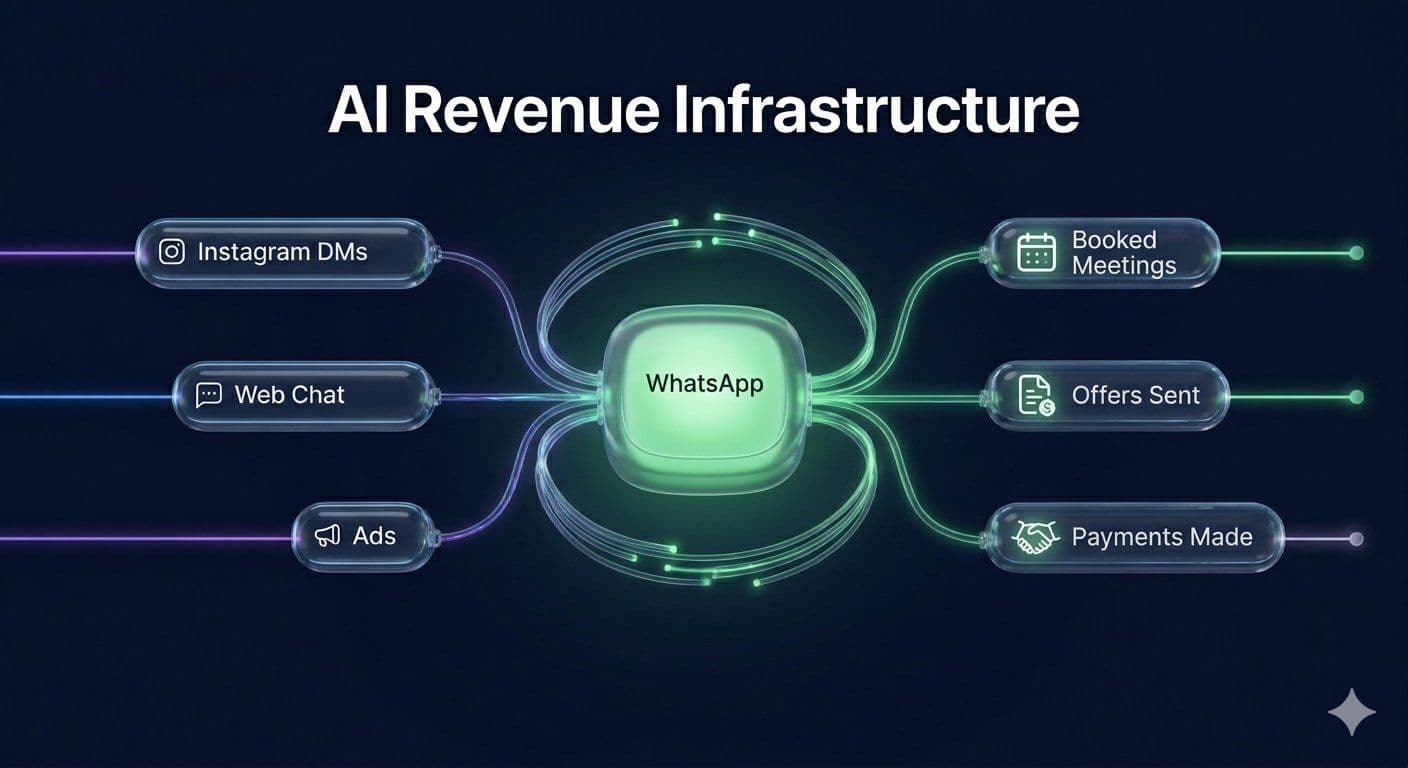
Instagram OS is the inbound layer that captures DMs, qualifies leads, and routes the hot ones to WhatsApp for event companies. Here is what is inside.
What "Instagram OS" actually means
The phrase comes from how we build it internally, not from a marketing slogan. We treat Instagram the same way an engineer treats a host operating system: it is a surface with APIs, rate limits, intent signals, and one job — accept inbound, route it, and pass state to the next process.
The next process is WhatsApp. That is the only message channel where event closers actually finish deals. So Instagram OS exists to bring DMs and comments out of the Instagram inbox and into a structured pipeline that ends in a closer-ready WhatsApp thread.
Concretely, Instagram OS is four things:
| Component | Job |
|---|---|
| Capture | Subscribe to Instagram DMs, story replies, and intent comments via the Graph API. |
| Qualify | Continue the same thread, extract date, headcount, venue type, budget, source. |
| Route | Decide what to do: hand off to a closer, nurture, or disqualify. |
| Sync | Write the conversation, labels, and lead status back to the CRM in real time. |
Most "Instagram automation" tools stop at capture and a single auto-reply. They do not understand the next three steps, which is exactly where event teams lose deals.
The five stages, in detail
1. Capture every DM and intent comment
DMs are obvious. Comments are not, but they should be. When a follower drops "interested" or "DM me price" under a Reel, that is a buying signal you have to grab before they scroll away. We use comment intent classification (a small model, not a giant one) to decide whether to send a DM trigger. The classifier is intentionally narrow: it labels each comment as buying_intent, question, compliment, or other. Only buying_intent triggers a DM.
That distinction matters. If you DM everyone who comments "love this", Instagram will rate-limit your account. The OS protects the IG account from itself.
For the platform side this leans on the Instagram Graph API and Meta's Messenger Platform webhook events.
2. Qualify in-thread, not in a separate form
The single biggest failure mode of off-the-shelf bots is shipping the prospect to a Google Form or Calendly link before they have agreed to give you their time. They will not click. Instead, the qualifier asks the next-best question inside the same DM thread:
- "Quick check, what date are you looking at?"
- "Got it, roughly how many guests?"
- "Outdoor mandap, indoor banquet, or something else?"
One question per reply. The qualifier carries memory of what has been asked, so nothing is repeated. The conversation does not feel like a form; it feels like a salesperson is asking the same questions they would ask on a call.
3. Route based on a ruleset, not a vibe
After enough signals are extracted, the OS decides. The ruleset for an event company looks something like this:
The closer never sees a disqualified or under-nurtured thread. That is the whole point of the routing layer: protect the closer's time.
4. Hand off to WhatsApp with state intact
Instagram is where the lead arrived. WhatsApp is where the deal closes. The hand-off has to carry the thread state, otherwise your prospect feels like they are starting over and your team has to re-extract the same five fields.
We do this with a single WhatsApp template message containing the prospect's name, event date, headcount, source Reel or ad ID, and a one-tap "continue here" link. Once they tap, the WhatsApp Business Cloud API thread takes over and the closer picks up with full context. For event teams already on Twilio, the cleanest path is the Twilio + WhatsApp Cloud API verification flow.
The state transfer is the part that separates this from "we will WhatsApp you". A "we will WhatsApp you" promise that arrives 30 minutes later, with no context, is worse than no message at all because it confirms your team is slow.
5. Sync to CRM in real time
Every event in the conversation lands in the CRM. Not at the end. Every step.
| Event | What gets written |
|---|---|
| New DM arrives | Lead created with source thread, Reel/ad ID, IG handle |
| Qualifying answer captured | Custom field updated with structured value |
| Label changes to closer-ready | Lead stage moves, closer is notified |
| Handoff WhatsApp template sent | Activity logged with template ID and timestamp |
| Closer continues thread | Last touch updated; conversation transcript linked |
If the conversation pauses mid-qualification, the half-filled lead is still in the CRM. A human can pick it up. The system never holds state hostage.
Why this beats Manychat-class tools for event companies
Manychat, ChatRace, and the generic "AI chatbot" category are built for support and one-off lead capture. They are not built for the concurrency profile of an event company:
| Failure mode | Manychat-class tool | Instagram OS |
|---|---|---|
| 40 DMs in 2 hours | Replies arrive late, queue stalls | Designed for spikes, every DM gets a sub-90-second reply |
| Comment intent | Treats every comment the same | Classifies first, only DMs buying intent |
| In-thread qualification | Tree of pre-canned replies | Single question per turn, structured fields, real memory |
| IG to WhatsApp handoff | Resets the conversation | Templated handoff with state |
| CRM | Zap that fires at the end | Real-time writes at every stage |
| Account safety | High risk of IG rate limiting | Built-in throttling and comment intent gating |
Cheap tools optimise for "first reply". An event company is judged on "first qualified handoff". Different problem, different system.
The qualification ruleset is the actual IP
People focus on the AI. The AI is generic; the ruleset is what makes the system work for a specific business. For an event company, getting the ruleset right is two days of conversation with the founder and ops lead. We ask:
- What is your minimum bookable event size?
- Which venue types do you not service?
- What date lead time is hopeless? (e.g. "anything under 21 days for a 200-pax wedding is disqualified")
- Who is your closer and what do they refuse to take cold?
- Which sources convert and which are tire-kickers?
The answers turn into the JSON ruleset above. That ruleset is the source of truth for closer-ready. It evolves as the business grows. The system without the ruleset is a chatbot.
What live numbers look like
On the event-company pilot setup we covered separately, the production Instagram OS surfaces three metrics that matter:
- First reply latency on a DM: consistently under 90 seconds, including on weekend spikes
- Time to closer-ready: under 5 minutes on average for high-intent threads
- Lead leakage on Monday morning: zero unread DMs from the weekend, every thread already labelled
These are not vanity metrics. First reply latency is what kills bookings; we measure it directly. Closer-ready time is what saves the closer's day; we measure it directly. Lead leakage is what keeps founders up; we eliminate it by design.
What this is not
A few things Instagram OS is deliberately not, so you can decide if you need it:
- It is not a generic "AI chatbot for any industry"
- It is not a Manychat replacement with a higher price tag
- It is not a chat widget you embed on a website
- It is not a CRM (it writes to one; it does not replace one)
- It is not magic. It is engineering plus a ruleset specific to your business.
If you have low enquiry volume, your team picks up DMs by hand, and Monday morning is not painful, you do not need this. If you watch Reels go viral and feel dread instead of pride, this is what fixes that.
FAQ
Is Instagram OS an app I install? No. It is an inbound system we install for you in your existing Meta Business Manager, Instagram account, WhatsApp Business account, and CRM. There is no separate app for your team.
Do I have to switch to a new CRM? No. Instagram OS writes to whatever CRM you use. We have built into GoHighLevel, HubSpot, Pipedrive, Airtable, and a few custom CRMs. As long as it has webhooks or a Zapier / n8n connection, the pipeline syncs.
Will Meta or Instagram ban my account? The biggest cause of bans is unsolicited DM blasts and aggressive comment-to-DM behaviour. The OS is built to avoid both: comment intent gating, throttling on burst sends, and template approval for WhatsApp. We have not had a client account flagged. We do not promise that a third-party tool from a different vendor will not get you flagged.
Can my team still use Instagram normally? Yes. The system runs in parallel with your team's normal Instagram use. Your team posts Reels, replies to friends and family, all as usual. The OS only handles the production lead surface.
Where does the AI come in? The qualifier uses a small model for in-thread conversation and another for comment intent classification. The routing and CRM sync are deterministic, not AI. The AI is the smallest, most replaceable part of the system; the infrastructure is the hard part.
How is this different from your other posts about Instagram DMs? The Instagram DM revenue leak post covers the problem framing. This post is the architecture. The inbound playbook is the broader operating model that ties Instagram, WhatsApp, CRM, and closer workflow together.
The bottom line
Instagram OS is the operating layer between an Instagram DM and a booked date. Capture every DM and intent-comment, qualify in the same thread, label the hot ones closer-ready, hand off to WhatsApp with full context, write everything back to the CRM. Not a chatbot. Not Manychat with a fresh coat of paint. A real inbound system designed for event companies that lose money when a Reel blows up on a Saturday afternoon.
- Instagram OS is the inbound layer that owns capture, qualification, routing, handoff, and CRM sync as one path.
- The win is not "smarter AI". It is preserving state across the IG-to-WhatsApp handoff and never losing a DM to Monday morning.
- The qualification ruleset is the business-specific IP; the engineering is the same across event companies.
- Closer-ready is a rule, not a vibe. Make it explicit so closers only see qualified threads.
- If a viral Reel currently means a dread spike for your team, you have outgrown chatbot tools.
If your inbound volume looks like this, the next step is a 7-day production pilot on one campaign. We install the full pipeline, you run a real week through it, and you walk away with either a working system or nothing committed.
White-label tech partner
Your agency has the clients. I have the tech layer.
You don't need to build a technical team before you can take on technical work. Whether you're an established agency or just getting started, I can provide the technical layer behind your delivery, from building the system to getting it into production.
PolarBuild case study →You only sell once
We never compete for your end clients. One partnership conversation. You fulfil for every account in your base.
Free POC before big builds
A three-day sales demo on the proven stack before any large software investment. You pitch to your prospects or existing clients. Implementation starts only when someone pays.
Geography replication
UK dental becomes US dental with a new local partner and new integration targets. Same playbook, new market.