
blog post
How Event Companies Convert WhatsApp Enquiries to Bookings

Updated
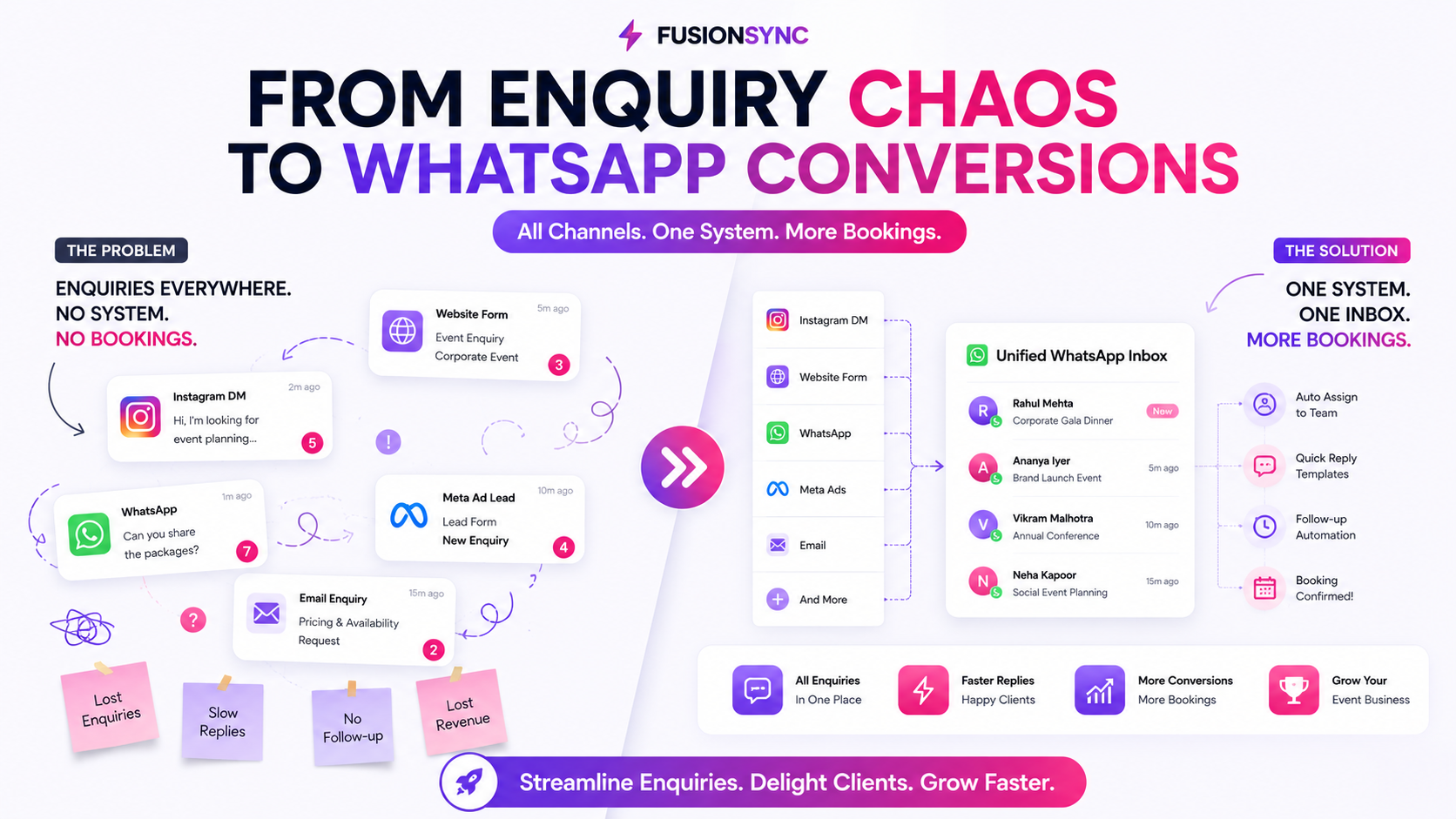
Event companies leak enquiries between Instagram, WhatsApp, and the CRM. Here is the inbound system that turns DMs into booked dates.
The shape of an inbound week for an event company
A working event business gets enquiries from three places at once:
| Source | Tone of message | Expected response time |
|---|---|---|
| Instagram DMs from Reels and Stories | Casual: "Hey is this date free?" | Under 5 minutes |
| WhatsApp from referrals and ad clicks | Slightly more formal, often with a phone number | Under 2 minutes |
| Website contact form | Structured but cold | Under 10 minutes |
The problem is not volume. The problem is concurrency. A Reel that takes off on a Saturday afternoon brings 40 DMs in two hours while your team is at a venue. By Monday morning the lead is cold and quietly shopping competitors. This is lead leakage, and one missed DM for a high-ticket event business is a one to five lakh booking gone silent.
Most teams have already tried Manychat, the basic WhatsApp Business app, or a generic AI chatbot. The tools reply. They do not qualify. The prospect asks a follow-up the bot cannot handle ("Can you do an outdoor mandap setup for 350 guests in monsoon?") and the conversation stalls. You are back to the same inbox problem with a slightly cleaner first-touch.
Why most chatbots fail event teams
Event sales is not a support ticket queue. The signals you need before a date is worth quoting are specific: date, headcount, venue type, budget band, decision maker, and how the prospect found you. A chatbot that replies "Thanks for reaching out, our team will get back to you" is dead weight in this context. It is doing the same job as your auto-responder.
There are four failure modes we see repeatedly:
- Reply-only logic. The bot answers but never asks the qualifying questions. The thread drifts.
- Single-channel. The bot lives on Instagram, the closer lives on WhatsApp, and the CRM lives somewhere else. The handoff loses the thread.
- No memory. Each new message starts a fresh session, so the bot asks the same questions twice and the prospect leaves.
- No spike handling. A 40-DM hour rate-limits the bot, replies arrive 20 minutes late, and warm intent goes cold.
The fix is not a smarter chatbot. It is an Instagram-to-WhatsApp inbound operating system that owns the full path, not just the first reply.
The five-stage Instagram-to-WhatsApp pipeline
The architecture that actually moves an enquiry from a DM to a booking has five stages. None of them is "smarter AI". All of them are infrastructure.
Stage 1: Capture (Instagram and WhatsApp)
The system listens to every DM, comment-with-intent, and WhatsApp inbound. No queue, no "set up auto-reply", no Saturday backlog. The capture layer pushes events to a webhook server the moment they arrive. We use the Instagram Graph API for Instagram and the WhatsApp Business Cloud API for WhatsApp. The capture step is the easy part. The harder part is what comes next.
Stage 2: Qualify (in the same thread)
The qualifier reads the message and asks the next-best question. Not a tree of pre-canned options. The point is to extract date, headcount, venue type, budget band, and decision maker without the prospect feeling interrogated. Real conversational flow, not a survey.
A working qualification ruleset looks like this in JSON. It is small on purpose; the value is in what you do with the answers, not in clever branching.
When ready_when clears, the conversation is labeled closer-ready and gets handed off. Until then, the bot keeps the thread warm and only asks one new thing per reply.
Stage 3: Handoff (Instagram -> WhatsApp, with state)
This is the stage everyone gets wrong. Most setups drop the prospect at this step. They send a "we will WhatsApp you" message and the thread context is lost. The right pattern is to preserve state: the qualifier sends a single WhatsApp template with the prospect's name, event date, headcount, and source already filled in. The prospect taps once and the conversation resumes inside WhatsApp with full memory of what they have already said.
| What most tools do | What works |
|---|---|
| "Please share your number, our team will contact you." | A WhatsApp template auto-sent with full event context, prospect taps once to continue. |
| Resets the conversation in WhatsApp | Carries thread state across channels so nothing is asked twice. |
| Manual copy-paste by your team | Webhook-driven, no human in the middle of the handoff. |
For teams already using Twilio, the WhatsApp Cloud API path gives the cleanest production setup without a SIM tray.
Stage 4: Closer-ready conversation (your team)
Now your closer opens WhatsApp and sees a thread that is already 80% qualified. Real numbers: response time drops from "next business day" to under 90 seconds, qualification depth goes from "name and number" to "name, date, headcount, venue type, budget band, source". The closer does what they are good at, which is closing, not extracting basic facts a system should have already captured.
Stage 5: CRM sync (the writeback)
Every step writes back to the CRM in real time. Lead source, qualification fields, conversation transcript, current label, next action. The CRM stops being a leaky spreadsheet and starts being the source of truth.
We use webhook-driven writes to GoHighLevel for most clients and Airtable for smaller teams. The exact CRM does not matter. What matters is that the writeback happens at every stage, not just at the end. If the conversation pauses mid-qualification, the half-filled context is still in the CRM and a human can pick it up.
What "closer-ready" actually means
The phrase is doing a lot of work. Concretely, a closer-ready conversation has all of the following at the moment the closer opens WhatsApp:
- Prospect name and best contact channel (WhatsApp number, Instagram handle, or both)
- Event date or date range
- Headcount and venue type
- A signal on budget band, even rough ("looking at 5 to 8 lakh range")
- The source thread (which Reel, which ad, which referral)
- A label that survives the conversation:
closer-ready,needs-nurture, ordisqualified
If any of those are missing, the conversation is not closer-ready. The system keeps it in the qualifier and pings the prospect once with a soft follow-up. We do not hand off half-qualified threads to closers; that is how event teams get burned out chasing tire-kickers.
A real live case: Funaway
Funaway is a Delhi-based event company we built a production pipeline for. The setup has been live through three high-volume weekends so far. What we see:
- Inbound enquiries from Instagram and WhatsApp run through the same pipeline, no separate teams for either
- Response time on a weekend spike (the 40-DMs-in-two-hours scenario) is under 90 seconds for first reply, sub 5 minutes to qualifying questions
- The closer takes over only when the thread is labeled
closer-ready, which has cut closer time per lead roughly in half - Nothing is lost on Monday morning because the CRM already has every thread, in every state, with full transcript
This is not a 50-page case study with unverifiable revenue claims. It is a production system you can see operating in real Instagram and WhatsApp threads. We document the parts that fail (rate limits, template rejections, race conditions) in separate teardowns. Two worth reading next: the Instagram DM revenue leak post explains where the leakage usually starts, and the inbound playbook covers the broader operating model.
Chatbot stack vs inbound operating system
This is the comparison most prospects want once they understand the pipeline:
| Capability | Chatbot stack (Manychat / generic AI bot) | Inbound operating system |
|---|---|---|
| First reply on Instagram | Yes, instant | Yes, instant |
| Qualification beyond name and number | No or shallow | Yes, structured ruleset |
| Cross-channel state (IG to WhatsApp) | Resets on handoff | Carries full context |
| Behavior at 40 DMs/hour spike | Rate-limited, late replies | Designed for peaks, no degradation |
| CRM writeback | Manual or none | Real-time, every stage |
| Closer-ready labeling | No | Yes, with a clear ruleset |
| Setup time | Hours, no engineering | Days, infrastructure-grade |
| Cost shape | Cheap monthly, expensive in lost bookings | Higher fixed cost, recovers lost bookings |
The honest take: if your enquiry volume is low and your closer can keep up by hand, a chatbot is fine. If you are losing weekend DMs to Monday-morning cold leads, you have outgrown the chatbot. You need the operating system.
Speed to lead matters more than people admit
Faster is not "nice to have". On inbound DMs, the response-time curve is brutally steep. The classic Harvard / InsideSales lead-response data, which is now over a decade old and still cited because nothing has improved, shows that the odds of qualifying a lead drop sharply after the first five minutes. We have a longer piece on why a 60-second response wins if you want the underlying numbers. For event companies the curve is even steeper because the buyer is comparing dates, not products. The first vendor who answers with the date free gets the bridal call.
What you actually get when you install this
Concretely, an inbound operating system for an event company includes:
- A capture layer for Instagram DMs, Instagram comment intent, and WhatsApp inbound
- A qualifier with a ruleset tailored to your service mix (mandap setups, corporate offsites, birthdays, weddings, MICE, etc)
- A WhatsApp template set for handoff, with state carried from Instagram
- A closer-ready labeling system inside the CRM (GoHighLevel, HubSpot, Airtable, or your CRM of choice)
- Real-time writeback for every conversation event
- A nurture flow for
needs-nurtureleads so they do not rot
What you do not get is "an AI chatbot we will hand you and walk away". Inbound infrastructure needs to be maintained. WhatsApp templates change, Meta updates their Graph API, ad spikes break assumptions. Treat this as ops, not as a SaaS purchase.
FAQ
Is this just a smarter chatbot? No. A chatbot is one component (the first reply). The operating system owns capture, qualification, handoff, closer routing, and CRM writeback as one path. The chatbot stops at "reply". The operating system stops at "booked date".
Will my closers still use WhatsApp the way they always have? Yes. The closer opens WhatsApp on their phone or web client and continues the thread. The difference is the thread is already qualified when they open it. The system does the extraction work, the closer does the closing work.
Do I have to leave my current CRM? No. The pipeline writes back to whatever CRM you already use, as long as the CRM exposes a webhook or has a Zapier / n8n integration. We have built pipelines into GoHighLevel, HubSpot, Pipedrive, Airtable, and a couple of custom CRMs.
What about WhatsApp Business API approval? You need a Meta Business Manager and a verified WhatsApp Business Account. If you do not have a sender number yet, the cleanest path is a Twilio number verified into the WhatsApp Cloud API which avoids the SIM tray problem. We handle the Meta side as part of the pilot.
Can this break during a spike? The pipeline is designed for spikes; that is the entire reason it exists. The most common failure mode under load is WhatsApp template rejection, not capture rate. We monitor template approval status and rotate templates when Meta tightens their review.
How long until I see the first booking through this? The honest answer is: as soon as your next inbound spike. Most event companies see the first closer-ready handoff inside 48 hours of going live.
The bottom line
Event companies do not lose enquiries because of bad marketing. They lose them in the 90 seconds between an Instagram DM landing and a human noticing. The fix is not another chatbot. It is an inbound operating system that captures every message, qualifies it in WhatsApp, hands it off to a closer with the full context, and writes everything back to the CRM.
- Event companies do not have a marketing problem. They have a handoff problem.
- A chatbot is one component. The full system is capture, qualify, handoff, close, sync.
- The two stages everyone skips are qualification (real, structured) and CRM writeback (real time, every step).
- "Closer-ready" is a ruleset, not a vibe. Make it explicit.
- If you cannot pick up 40 DMs in two hours on a Saturday, you need infrastructure, not a smarter reply.
If you run an event business and your inbound week looks like this, the next sensible step is a 7-day production pilot on one campaign. Either it improves the handoff or it does not, and you walk away with a working system or with nothing committed.
AI-native business systems
Bring a niche, or bring a workflow.
If you run the business, we build the system around it. If you sell into a niche, we build the system behind your offer.
PolarBuild case study →You sell the niche. We build the system.
We never compete for your end clients. One partnership conversation. You fulfil the same system across the accounts in your niche.
Free POC before dedicated software
A three-day sales demo of the system for your vertical before any large software investment. Implementation starts only when someone in that niche pays.
Replicate the niche, not a one-off build
UK dental becomes US dental with a new local partner and new integration targets. Same system thesis, new market.