
Lead Response Time
The 45-Second Form-to-Call System for Inbound Leads

Updated
Form leads die in email queues. Here is the 45-second form-to-call architecture with WhatsApp failover that actually converts service leads.
A form lead that waits 30 minutes for an email is already gone
The cleanest leak I see when I open a service-business funnel is not in the ad creative, not in the landing page, and not in the qualification script. It is in the gap between a prospect hitting submit on a web form and a human on the other side of a real conversation.
The default for most businesses is still "we will email you in 24 hours" or "a rep will get back to you shortly." That is a fast non-response. The operational equivalent of taking the lead, putting it on a shelf, and asking your competitor to please come pick it up.
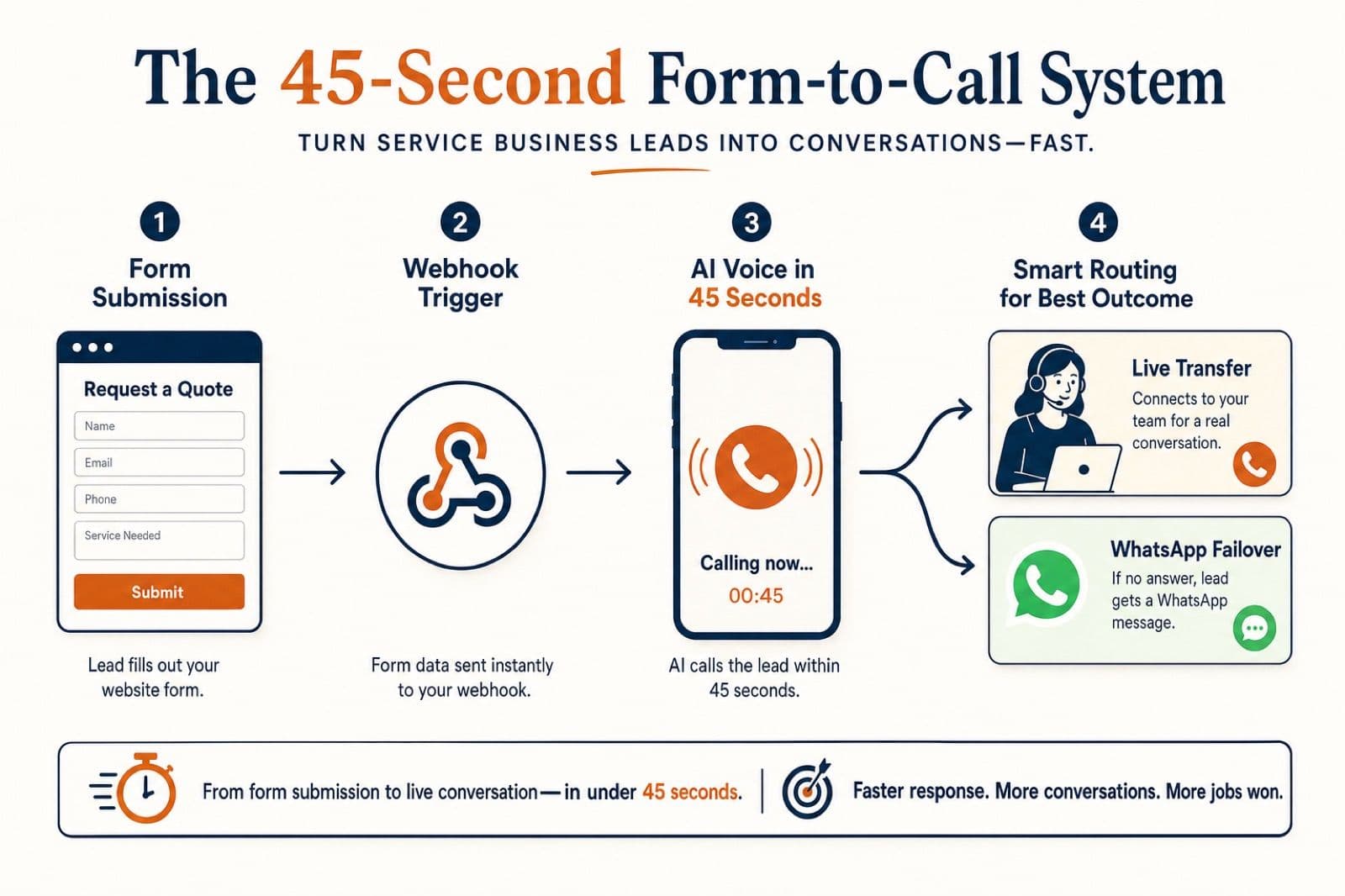
The standard I now build to for clients is a 45-second form-to-call system. Form submits, the system fires a webhook, an AI voice agent calls the prospect by name inside 45 seconds, runs a short qualifying script, and either transfers live to a closer or drops a calendar link. If the prospect does not pick up, the system flips to WhatsApp inside 60 seconds and keeps the thread alive.
That last part is the one almost every vendor demo skips. The voice call is the sexy half. The WhatsApp failover is the half that actually moves the bookings. Without it, you are paying for AI voice infrastructure on top of the same broken pickup math service businesses have always had. This is the inbound operating system playbook applied to the one channel everyone still treats like email: the contact form on the landing page.
What "speed to lead" actually meant before voice AI
The speed-to-lead research is old enough to drink. The shape of the curve is not new and not controversial. It keeps getting confirmed in newer studies on more channels.
The original primary source is the InsideSales / MIT Lead Response Management Study run by Dr. James Oldroyd at MIT Sloan with InsideSales. It analyzed roughly 15,000 leads across multiple industries and produced the numbers everyone now quotes. The Harvard Business Review version that popularized it, The Short Life of Online Sales Leads, separately audited 2,241 U.S. companies and found average first response time of 42 hours.
The two findings from that work that matter for a form-to-call system:
| Response window | What the data showed |
|---|---|
| Under 5 minutes vs 30 minutes | Roughly 100x more likely to make contact |
| Under 5 minutes vs 30 minutes | Roughly 21x more likely to qualify the lead |
| Within 1 hour vs 24 hours | Nearly 7x more likely to qualify the lead |
The original "5-minute rule" was a 2007 finding about phone calls to web-form leads. It was never a marketing slogan. It was a behavioral observation. People who fill out a form are in a buying moment that decays fast. Other research since then has only made the curve steeper.
A more recent reading of the same shape is Drift's industry follow-up data showing that only about 7 percent of companies respond within 5 minutes and 55 percent take more than five business days. If the original study said "5 minutes is the threshold," the 2020s update is "almost nobody is doing it, and the buyer behaviour has only gotten faster."
This is where I always get the same question from founders: "Are you saying my five-minute SLA is wrong?" No. Five minutes is the floor. On inbound web forms specifically, it is now possible to hit under one minute without a human in the loop, and the cost of not doing it shows up as missed bookings, not just a slower pipeline. The broader version of this argument is in the 2026 speed-to-lead teardown for service businesses.
Why a 45-second voice call beats a 4-hour email reply
Email and voice work different parts of the same brain. When a prospect submits a form, three things are simultaneously true: they are still on your tab (intent is current), they are about to switch context (intent is fragile), and they have your name in their head exactly once (intent is unbranded).
Email puts all three of those at risk. Even an instant transactional email lands in an inbox, which is a queue. The prospect closes the tab, opens Instagram, and the next time they think about your category is when the competitor's ad shows up.
A voice call collapses the gap. A call within 45 seconds means the prospect's phone rings while they are still on your page. The branding moment is the call itself. The qualification moment is the same call. The booking decision can happen in the same minute they raised their hand.
That is the entire promise of voice agents like Retell, Vapi, and Bland, which now hit 600 to 900 millisecond median latency on inbound voice and can fire outbound calls from a webhook with a budget measured in single-digit seconds. The technology is no longer the bottleneck. The architecture around it is.
The reason the gap is 45 seconds and not 5 seconds is not the AI. It is the buyer. Calling the same second they hit submit feels surveillance-creepy. Calling 30 to 60 seconds later feels responsive. Most operators I work with land at around 40 seconds end to end and the answer rate is materially better than calling instantly.
The pickup problem: a fast call is not enough
This is the part of the conversation most "instant callback" vendors skip.
If you call a prospect within 45 seconds and they do not pick up, you do not have a 45-second response system. You have a fast voicemail.
The pickup math in 2026 is brutal. Hiya's State of the Call 2026 report, based on a survey of more than 12,000 consumers across six countries, found that 86 percent of unknown calls go unanswered. The U.S. number is consistent with earlier Pew Research findings that 80 percent of Americans say they do not generally answer their phone for an unknown number. That data was collected in 2020, before AI voice deepfakes pushed consumer trust even lower. Hiya's 2026 data found that one in four Americans say they have received a deepfake voice call in the past 12 months.
Translate that to your funnel:
| Calls placed | Picked up | Voicemail | What you get |
|---|---|---|---|
| 100 | 14 | 86 | 14 conversations, 86 wasted call attempts unless something else fires |
If the system stops at the call, the best case is a 14 percent conversation rate. The fact that the call was fast and the AI was friendly does not change that ceiling. The ceiling is decided by whether the phone gets answered, which is behavior you do not control.
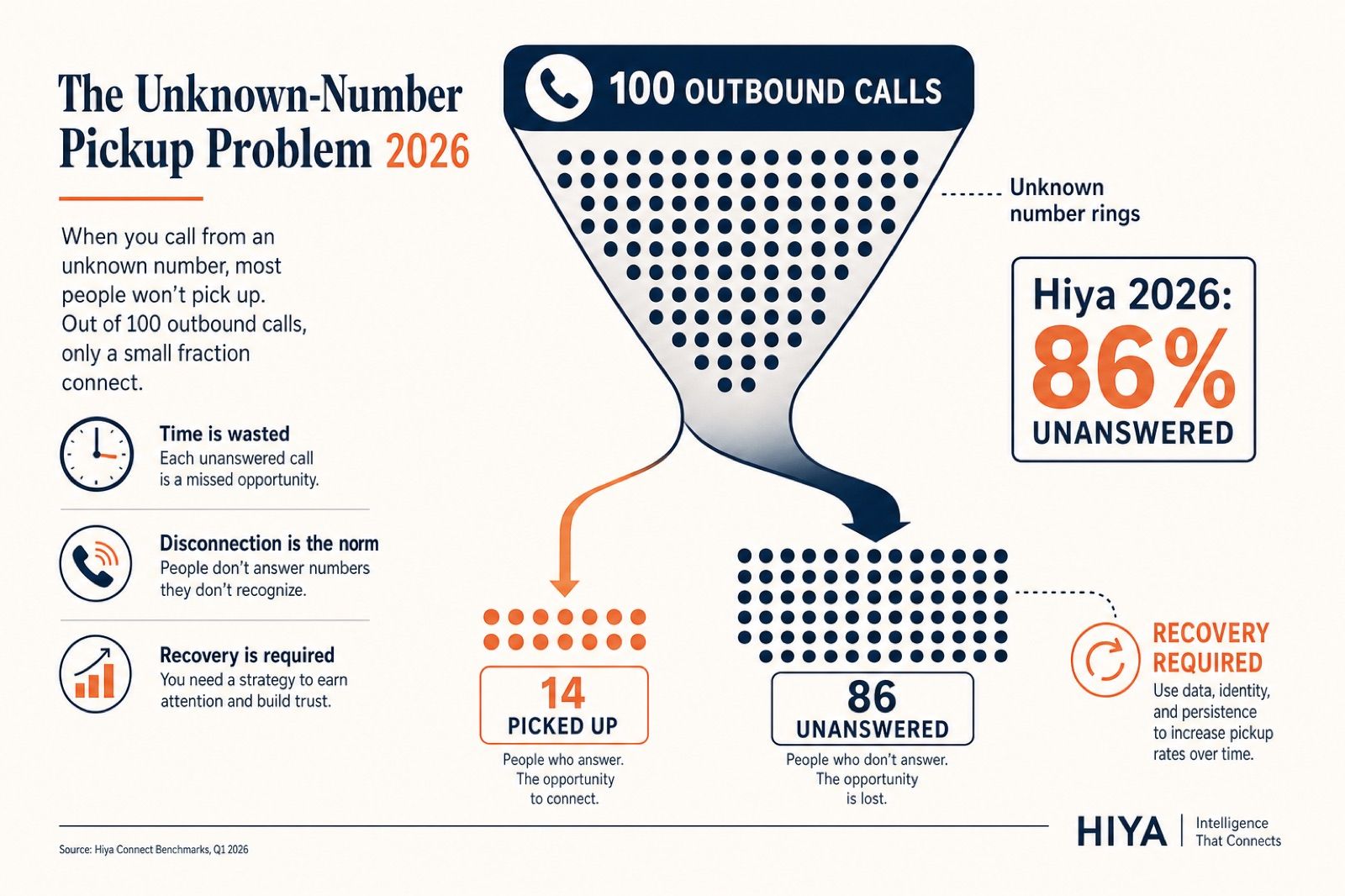
This is the single most important number in a form-to-call design. It is the reason every serious system needs a second leg that does not depend on the phone being answered. That second leg is what most "instant callback" products quietly leave out, and it is the part that decides whether the architecture is worth deploying.
The failover that everyone forgets: WhatsApp plus SMS
The pickup problem is not new. It is the same problem missed-call-text-back products have been solving in home services for years. What is new is that the failover now wires into the form callback as one continuous flow, not a separate marketing channel.
The benchmark for missed-call recovery is solid. A 2026 missed-call-text-back analysis aggregating 50-plus deployments puts recovery at 18 to 34 percent of missed calls into a real conversation, and 30 to 60 percent of those conversations into booked appointments or quote requests. Independent vertical breakdowns show 35 to 50 percent SMS response rates when the message is sent inside 60 seconds.
The choice between WhatsApp and SMS depends on the market and the prospect's expectation.
| Channel | Open rate | Reply rate | When to lead with it |
|---|---|---|---|
| 95 to 98 percent | 40 to 60 percent | India, LATAM, EU, MENA, anywhere CTWA is normal | |
| SMS | 90 to 98 percent | 25 to 45 percent | U.S., Canada, AU, NZ, anywhere SMS still feels native |
| 20 to 30 percent | 5 to 10 percent | Never as the first recovery touch |
Aggregator studies in 2026 line up on the same pattern: WhatsApp wins on click-through and conversational depth in WhatsApp-primary markets, SMS wins on universal reach and US-style instant text habits. For an event company in India running Click-to-WhatsApp ads, WhatsApp is the obvious primary failover. For a US service business running paid search to a contact form, SMS first with WhatsApp as the secondary thread is usually the better default.
The failover content also matters. A useful failover message is not "sorry we missed you." It references the exact thing the prospect asked about and offers one next step. For an event company, that looks like:
Hi Priya, this is Aman from {brand}. I just tried calling about your June event enquiry. Easiest is to reply here with your date and rough guest count, or grab a quick slot at {cal.com link}.
The same logic powers the WhatsApp closing pattern in how event companies convert WhatsApp enquiries to bookings. The voice call and the WhatsApp thread are not two systems. They are the same conversation continued on whichever surface the buyer actually engages on.
The 45-second architecture, step by step
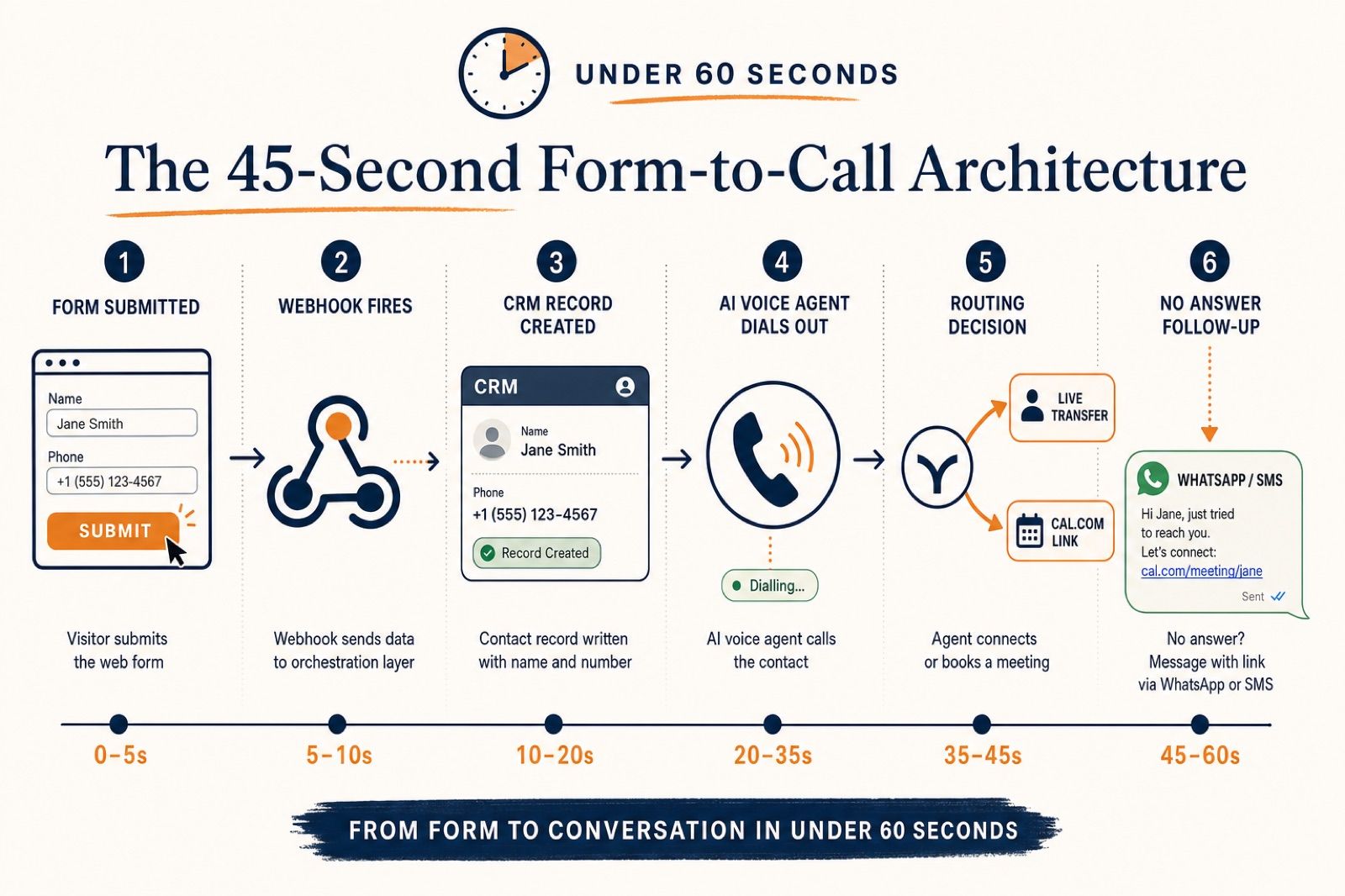
This is the shape I deploy. There are three or four valid variations on it, but the load-bearing pieces are the same in every working version.
Step 1: The form trigger
Whatever platform hosts the form (Webflow, WordPress with Gravity Forms, a Next.js page, a paid-ad landing page, Typeform, Tally, a Cal.com pre-screen), it fires a webhook on submit. The webhook delivers the lead payload to an orchestration layer. I usually run this in n8n on a self-hosted VPS or in Cloudflare Workers when latency budgets are tight. The n8n webhook latency profile is well documented: reception is 1 to 5 ms, queueing is the bottleneck if you do not run executions in queue mode.
Budget for this step: under 2 seconds.
Step 2: CRM write and de-dup
The orchestration layer writes the lead to the CRM immediately, before the call fires. This matters because if the call fails for any reason, the lead must not disappear. Source ad ID, UTM tags, page slug, form ID, and timestamp all go in the record. A de-dup check looks for the same phone in the last 24 hours so the prospect does not get called twice for resubmits.
Budget for this step: under 1 second.
Step 3: AI voice call placed via Twilio or BSP
The orchestration layer calls a voice provider API. The voice provider dials Twilio (or another carrier), connects, and starts the conversation. The voice agent has the form context in its prompt: the prospect's name, what they asked about, the page they came from, and the qualifying script.
A useful first script for an event company looks like this:
Hi, is this Priya? This is the FusionSync booking line for {brand}. I am calling about your enquiry for a June event. Two quick questions and I will either get you a slot or text the calendar over. What date are you thinking and roughly how many guests?
Two questions, not five. The point is not to fully qualify on call one. The point is to keep the buyer in the conversation and capture enough to either route or follow up.
Latency benchmarks for the major providers in 2026, aggregated from independent comparisons:
| Platform | Median latency | Best for |
|---|---|---|
| Retell AI | 600 to 800 ms | Inbound, polished UX, lowest latency |
| Vapi | 700 to 900 ms | Custom stacks, BYO model and voice providers |
| Bland AI | 800 to 1,200 ms | High-volume outbound, batch dialing, SMS combos |
| Synthflow | 900 to 1,200 ms | No-code teams, fastest setup |
Budget from "place call" to "phone rings": under 15 seconds in most configurations.
Step 4: The routing fork
When the prospect picks up and the qualifier clears, the system makes a routing decision in the same call.
Three forks worth supporting:
| Condition | Action |
|---|---|
| Qualified and a closer is available | Live transfer via Twilio conference bridge |
| Qualified and no closer available | Drop a Cal.com or Calendly slot, send the link via SMS or WhatsApp during the call |
| Not qualified or wrong fit | Polite close, log the disposition, do not nurture further |
The Cal.com fallback is the most underrated of the three. Lunacal's 2026 scheduling report found that the average scheduling page converts about 15 percent of visitors into booked meetings, and the top 10 percent reach 30 to 33 percent. When you send the link inside a live, warm conversation rather than as a cold email, the booking rate trends toward the top range, not the average. Cal.com's own customer write-ups reference 20 percent lifts in close rate just from removing scheduling friction.
Budget for the fork decision: 1 to 3 seconds of voice latency, no extra system time.
Step 5: The no-answer failover
If the prospect does not pick up, the voice provider posts a "call ended, no answer" webhook back to the orchestrator. The orchestrator immediately fires a WhatsApp template message (in WhatsApp-primary markets) or an SMS (in SMS-primary markets) with the failover script.
The total window from "form submit" to "failover message delivered" should be under 60 seconds. In practice I usually see 35 to 50 seconds on a healthy stack. The same kind of pattern used in the sub-2-minute Meta Lead Ads follow-up architecture applies, except the trigger is a form submission rather than a Lead Ad webhook.
The failover thread is now the primary conversation surface. The voice call did its job: it tagged the lead as called, it gave the prospect a memorable branded moment, and it created the context the WhatsApp message references.
Step 6: Closer-ready handoff
Once the prospect replies on WhatsApp or books a slot, the conversation is labelled closer-ready. The closer opens the CRM, sees the source ad ID, the form payload, the call transcript, the disposition, the WhatsApp thread link, and the calendar event. They do not have to ask "what was this about?" The thread already answered. The closer is not doing intake; they are closing a warmed, qualified conversation.
What this actually costs to run
A working version of this stack has four real cost lines. The numbers below are 2026 baselines for a 300-leads-per-month operator. They are not vendor invoices; the exact figure depends on call duration, message mix, and locale.
| Cost line | Typical 2026 range | Notes |
|---|---|---|
| Voice provider per minute | $0.07 to $0.18 | Retell, Vapi, Bland, Synthflow midband |
| Telephony per minute | $0.013 to $0.05 | Twilio US outbound, varies by country |
| WhatsApp BSP per conversation or message | $0.005 to $0.025 | Marketing template rates higher than utility |
| Orchestration | $0 to $50 per month | n8n self-hosted, Make, or custom worker |
For a service business with 300 monthly form leads, average call duration of 1.5 minutes, 14 percent pickup, and a WhatsApp failover on the rest, the monthly run cost is typically in the $80 to $300 range before recovery revenue. The published missed-call text-back ROI breakdowns from multiple service-business deployments consistently show 5x to 50x return at that volume because the recovered bookings dwarf the infrastructure spend.
The expensive thing is not the voice minutes or the WhatsApp messages. The expensive thing is leads that submitted a form and never spoke to anyone. Every architecture decision above is designed to keep that number near zero.
The five mistakes I see most often
These are the failure modes I keep running into when I audit other people's form-to-call setups before rebuilding them.
| Mistake | What it costs |
|---|---|
| Calling instantly (under 5 seconds) with no buffer | Lower pickup rate, prospects feel surveilled, hangups go up |
| Voice agent that pitches instead of qualifies | Burns the call on a monologue, no captured fields |
| No CRM write before the call | One failed call and the lead is lost forever |
| No WhatsApp or SMS failover | 86 percent of attempts produce no conversation |
| Cal.com link sent without context | Booking page converts at platform average, not the top decile |
The first one is the most common. Founders see "instant callback" as a feature and ask for the lowest possible latency. The pickup data does not reward that. A 40-second buffer with a clear caller ID and a confident first line consistently outperforms a sub-5-second call. The second one is the one I had to learn the hard way: the same voice agent that performs at 30 percent qualified conversation rate when it asks two short questions performs at 10 percent when it tries to deliver a 90-second value pitch. The closer pitches on call two; the agent qualifies on call one.
FAQ
Is 45 seconds the right target, or should I aim lower?
Forty-five seconds is the practical sweet spot for most service businesses. Faster is technically possible but lowers pickup because the call feels intrusive. Slower (over 90 seconds) starts losing the buying moment. If the system is healthy, the median ends up around 40 seconds and the p95 stays under 90 seconds, even during ad spikes.
What if I do not have an AI voice agent and only want SMS or WhatsApp?
That still works. The same architecture without the voice leg is the missed-call-text-back pattern applied to web forms. It converts lower than a voice-plus-failover stack but dramatically outperforms email-only. If you only build one leg, build the failover thread first.
Will the FCC, GDPR, or TCPA rules affect this?
Yes, especially in the US. Automated voice callbacks to form leads need a clear consent record, the right caller ID, and respect for do-not-call lists; the form needs to disclose the callback. The same applies to SMS under TCPA. For WhatsApp, the prospect needs to be inside an active customer service window or you need an approved template. Build the consent record at form submit time and pass it through the orchestrator with the call.
Do I need a human in the loop on call one?
No, and that is the whole point. Human-only response cannot hold a 45-second median during evenings, weekends, ad spikes, and lunch breaks. AI handles call one. A human handles the second touch when the lead is qualified, transferred, or booked. The skill the human brings to the moment is closing, not intake.
What happens if the prospect calls the AI back instead of replying on WhatsApp?
Most voice providers can route inbound calls to the same number with the prior call context, so the voice agent picks up the thread where it left off. This is rare on US numbers (prospects usually message back) and more common in India or LATAM where calling is still the default behaviour.
What CRM does this work with?
Any CRM with a webhook in and a webhook out. The system is CRM-agnostic. I have built it on top of HubSpot, GoHighLevel, Pipedrive, Zoho, Airtable, and custom Postgres-backed CRMs.
How is this different from the chatbot on my site?
A chatbot replies in the browser tab while the prospect is still there. A form-to-call system reaches the prospect after they leave. Most service-business prospects do not stay on the site long enough for a chatbot to qualify them; the form-to-call system meets them where they actually are: on their phone, on WhatsApp, or on a Cal.com slot.
The bottom line
A web form is a buying signal. Replying to it with an email confirmation is the same as not replying at all. The architecture that actually converts is a 45-second AI voice call wired with a WhatsApp or SMS failover, a Cal.com routing fork, and a closer-ready handoff. The voice call earns the branded moment. The failover does the recovery work. Together they turn the 86 percent of unknown calls that go unanswered into a conversation thread instead of a dead end.
- Form leads have a 5-minute-rule decay curve that has only gotten steeper across two decades of research.
- A 45-second outbound call from an AI voice agent is technically simple in 2026; the 600 to 900 millisecond latency from Retell, Vapi, or Bland is no longer the bottleneck.
- Hiya's 2026 data shows 86 percent of unknown calls go unanswered, which is why a fast call alone is not a system.
- A WhatsApp or SMS failover inside 60 seconds recovers 18 to 34 percent of missed calls into real conversations.
- A Cal.com routing fork sent inside a live conversation converts well above the 15 percent scheduling-page average.
- The expensive thing is not the voice minutes or the WhatsApp fees, it is the leads that submit a form and never speak to anyone.
If you want to see whether your own form leads are leaking, the fastest path is a free AI audit on your last 30 days of inbound. If you already have meaningful form or ad volume, the free 7-day pilot is the cheapest way to test the 45-second system on one campaign before deciding whether to wire it across the rest of the stack.
AI-native business systems
Bring a niche, or bring a workflow.
If you run the business, we build the system around it. If you sell into a niche, we build the system behind your offer.
PolarBuild case study →You sell the niche. We build the system.
We never compete for your end clients. One partnership conversation. You fulfil the same system across the accounts in your niche.
Free POC before dedicated software
A three-day sales demo of the system for your vertical before any large software investment. Implementation starts only when someone in that niche pays.
Replicate the niche, not a one-off build
UK dental becomes US dental with a new local partner and new integration targets. Same system thesis, new market.