
Lead Response Time
Speed to Lead 2026: Why 60 Seconds Is the New Minimum

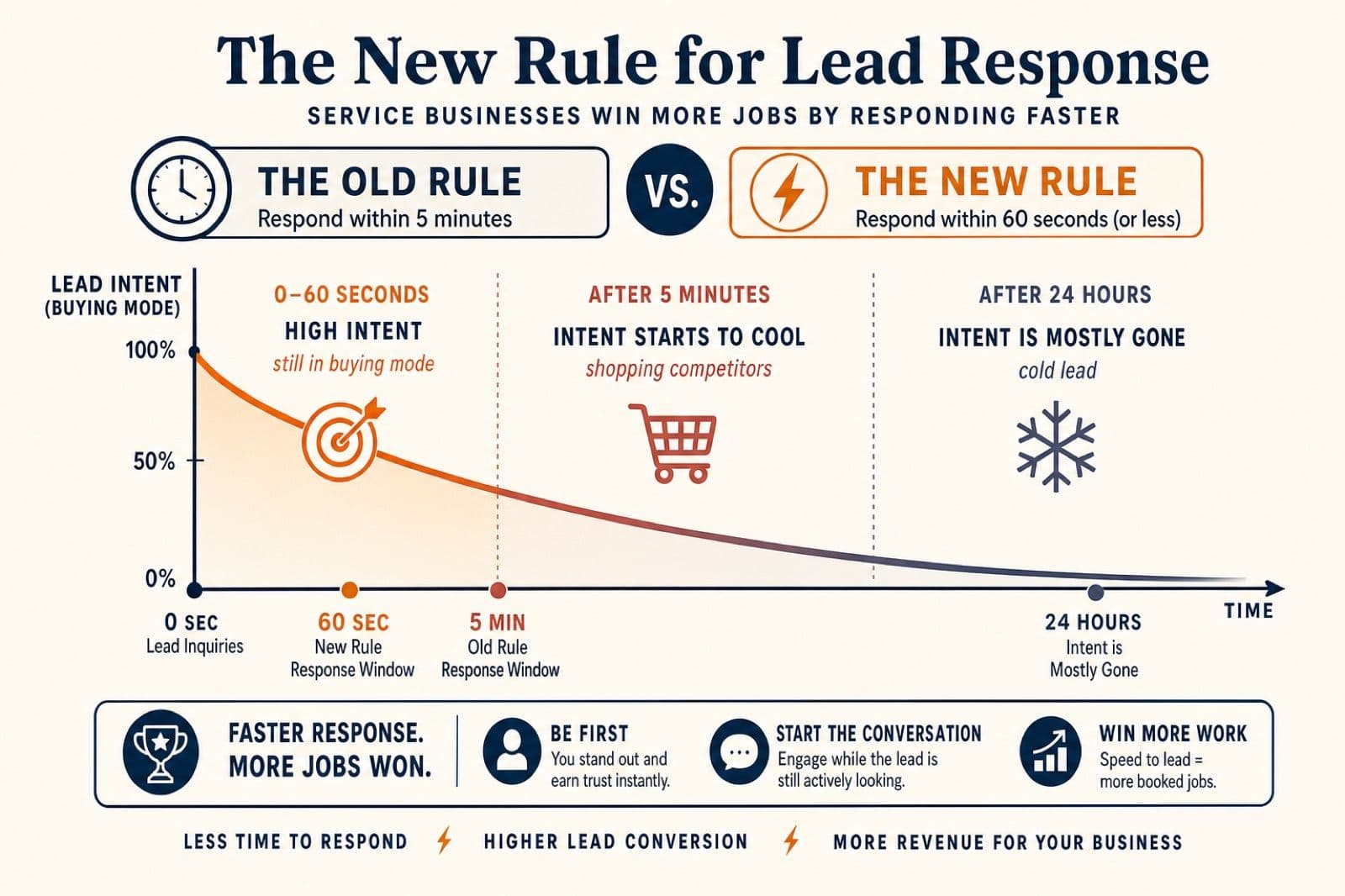
The 5-minute rule is now the floor. Here is why service businesses need sub-60-second replies across calls, Instagram, WhatsApp, and forms.
The 5-minute rule is not wrong. It is just too slow now.
Speed to lead used to mean "respond within five minutes." In 2026, that is still better than most teams. It is also no longer the bar for service businesses that live on Instagram DMs, WhatsApp, web chat, ad forms, and missed calls.
The new minimum is a meaningful first response inside 60 seconds.
Meaningful is the important word. A bot that says "thanks, our team will get back to you" does not count. A voicemail greeting does not count. A missed-call text that asks no next question barely counts. For an event company, a real first response sounds like: "Absolutely. What date are you looking at?" It starts qualification while the customer is still in the buying moment.
That is the core difference between the old playbook and the new one. The old five-minute rule was built for web forms and callback queues. The 2026 rule is built for conversational buying, where the customer has three vendor tabs open, two WhatsApp chats active, and no patience for silence.
I already wrote the technical architecture for a 60-second inbound response system. This post is the business teardown: why the standard moved, where service businesses lose the most money, and what a practical response system needs to do before a human ever touches the thread.
What speed to lead actually means in 2026
Speed to lead is the time between the customer's buying signal and your first useful action.
Not first notification. Not first CRM record. Not first auto-reply. First useful action.
| Channel | Buying signal | Useful first action | Bad first action |
|---|---|---|---|
| Instagram DM | "Do you have packages for June?" | Ask date, guest count, and event type in-channel | "Thanks, call us tomorrow" |
| "Price?" from a Click-to-WhatsApp ad | Confirm service area or event date | Generic brochure dump | |
| Web form | Contact form submitted | Call or text with the specific request referenced | Delayed email sequence |
| Missed call | Caller hangs up after 5 rings | Instant text-back or AI voice callback | Voicemail only |
| Website chat | Visitor asks availability | Answer and route to booking path | "Leave your email" |
The old sales metric measured how fast a rep called a form lead. The new service-business metric is broader: how fast does the system move the buyer to the next useful step on the channel where they already raised their hand?
That shift matters because most service businesses do not lose leads in the CRM. They lose them before the CRM knows the lead exists. Instagram DMs sit unread during events. WhatsApp messages land on one owner's phone. Missed calls disappear into voicemail. A form gets a Monday reply after a Saturday inquiry. If you want the longer leak map, the diagnostic in why service businesses lose leads after marketing already worked is the companion read.
The data curve is brutal, and it is not new
The classic speed-to-lead research is old enough to drink. It still matters because the shape of the curve keeps showing up across channels.
Harvard Business Review's 2011 article, The Short Life of Online Sales Leads, summarized research from James Oldroyd, Kristina McElheran, and David Elkington. They audited 2,241 U.S. companies and found the average response time among responders was 42 hours. In a separate study of 1.25 million sales leads across 29 B2C and 13 B2B companies, firms that contacted a lead within one hour were nearly seven times more likely to qualify the lead than firms that waited another hour, and more than 60 times more likely than firms that waited 24 hours or longer.
That was the one-hour cliff. The five-minute cliff came from the Lead Response Management research that found responding within five minutes made companies roughly 100 times more likely to connect and 21 times more likely to qualify than waiting 30 minutes. The one-minute cliff came later: Velocify research distributed through Salesforce AppExchange found that calling within one minute of lead generation increased conversion likelihood by 391 percent compared with waiting longer.
Different studies, different samples, same curve:
| Response time | What the data says | What it means operationally |
|---|---|---|
| Under 60 seconds | Peak intent, one-minute response can materially lift conversion | System should respond before the customer switches context |
| Under 5 minutes | Still strong, classic 21x qualification advantage vs 30 minutes | Human handoff can happen here, but system must already be active |
| 5-30 minutes | Decay is steep, competitors enter the conversation | You are now selling against other replies |
| 1-24 hours | HBR found a major qualification drop vs one-hour responders | Follow-up starts to feel like recovery |
| 24+ hours | Lead is functionally cold for most service-business motions | Nurture, not active sales |
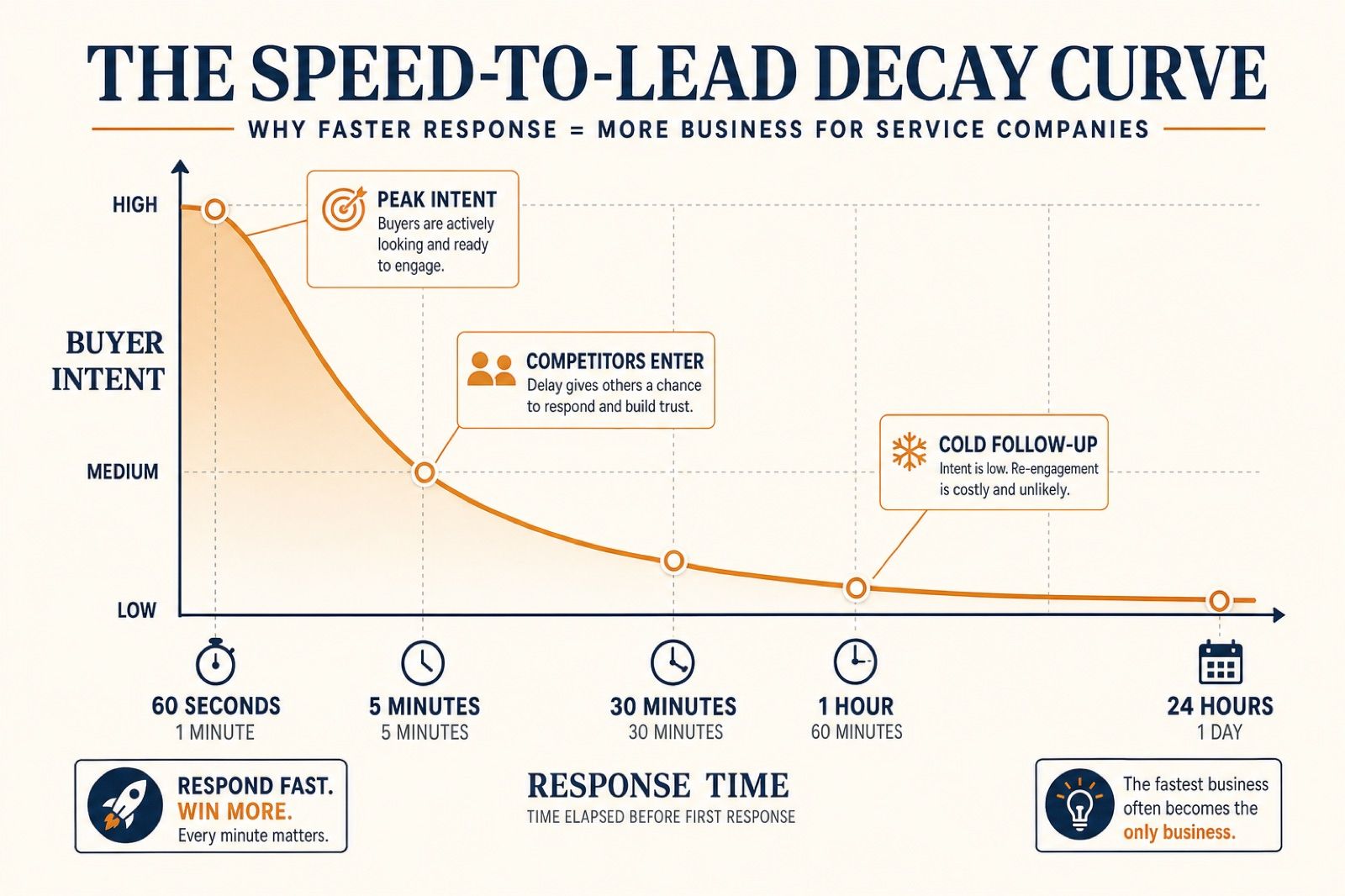
Here is the founder translation: the lead is not "waiting." They are still shopping.
If they DM three decorators, the first useful reply gets to shape the requirements. If they call two venues, the one that answers gets the date, headcount, and budget first. If they click a WhatsApp ad, the company that starts the booking thread while they are still in WhatsApp gets the highest-intent version of that buyer.
This is why the 2026 benchmark is not "respond sometime today." It is not even "respond within five minutes." It is "start the useful conversation before the buyer changes context."
Service businesses lose leads differently from SaaS teams
Most speed-to-lead advice is written for SaaS sales teams. Form submitted, rep assigned, dialer fires, meeting booked. That is not how service businesses actually operate.
An event company, clinic, agency, real estate team, school, or local service operator usually has a messier inbound surface:
| Lead source | Why it leaks | Why speed matters |
|---|---|---|
| Instagram DMs | One inbox, multiple staff, no qualification fields | Customer is still browsing your portfolio |
| Thread lives on a phone, not a CRM | Replies feel personal, so silence feels worse | |
| Missed calls | Voicemail is treated as a queue | Callers often do not leave messages or call back |
| Meta lead forms | Leads arrive detached from context | Buyer forgets what they clicked |
| Website chat | Visitor is still on the page | A fast answer can keep them from bouncing |
CallJolt's 2026 home-service missed-call data estimates that 62 percent of calls to home service businesses go unanswered and that 86 percent of callers who reach voicemail hang up without leaving a message. You should be cautious about applying home-services data directly to every vertical, but the behavioral pattern is familiar: high-intent service buyers do not patiently wait in a queue. They move to the next available provider.
The same pattern shows up in conversational channels. SetSmart's analysis of 828,000 AI DM conversations found that WhatsApp responders qualified at 33.96 percent and booked calls at 18.82 percent of engaged conversations, roughly 3x the WhatsApp booked-call rate of Instagram among engaged leads in that dataset. The useful lesson is not "WhatsApp beats Instagram." It is that the channel where the buyer is already willing to reply has enormous leverage if the system can respond and qualify immediately.
For event companies, this is the weekly reality:
- A bride DMs at 11:40 PM after seeing a reel.
- A corporate event buyer sends a WhatsApp message from an ad during lunch.
- A family calls on Sunday while touring venues.
- A student inquiry arrives from a Meta lead form after class.
Human-only teams can catch some of that. They cannot catch all of it, every day, in under 60 seconds, with a useful next question.
The real metric is not first reply. It is first qualified reply.
Most automation vendors cheat this conversation by optimizing for the easiest metric.
First reply latency is easy. You can get it to two seconds with a generic auto-responder. That does not mean the lead is moving.
The metric that matters is time to first qualified reply: the time from lead arrival to the first response that extracts useful sales information. For a service business, that useful information is usually one of five things:
| Business type | First qualified question |
|---|---|
| Event company | "What date and guest count are you planning for?" |
| Clinic | "What service are you looking for, and is this urgent?" |
| Real estate | "Are you buying, selling, or renting, and what area?" |
| School or coaching program | "What age group or course are you asking about?" |
| Agency | "What outcome are you trying to improve first?" |
This is where the old chatbot category fails. It can be fast while still being operationally useless. The buyer gets a reply, but the team gets no structured context, no routing decision, no CRM update, and no closer-ready handoff.
The correct response system has to do three jobs inside the first minute:
- Acknowledge the exact intent. If the lead asked about pricing, do not reply with "how can we help?" If they asked about June availability, do not send a services menu.
- Ask one qualifying question. One question beats a five-question form. The customer should feel the conversation moving, not the process beginning.
- Write structured state. Date, budget, location, service type, urgency, source, campaign, and thread URL should start filling in before a human opens the CRM.
That is why the AI SDR failure story matters here. Outbound AI SDR tools were built to send first messages. Service businesses need systems that respond to first messages. Those are different products with different success metrics.
The 2026 response-time scorecard
If you run a service business, use this scorecard before you buy another ad campaign.
| Metric | Healthy | Warning | Broken |
|---|---|---|---|
| Median first useful response | Under 60 seconds | 1-5 minutes | Over 5 minutes |
| p95 first useful response | Under 5 minutes | 5-30 minutes | Over 30 minutes |
| After-hours response | Same workflow as business hours | Auto-reply only | Next-day callback |
| Missed-call handling | Instant text-back or callback | Voicemail plus manual callback | Voicemail only |
| DM qualification | First question asked in-channel | Manual triage later | No qualification |
| CRM writeback | Real-time with thread link | End-of-day manual update | No source of truth |
| Human handoff | Routed with context | Routed with partial notes | Raw lead forwarded |
Most founders only know the median. The p95 is where the money leaks.
If your median Instagram response is 90 seconds, that sounds good. If your p95 is nine hours because weekend and after-hours leads sit untouched, you still have a revenue leak. The buyers who arrive during high-intent windows are often the ones worth the most: events, urgent services, destination inquiries, last-minute bookings, high-budget corporate buyers.
This is also where a free audit is usually more useful than another dashboard. Pull the last 100 inbound conversations and measure five timestamps:
- Lead arrived
- First human or system reply
- First qualifying question
- Qualification completed
- Closer-ready handoff
If you cannot find those timestamps, the response system is not measurable yet. That is the first fix.
What a 60-second system needs to include
You do not need an enormous sales platform to hit the threshold. You need a small number of pieces connected correctly.
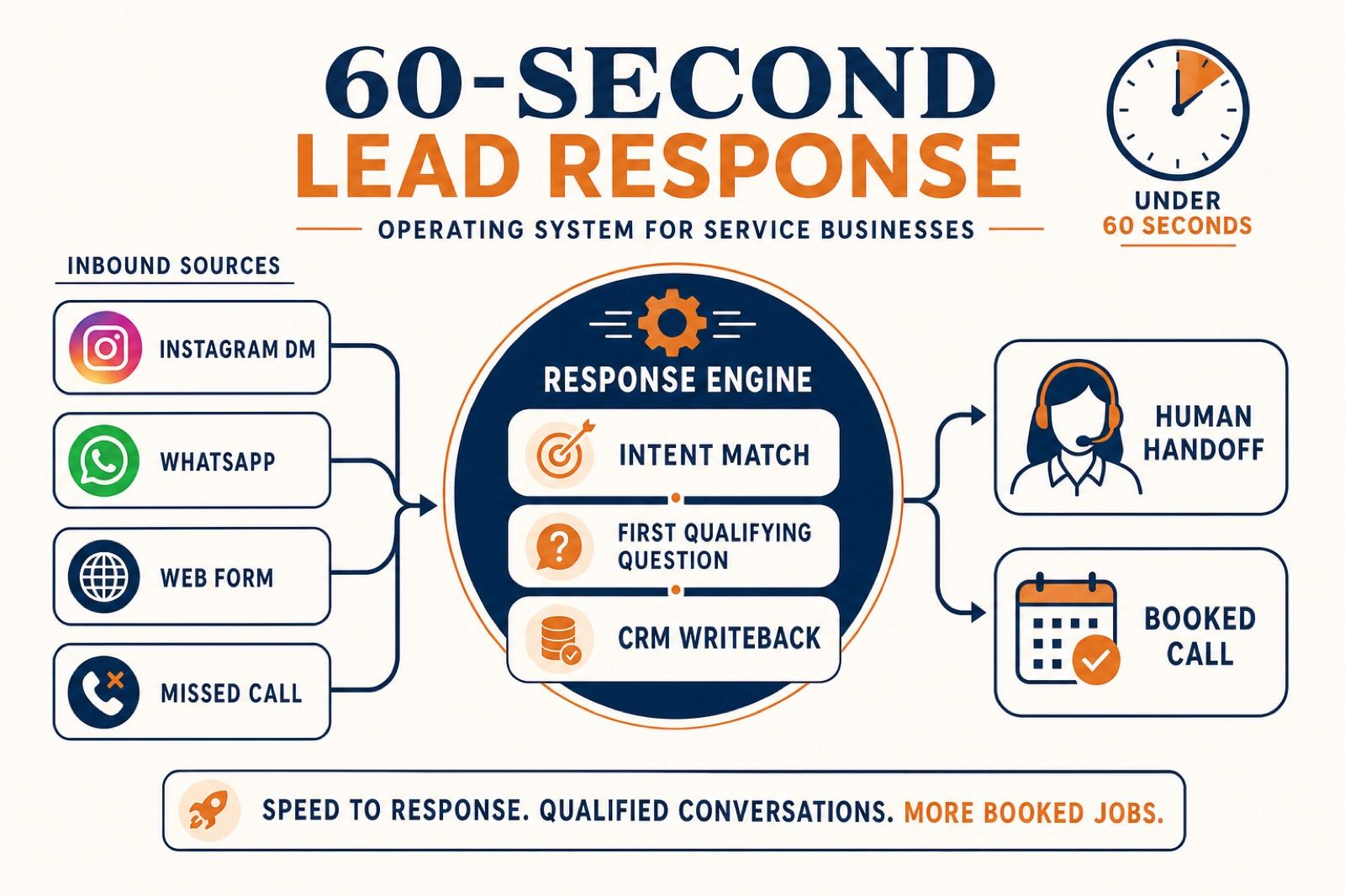
At minimum, the system needs six parts.
1. Channel-native intake
Every source should fire instantly: Instagram webhook, WhatsApp webhook, form submission event, call webhook, chat event. No polling. No spreadsheet. No inbox that someone checks later.
2. Intent matching
The system should classify what the customer is asking before it replies. Pricing, availability, package details, location, urgent support, partnership request, spam. The first question depends on the intent.
3. One-question qualification
Ask one question at a time. For event companies, the first three are usually date, event type, and guest count. Do not ask for ten fields. The point of conversation is to reduce friction.
4. Real-time CRM state
Every answer should write somewhere structured. A closer should not have to read a whole DM thread to know whether the lead is hot. They should see date, headcount, budget signal, urgency, source, and conversation link.
5. Human handoff rules
Hot leads should reach a human quickly. Cold or incomplete leads should stay in AI-assisted nurture. A good system does not replace closers. It protects them from raw, unqualified noise.
6. Stalled-thread recovery
If a customer answers two questions and disappears, the system should follow up while the context is still fresh. The timing depends on the channel. For WhatsApp, the economics of the 72-hour Click-to-WhatsApp window matter, which I covered in the WhatsApp pricing teardown for event companies.
The simplest test: if the owner turns off notifications for one Saturday afternoon, does the business still respond, qualify, and route hot leads in under 60 seconds? If not, the process is still human-dependent.
Where AI actually belongs
AI is useful here, but not in the way most vendors pitch it.
The job is not to "sound human" for 30 turns. The job is to preserve buying intent until a real sales path exists. That means AI should handle the early, bounded work:
| AI-owned task | Human-owned task |
|---|---|
| First useful reply | Complex pricing judgment |
| Basic qualification | Negotiation and objection handling |
| Availability check | High-value closing conversation |
| CRM writeback | Relationship building |
| Reminder and recovery nudges | Final scope and custom proposal |
| Spam filtering | Edge cases and escalations |
NextPhone's 2026 AI receptionist guide frames the phone side clearly: AI receptionists can answer common questions, schedule appointments, take messages, detect emergencies, route calls, and filter spam. That same operating model applies to Instagram and WhatsApp. The AI should not pretend to be your best closer. It should keep every lead alive long enough for your best closer to matter.
This is why "instant response" by itself is not the offer. The offer is instant response with structured movement:
- Reply in-channel
- Ask the right first question
- Capture the answer
- Score urgency
- Route hot leads
- Sync the CRM
- Recover stalled threads
If the system only replies fast, it is a chatbot. If it turns a raw inbound into a closer-ready conversation, it is an operating system.
The founder test: calculate your response leak
Here is a simple way to make speed to lead concrete.
Take the last 30 days of inbound and build this table:
| Source | Leads | Median first useful response | p95 first useful response | Qualified | Booked |
|---|---|---|---|---|---|
| Instagram DM | 120 | 18 minutes | 19 hours | 24 | 9 |
| 80 | 7 minutes | 4 hours | 31 | 14 | |
| Website form | 35 | 3 hours | 2 days | 8 | 2 |
| Missed calls | 50 | Unknown | Unknown | 6 | 1 |
Then ask three questions.
What percentage of leads got a useful response inside 60 seconds? If the number is under 50 percent, you do not have a speed-to-lead system. You have a notification habit.
What percentage completed qualification before a human joined? If the number is under 30 percent, your closers are doing intake work instead of closing.
Which source has the worst p95? That is usually where the biggest leak lives. In event companies, it is often Instagram on weekends and missed calls after hours. In clinics, it is calls during front-desk rushes. In agencies, it is form submissions that wait for a manual review.
Now model the revenue:
| Input | Example |
|---|---|
| Monthly inbound leads | 300 |
| Leads that receive slow or no useful first response | 40 percent |
| Slow-response leads | 120 |
| Conservative lost-booking rate from slow response | 10 percent |
| Lost bookings | 12 |
| Average gross profit per booking | $500 |
| Monthly response leak | $6,000 |
The exact numbers will differ. The point is the same: slow response is not a customer-service metric. It is paid media waste, sales capacity waste, and lost booking margin.
FAQ
What is a good speed-to-lead benchmark in 2026?
For service businesses, a good benchmark is a meaningful first response inside 60 seconds and a p95 under five minutes. The median tells you what happens on normal leads. The p95 tells you what happens during weekends, after-hours spikes, staff overload, and campaign surges, where many high-value leads leak.
Is the five-minute rule still valid?
Yes, but it is now the floor, not the goal. The classic research found major gains for responding within five minutes versus 30 minutes. In 2026, customers on Instagram, WhatsApp, chat, and phone expect a faster first move because they are already inside a live conversation channel.
Does an auto-reply count as speed to lead?
Only if it moves the buyer forward. "Thanks, we will get back to you" is a fast non-response. A useful response acknowledges intent and asks the next qualifying question. For example, an event inquiry should get a date, guest count, or venue question, not a generic holding message.
Can humans maintain sub-60-second response without AI?
Only at very low volume or for short windows. Real service businesses have meetings, live jobs, events, lunch breaks, after-hours inquiries, and weekend spikes. Humans should close and handle judgment-heavy conversations. Infrastructure should capture, qualify, and route the first minute.
Which channels need the fastest response?
Missed calls, Instagram DMs, WhatsApp messages, and website chat need the fastest response because the customer is already active and can switch vendors immediately. Web forms also matter, but the highest-intent channels are the ones where the customer expects a conversation, not a delayed email.
What should the first response ask?
Ask the question that most quickly determines fit and next step. Event companies should ask date, guest count, or event type. Clinics should ask service and urgency. Agencies should ask the outcome the buyer wants. The first response should produce structured context, not just acknowledge receipt.
The bottom line
Speed to lead in 2026 is not about being polite quickly. It is about preserving buying intent before the customer switches context or gives a competitor the first real conversation. For service businesses, the old five-minute rule still matters, but the practical minimum is now a useful response inside 60 seconds across Instagram, WhatsApp, forms, chat, and missed calls.
- The old research still holds: fast responders qualify dramatically more leads than teams that wait 30 minutes, one hour, or a full day.
- The new buyer behavior makes the curve steeper because service buyers compare vendors inside live channels, not static forms.
- The metric that matters is first qualified reply, not first auto-reply.
- Human-only teams cannot hold the threshold across weekends, after-hours traffic, and campaign spikes.
- The right system captures the lead, asks one useful question, writes CRM state, and routes hot conversations before a closer joins.
If you want to see where your own response leak is, start with a free AI audit. If you already have meaningful Instagram or WhatsApp volume, start with the free 7-day pilot and test the 60-second system on one real campaign.
AI-native business systems
Bring a niche, or bring a workflow.
If you run the business, we build the system around it. If you sell into a niche, we build the system behind your offer.
PolarBuild case study →You sell the niche. We build the system.
We never compete for your end clients. One partnership conversation. You fulfil the same system across the accounts in your niche.
Free POC before dedicated software
A three-day sales demo of the system for your vertical before any large software investment. Implementation starts only when someone in that niche pays.
Replicate the niche, not a one-off build
UK dental becomes US dental with a new local partner and new integration targets. Same system thesis, new market.