
Production Teardowns
BYOK AI Automation: Cut the SaaS Middleman Tax 90%

Updated
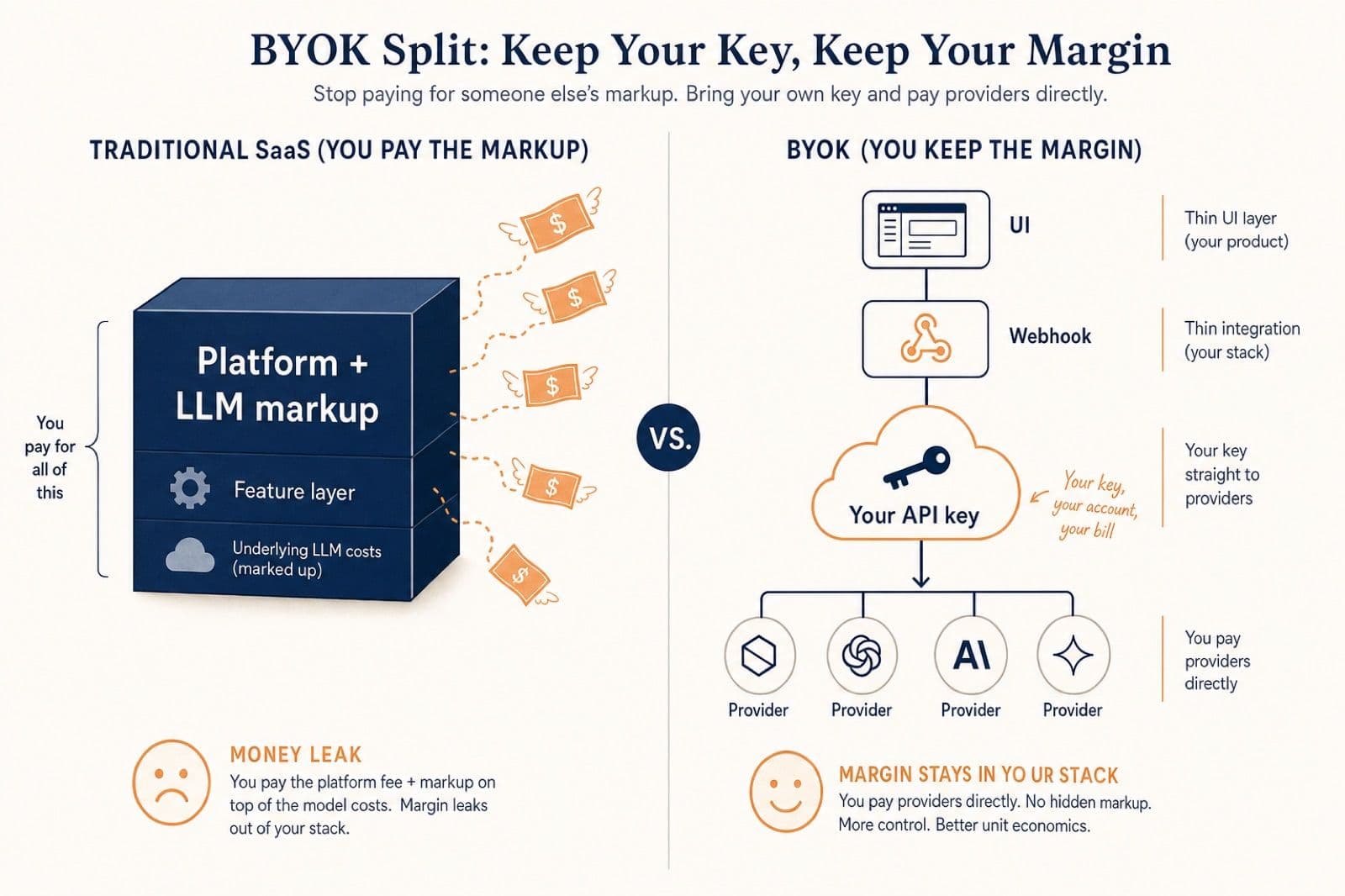
Most Instagram DM tools resell LLM tokens at a markup. BYOK architecture routes your key direct to OpenRouter or Groq. Here is the math agencies miss.
The SaaS middleman tax is not the subscription. It is the token markup you never see
I built igthreadly.com because I was tired of paying twice for the same inference.
The first bill is obvious: $15 to $500 a month for seats, contacts, or "AI credits" on a platform that routes Instagram DMs and WhatsApp threads. The second bill is the one almost nobody audits. Every time a prospect asks a custom question, the platform runs an LLM call on infrastructure it owns, then bills you through a credit system priced above what the same model costs on OpenAI's API or OpenRouter.
That second layer is the SaaS middleman tax. It is not fraud. It is economics. A closed-stack automation vendor has to pay for hosting, support, compliance, and margin. The cleanest place to recover margin on an AI-heavy product is the inference layer, because usage scales with client volume and the buyer rarely compares per-token rates line by line. I hit the same wall on a client call that led to the open-source Instagram router: $200 a month for a chatbot, $150 for a WhatsApp widget, and closers still copying DM screenshots into the CRM. The tools were not expensive because routing is hard. They were expensive because inference was bundled and opaque.
BYOK (Bring Your Own Key) flips the model. The platform stops being an LLM reseller and becomes what it should have been all along: a fast UI, a webhook router, and a state engine that talks to the Instagram Graph API on your credentials. You paste your own OpenRouter, Groq, or OpenAI key. Prompts hit the provider directly. Token cost is whatever that provider charges you. The platform's job is routing and reliability, not marking up intelligence.
This post is the production teardown of that decision: why I shipped BYOK into igthreadly, what the bill looks like for a ten-client agency, and where the architecture still has real costs (Meta, WhatsApp, voice) that BYOK does not magically erase.
What "middleman" actually means in an AI messaging stack
Traditional social automation tools were built in three layers that got fused into one SKU:
| Layer | What it does | Who traditionally owns it |
|---|---|---|
| Channel adapter | Webhooks in from Instagram, Messenger, WhatsApp; sends replies out | The SaaS vendor |
| Workflow / UI | Flow builder, inbox, tags, handoff rules | The SaaS vendor |
| Inference | Classify intent, draft replies, extract fields from free text | The SaaS vendor (bundled) |
When inference lives inside the vendor's boundary, the vendor chooses the model, batches requests, and sets the price you see. That price is almost never "cost plus zero." Industry reporting on AI SaaS margins consistently describes inference resale as a major gross-margin lever: platforms buy tokens wholesale (or via committed spend) and sell "AI messages" or "AI credits" retail. Aggregator analyses of AI wrapper businesses often put effective markup on bundled inference in a wide band; treat any single "X% markup" headline as directional unless you have that vendor's actual credit schedule.
The buyer experience is a flat monthly tier plus overage. That is easy to budget and terrible to optimize. An agency that adds five high-volume Instagram clients in one quarter does not add five times the platform's fixed costs. It adds five times the inference the vendor runs on your behalf, while your subscription tier may only move one step.
BYOK separates layer three from layers one and two.
The platform never sees your margin on tokens because it is not in the token business.
Native Graph API routing vs the proxy middleman
There is a second middleman layer that is not about tokens at all.
Many "Instagram automation" products do not connect your business to Meta as a first-class app. They route your account through their own Meta app, shared infrastructure, or brittle unofficial APIs. You get speed to demo and lose control at scale: rate limits are pooled, webhook reliability is someone else's incident, and policy changes become their ticket queue, not yours.
Igthready is built on the native Instagram Graph API path: your Meta app, your permissions, your webhook subscriptions. The platform is the UI and orchestration layer on top of credentials you own. That is the same architectural instinct as BYOK for LLMs. Own the channel credential. Own the intelligence credential. Pay the platform for glue, not for being the only door.
For agencies, the practical win is client isolation. Client A's spike in Reel comments does not steal rate limit headroom from Client B through a shared vendor app ID. For founders, the win is auditability. When Meta changes messaging rules, you see the webhook payload and the error code in your stack, not a black-box "automation paused" banner.
This is why I treat igthreadly as infrastructure for agencies productizing Instagram-to-WhatsApp qualification, not as another boxed bot SKU. The product roadmap is Graph-native features and webhook reliability, not reselling GPT calls.
The billing models that punish agencies at scale
Before the worked example, name the traps in the category-leader pricing pages (check each vendor's site before you budget; tiers change often).
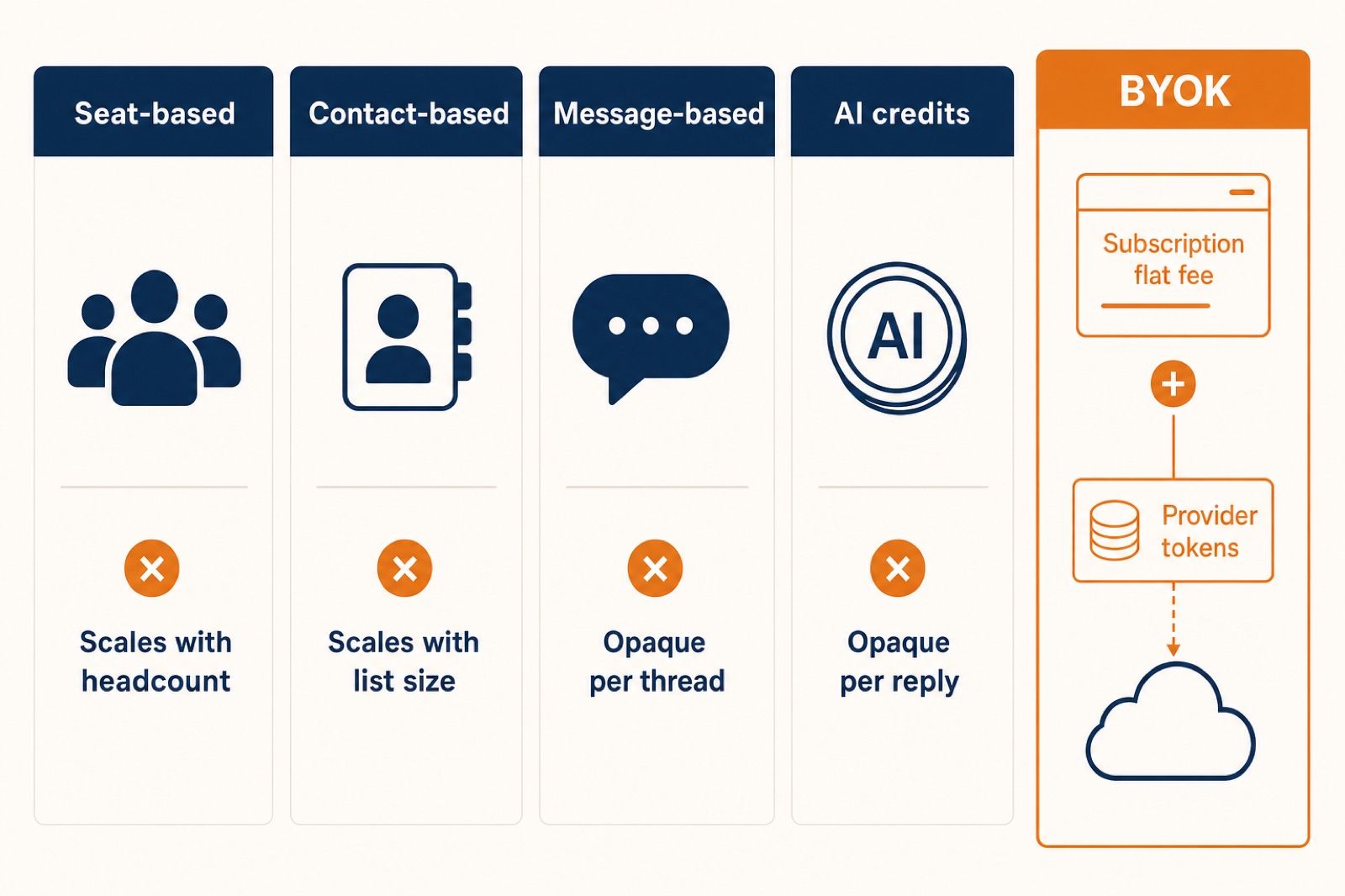
Seat-based SaaS
You pay per agent login. Fine for a three-person shop. Brutal for an agency running twenty client inboxes behind one operations team. Every seat is a tax on headcount that does not correlate with message volume.
Contact-based SaaS
You pay per stored contact or subscriber. Volume grows even when half the list is cold. Instagram commenters and one-time DM askers inflate the denominator fast.
Message- or conversation-based SaaS
Closer to usage, but the unit is often "automated messages sent" or "conversations," not tokens. A single qualified thread might trigger ten small LLM calls inside one "conversation" on the vendor's side while you pay one conversation unit. You cannot optimize what you cannot see.
Bundled "AI credits"
The opaque layer. One credit might equal one GPT-4 class reply, or half a reply, or a "smart" action that chains two models. Credits decouple your mental model (tokens in, tokens out) from the invoice (credits depleted).
BYOK does not eliminate platform subscription cost. It eliminates the hidden inference markup inside credits. That is the lever agencies actually control when client count scales.
Worked example: one agency month, two architectures
Assume a small Instagram-first agency running automated qualification for 10 event-company clients. Each client averages 400 inbound DM threads per month. Each thread needs roughly 6 LLM calls (intent on comments, first reply, three qualification turns, handoff summary). That is 24,000 inference calls per month.
Assume each call averages 800 input tokens and 200 output tokens (short turns, structured prompts). Monthly tokens: about 19.2M input and 4.8M output.
Pricing moves. These numbers use public list rates as a teaching baseline (verify on OpenAI pricing, Groq pricing, OpenRouter model pages before you sign a client SOW).
| Model route (illustrative) | Input $/1M | Output $/1M | Est. monthly inference |
|---|---|---|---|
| GPT-4o mini class | ~$0.15 | ~$0.60 | ~$5.76 |
| GPT-4.1 mini class | ~$0.40 | ~$1.60 | ~$15.36 |
| Llama 3.3 70B on Groq (fast tier) | ~$0.59 | ~$0.79 | ~$15.10 |
Round inference to ~$6 to ~$16 per month for this workload on efficient models.
Now stack the platform side for the same agency:
| Cost line | Closed-stack estimate (illustrative) | BYOK stack (illustrative) |
|---|---|---|
| Base platform (10 clients, pro tiers) | $400 to $1,200/mo (varies by vendor) | $100 to $400/mo platform fee |
| Bundled AI credits / overage | $150 to $600/mo at volume | $0 markup (you pay provider directly) |
| Direct inference (from table) | Included opaque in credits | ~$6 to ~$16/mo |
| **Total (illustrative)** | **$550 to $1,800/mo** | **~$106 to ~$416/mo** |
The gap is not always "90%." It widens when:
- Clients ask long, messy questions (token count rises; credits burn faster on closed stacks).
- You run comment intent on every Reel spike (inference multiplies; BYOK lets you swap to a cheaper model for classification only).
- You add clients without adding seats (seat-based tools punish you; BYOK plus flat platform does not).
The gap narrows when:
- You are on a legacy grandfathered plan with generous AI inclusion.
- Your flows are almost entirely deterministic (no LLM), so you were never paying heavy inference anyway.
- You need enterprise compliance features only a closed vendor offers.
Honest takeaway: BYOK wins hardest on AI-heavy qualification at agency scale, not on a single solopreneur bot with fifty DMs a month.
Why this matters more for Instagram and WhatsApp than for email
Email automation can hide latency. Instagram and WhatsApp cannot.
A DM thread is a real-time negotiation. The prospect expects a reply in seconds. That pushes you toward:
- Fast models (Groq, small OpenAI models) for first touch.
- Heavier models only on handoff summary or edge-case extraction.
- High call count per booking (comment intent, DM open, three qualify turns, WhatsApp handoff text, CRM field extraction).
That call pattern is exactly where bundled credits hurt. It is also where BYOK lets you run a model router: cheap model on comment classification, mid model on in-thread qualify, one premium call on closer-ready summary. OpenRouter makes that a config change, not a vendor roadmap request.
This connects to the inbound side FusionSync installs for event companies: the Instagram OS capture and qualify loop and the WhatsApp pricing mechanics are separate bills from LLM inference. BYOK does not replace Meta template charges or BSP fees. It stops you from paying a second markup on top of the intelligence that decides which template to send inside the free window.
How I implemented BYOK in igthreadly (architecture, not marketing)
Igthready is not "a chatbot." It is a native Meta Graph routing layer plus webhook engine. BYOK is a credential slot in that engine, not a feature flag on a reseller stack.
Credential storage
API keys live encrypted per workspace. The server never logs prompt bodies with the key attached. Rotation is self-serve: paste a new key, old jobs finish on the old key until drain, new traffic uses the new key.
Request path
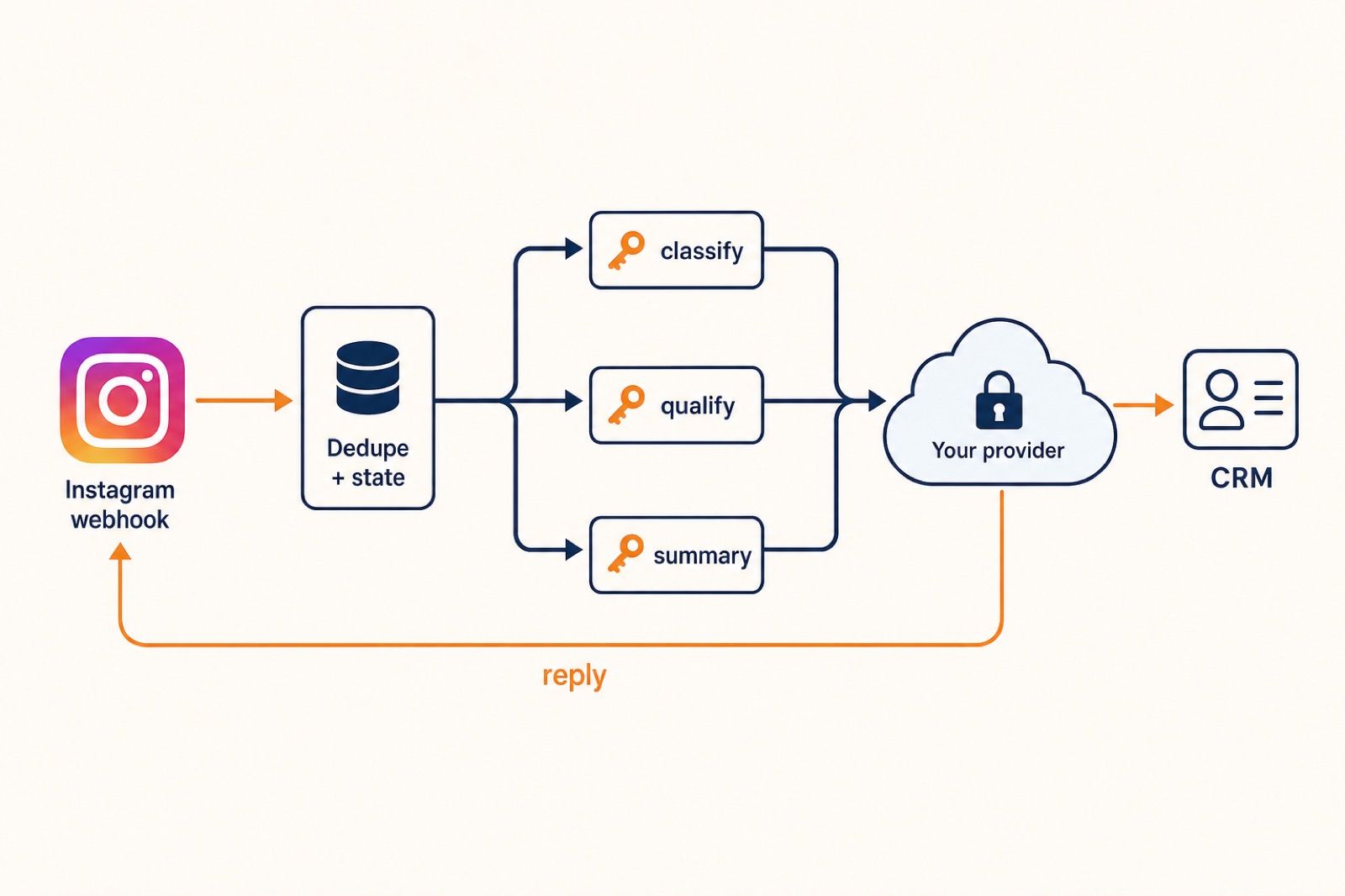
- Instagram webhook hits the ingress (dedupe by sender + message id + timestamp window, same pattern as the open-source Instagram router).
- State machine loads thread context from the database (date, headcount, venue type, labels).
- Router picks model profile for this step:
classify_comment,qualify_turn,handoff_summary. - HTTP call goes from igthreadly to your provider endpoint with your key in the header.
- Reply posts back through Graph API; CRM webhook fires if configured.
The platform fee pays for steps 1, 2, 4's orchestration, and 5. You pay step 4's tokens.
Model profiles (why BYOK is more than a settings field)
Without profiles, teams paste one key and one model and wonder why the bill spiked. With profiles:
| Profile | Typical model class | When it runs |
|---|---|---|
| classify_comment | Small, fast | Reel comment storms |
| qualify_turn | Mid | Each in-DM question |
| handoff_summary | Stronger, once | Label flips to closer-ready |
That is a 60 to 80 percent token savings versus running a flagship model on every hop, before you count SaaS markup removal.
The three surprise bills BYOK does not remove
BYOK is not magic. Agencies still get punched by these if they only optimize LLMs.
1. Meta and WhatsApp metered messaging
Template categories, CTWA windows, and BSP markup are their own game. I wrote the full 2026 map in WhatsApp pricing for event companies. BYOK does not change Meta's per-message rate card.
2. Voice and telephony when you add form-to-call
If you bolt on a 45-second form-to-call layer, Retell, Vapi, Twilio, and carrier minutes are separate from chat inference. BYOK on Instagram does not touch voice COGS.
3. Your own ops cost when webhooks fail
When you own the key, you also own the retry policy, rate limits, and provider outage fallbacks. A closed vendor hides that until credits mysteriously double. BYOK surfaces it on day one. That is a feature for engineers, a tax for teams with no one watching logs.
Closed stack vs BYOK: when each wins
| Dimension | Closed-stack automation SaaS | BYOK (igthreadly-style) |
|---|---|---|
| Time to first bot | Faster (model included) | Slightly slower (key + profile setup) |
| Invoice predictability | Simple until credits run out | Two lines: platform + provider dashboard |
| Cost at 10+ AI-heavy clients | Often worse (markup + tiers) | Often better (direct tokens + model routing) |
| Model choice | Vendor roadmap | You switch models same day |
| Compliance / SOC story | Vendor's certifications | Split: you review provider DPA too |
| Best fit | Low volume, no engineer | Agency scale, technical owner |
If you are an event company owner with two DMs a day, a simple closed tool may be fine. If you are an agency productizing Instagram qualification for thirty venues, BYOK is not a hobbyist optimization. It is margin structure.
What agencies should do this week (checklist)
- Export last month's "AI" line items from your current tool. If the invoice only says "credits," ask support for consumption detail or run a test thread with logging on your side.
- Reconstruct one qualified booking in tokens. Count turns. Multiply by your real prompt size. Compare to provider list price.
- Split models before you split vendors. Moving comment classification to a $0.15-class model often saves more than renegotiating a $99 plan.
- Keep platform spend for routing, not intelligence. Pay for webhook reliability, Graph API compliance, inbox UX, and multi-client workspaces. Do not pay an invisible premium on every token.
- Document keys like production secrets. Rotate quarterly. Separate keys per client workspace if your provider supports sub-accounts or project keys.
FAQ
What does BYOK stand for?
BYOK means Bring Your Own Key. You supply API credentials for an LLM provider (OpenAI, Groq, OpenRouter, Google Gemini, and others). The automation platform routes traffic through your account instead of reselling inference.
Is BYOK only for developers?
No, but it helps to have someone who can read a provider dashboard and set spend limits. The UI can stay no-code; the key management is the technical step.
Does BYOK mean the platform is free?
No. You still pay for the webhook engine, Meta channel integration, inbox, and multi-tenant workspace. You stop paying hidden token markup on top of that.
Can I use multiple models at once?
Yes. That is the main operational win. Classification, qualification, and summarization rarely need the same model. BYOK plus routing profiles is how agencies keep quality while cutting cost.
Is my API key safe on a third-party platform?
Treat it like any production secret: encrypt at rest, restrict scopes, rotate on schedule, and use provider-side spend caps. Review the platform's security page and data processing terms before pasting production keys.
Will Meta ban me for using BYOK automation?
Meta cares about policy-compliant messaging and rate limits, not who bills your OpenAI account. Follow Instagram Platform policies and avoid spammy broadcast patterns.
How does BYOK relate to FusionSync?
FusionSync installs the full inbound operating system for event companies (Instagram capture, WhatsApp handoff, CRM sync). Igthready is the product layer where I dogfood the same Graph-native, BYOK architecture for agencies and technical buyers who want direct control of inference economics.
The bottom line
The SaaS middleman tax on AI automations is not your subscription line. It is bundled inference sold as credits while your client count scales faster than your tier.
BYOK architecture separates the webhook and UI engine from the LLM bill, routes prompts with your key to OpenRouter, Groq, or OpenAI at list pricing, and lets agencies swap models per step instead of per vendor roadmap. On AI-heavy Instagram qualification, the savings are often dramatic; on deterministic flows, they are marginal.
- Audit credits and reconstruct one booking in tokens before you switch tools.
- Split models (classify cheap, qualify mid, summarize once) before you argue about platform fees.
- Remember Meta, WhatsApp, and voice stay metered; BYOK only fixes the intelligence markup.
- Igthready is built as Graph-native routing plus BYOK because agency margin lives in inference volume, not seat count.
If you run event-company inbound and want the full path (not just keys), start with a free 7-day pilot on the FusionSync inbound operating system. If you want a technical audit of your current stack (DM routing, WhatsApp windows, CRM sync, and where inference is leaking money), book a free AI audit and we will map it line by line.
AI-native business systems
Bring a niche, or bring a workflow.
If you run the business, we build the system around it. If you sell into a niche, we build the system behind your offer.
PolarBuild case study →You sell the niche. We build the system.
We never compete for your end clients. One partnership conversation. You fulfil the same system across the accounts in your niche.
Free POC before dedicated software
A three-day sales demo of the system for your vertical before any large software investment. Implementation starts only when someone in that niche pays.
Replicate the niche, not a one-off build
UK dental becomes US dental with a new local partner and new integration targets. Same system thesis, new market.