
Production Teardowns
WhatsApp Pricing 2026: What Event Companies Actually Pay

Meta changed WhatsApp pricing again. Here is the real cost model an event company running Click-to-WhatsApp ads pays in 2026, line by line.
Meta changed how WhatsApp gets billed. The model is cleaner. The surprises moved.
If you are an event company running Instagram-to-WhatsApp inbound, the bill you get from your provider in 2026 looks nothing like the bill you got eighteen months ago. That is not because Meta got greedy. It is because Meta switched from per-conversation pricing to per-message pricing on July 1, 2025, then refreshed the rate cards on April 1, 2026, then quietly bumped marketing rates in specific markets like India by about ten percent on January 1, 2026.
The math is now operationally cleaner. You can predict the bill almost line by line if you know what you are doing. The surprises are different now too, and they hit a specific kind of operator: the one who is winning Click-to-WhatsApp ads on a tight CPL, but bleeding money on the cleanup tail of the campaign.
I have been running this stack for event companies long enough to see the same three "where did that line item come from" moments. This post is what I wish someone had handed me eighteen months ago.
The four categories that decide your bill
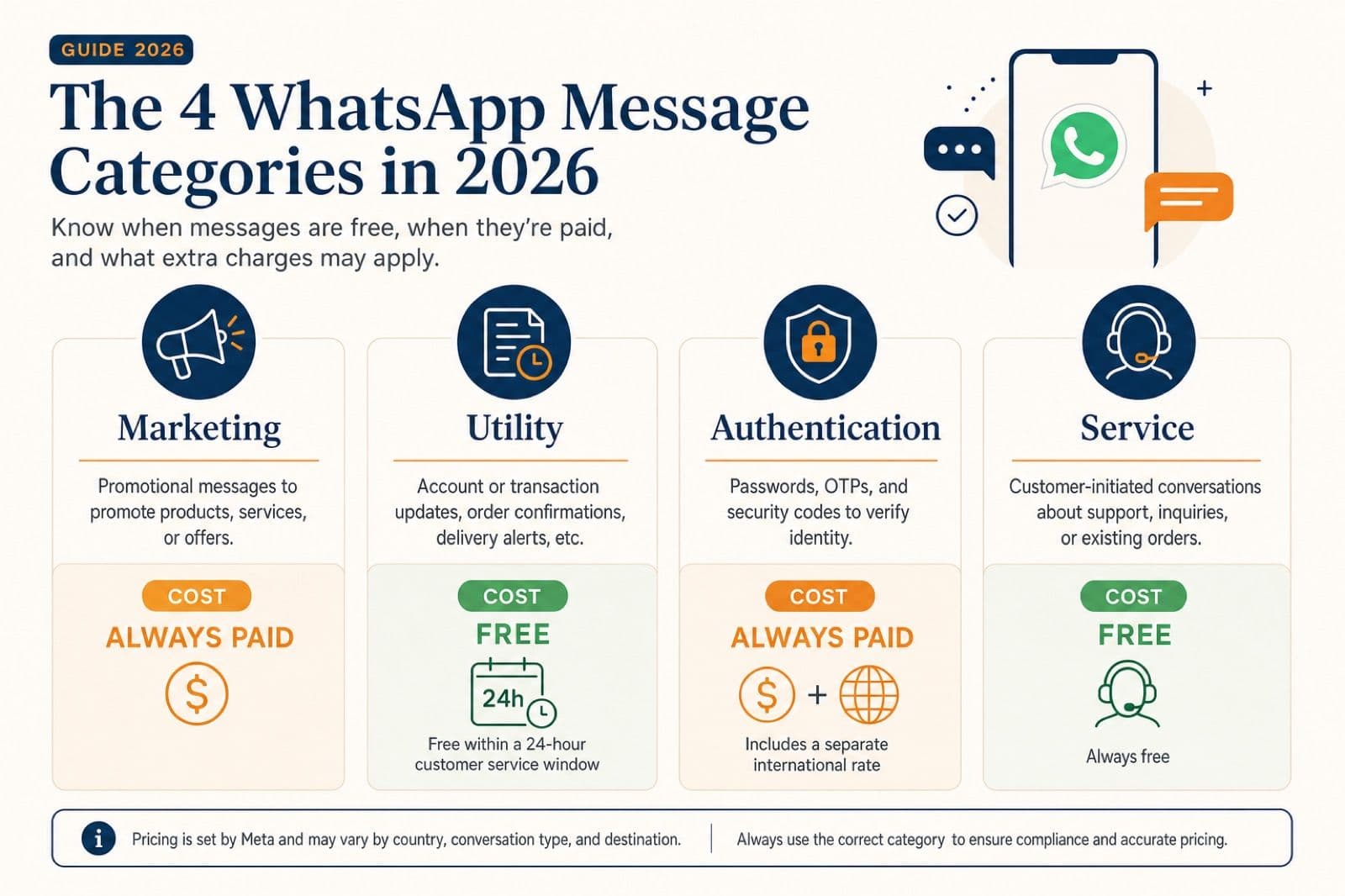
Every WhatsApp template message you send falls into one of four categories, and the category is what Meta charges against. The category is set at template approval time, and once you accept the category you accept the rate.
The mechanics, simplified:
| Category | What it covers | Rate behavior | Free if... |
|---|---|---|---|
| Marketing | Promotions, broadcasts, re-engagement, newsletters | Always billed | Never (no volume discounts) |
| Utility | Booking confirmations, reminders, payment receipts, status updates | Billed when delivered outside an open service window | Sent inside a 24-hour customer-initiated service window |
| Authentication | OTPs, verification codes, login alerts | Always billed (with a separate "International" rate for cross-border OTPs) | Never |
| Service | Free-text reply to a customer-initiated thread, no template | Free, unlimited | Inside the 24-hour customer service window |
Three things to internalize before the rest of this post makes sense.
First, the country code on the customer's WhatsApp number decides the rate, not your business location. A Spanish event planner messaging an Indian bride pays the India rate. A US venue confirming an Indian customer's booking pays the India rate. The rate card is keyed to the recipient.
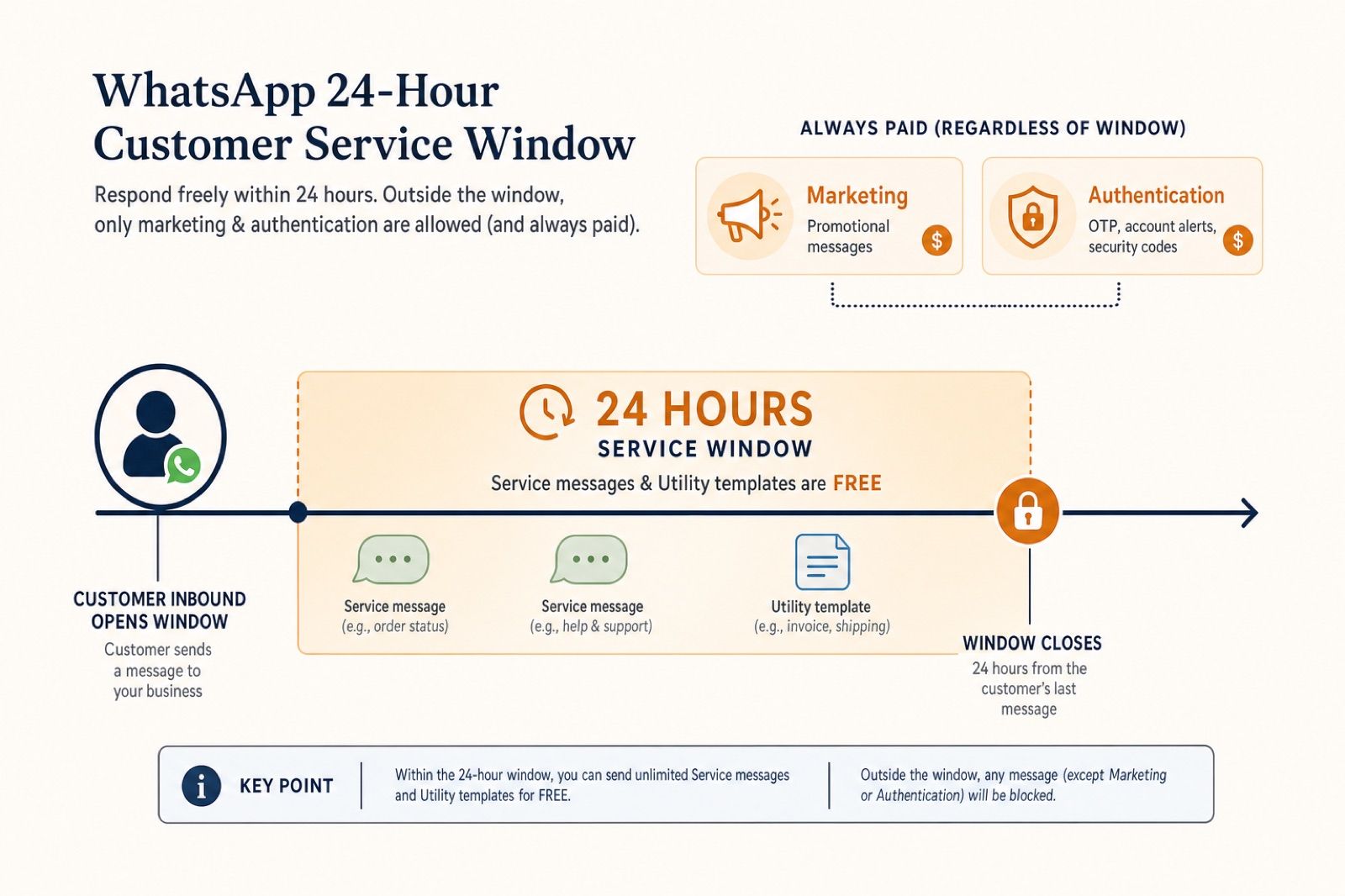
Second, the "service window" is the cheat code. Every time a customer messages you on WhatsApp, a 24-hour service window opens. Inside that window your free-text replies are free, your utility templates are free, and you can run an entire qualification conversation without paying Meta for a single outbound message. The whole point of a well-architected inbound system is to spend as much of the conversation as possible inside that window.
Third, marketing templates are the only category with no volume discounts. Per Meta's pricing docs and confirmed by the Mindlytics India pricing breakdown, marketing messages sit at a flat per-message rate no matter how many you send. Utility and authentication get auto-applied volume tiering that resets monthly. The implication for event companies is sharp: every marketing broadcast is full-price, and there is no negotiation lever.
The 2026 rate card, where event traffic actually lives
Here is the per-message rate card, mapped to the markets event companies usually care about. All values are Meta's base rate before BSP markup, GST, and currency conversion. Cross-check against the official Meta rate page (linked above) before you finalize a budget. Meta does adjust these.
| Market | Marketing | Utility | Authentication | Service |
|---|---|---|---|---|
| India | ₹0.8631 (~$0.011) | ~₹0.115 (~$0.0014) | ~₹0.115 (~$0.0014) | Free |
| Brazil | $0.0625 | $0.0068 | $0.0068 | Free |
| United States | $0.025 | $0.004 | $0.004 | Free |
| United Kingdom | £0.0382 (~$0.048) | £0.0159 (~$0.020) | £0.0159 (~$0.020) | Free |
| Germany | €0.1131 (~$0.124) | €0.0456 (~$0.050) | €0.0456 (~$0.050) | Free |
| UAE | $0.0499 | $0.0157 | $0.0157 (Auth-Intl ~$0.051) | Free |
| Mexico | $0.0305 | $0.0085 | $0.0085 | Free |
| Indonesia | Rp586 (~$0.036) | Rp357 (~$0.022) | Rp357 (~$0.022) | Free |
Two operator readings of this table:
- India and Brazil are cheap on marketing. That is part of why CTWA exploded in those markets, with Forrester research commissioned by Meta showing 92 percent lower cost-per-lead and 94 percent higher conversion versus equivalent landing-page campaigns. An event company in India sending a 1,000-message marketing broadcast pays about ₹863 before fees. The same broadcast to a German list costs roughly €113, or ten times more.
- Western Europe is expensive on marketing. Germany, UK, and France are not great markets to lean on outbound marketing broadcasts as a default. If your guest list is European, plan the architecture so that almost everything happens inside the service window.
For most event companies running Instagram-to-WhatsApp inbound for event bookings, the customer base is concentrated in one or two markets, and you should price your specific market in your operating model. The "global average" is a misleading number.
The CTWA 72-hour window is the second cheat code, and most operators waste it
This is the part of the pricing change most agencies do not explain on a sales call.
When a customer clicks a Click-to-WhatsApp ad and lands in a conversation with you, Meta opens a 72-hour free messaging window. For three days you can send free-text outbound messages to that customer without paying any template charges. Marketing templates, utility templates, the lot. Meta is subsidizing the ad-to-conversation handoff to keep CTWA performance numbers compelling.
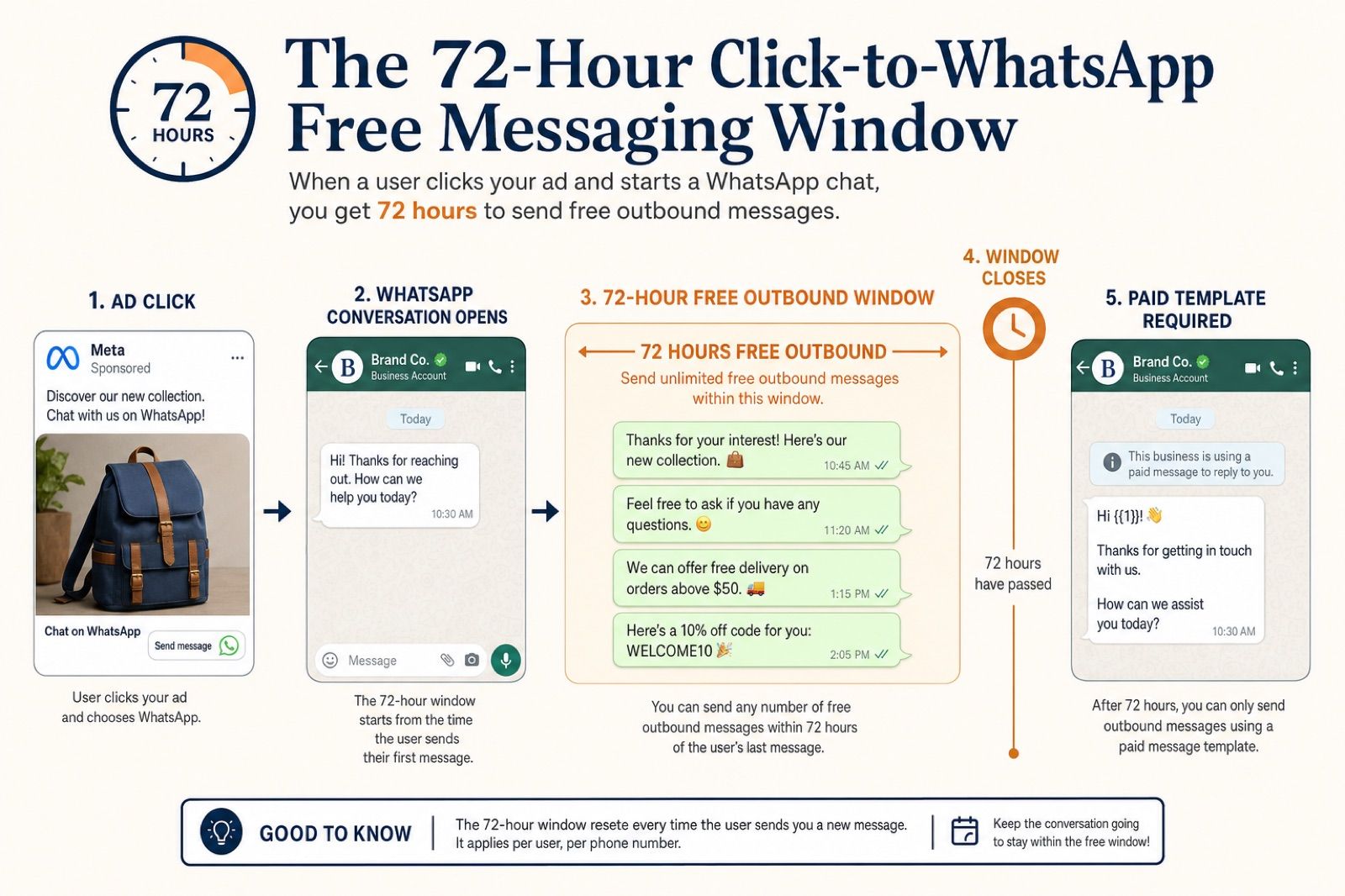
Kanal's 2026 CTWA breakdown puts the operational pattern bluntly: best-in-class operators run qualification, booking, payment, and confirmation inside the 72-hour window. Average operators send a slow drip and leave most of the funnel for after the window closes, when every outbound nudge is a paid marketing template.
The arithmetic difference is brutal once you see it. Imagine 1,000 CTWA ad clicks in a month for an Indian event company. Best case:
- All 700 conversations that reply complete qualification, package selection, and booking inside 72 hours.
- Outbound marketing messages required after the window closes: maybe 50, for stragglers.
- Cost: 50 × ₹0.8631 = ₹43 on marketing templates. Plus a few utility templates for receipts and reminders (mostly inside the service window, so mostly free).
Average case:
- Slow first reply (the CTWA window starts ticking the moment the customer clicks).
- Many leads sit unattended past hour 24 or hour 48. By hour 72, the operator now needs marketing templates to re-engage 400 of the 700 conversations.
- Cost: 400 × ₹0.8631 = ₹345 on marketing templates, plus the same utility flow.
Same campaign, same ad spend, almost ten times the WhatsApp bill on outbound nudging. The variable that drives the difference is not pricing strategy. It is response speed, which is exactly the same operational variable that decides whether the campaign converts at all. Sub-60-second first response on inbound is not a marketing line. It is a pricing line.
The three surprise bills that hit event companies
You can read the rate card cleanly and still get hit by a number you did not budget for. Here are the three I see most often.
1. Marketing-template re-engagement after the 72-hour window closes
Already covered above, but worth stating as its own bullet because most operators do not see it coming. Once the CTWA free window closes, every outbound message is a paid marketing template. The bill is not "the ads cost X." The bill is "the ads cost X plus the tail of templates needed to nudge the slow-replies back into the conversation." Plan for the tail.
2. GST and BSP markup stacking, especially in India
If you operate in India, two costs sit on top of every Meta rate you see published.
- 18 percent GST under OIDAR rules on Meta's charges, since Meta is treated as an imported service. The short version: every Meta line item gets 1.18x'd before it hits your invoice.
- BSP markup on top of Meta's pass-through rates. SetSmart's BSP comparison for 2026 puts the typical markup at 10 to 30 percent in India, with developer-centric providers like Twilio charging a flat $0.005 per message (inbound and outbound, even inside the service window) and SaaS-style providers like Wati bundling a no-code UI for ₹4,000 to ₹25,000 per month plus pass-through Meta rates.
So a marketing message that Meta charges at ₹0.8631 lands in your invoice at about ₹1.04 after a 20 percent BSP markup, then ₹1.23 after GST. That is a 42 percent uplift on the published rate. Multiply by 10,000 messages and you are looking at ₹3,500 of "invisible" cost above what Meta's rate card shows.
3. Authentication-International rate when your booking flow crosses borders
Most event companies that book international guests get bitten by this once. If your WhatsApp Business Account is set up in one country and you send authentication templates (booking access OTPs, account verification codes, payment confirmation OTPs) to a customer in a different country, you trigger the "Authentication-International" rate.
Looking at the UAE row in the rate card above, a domestic authentication template costs about $0.0157. The international rate is roughly $0.051, more than triple. Some markets carry an even bigger gap. If you run a destination wedding business with guests across India, UAE, and the UK, every OTP you fire is potentially at the international rate, and you find out at the end of the month.
The cleaner architecture is to run OTP-free booking flows wherever possible (rely on the WhatsApp identity itself for verification), or to scope OTPs only to the highest-value transactions. Most event-company booking flows do not need an OTP at every step.
A real cost model: 1,000 CTWA leads per month for an Indian event company
Let me make this concrete. Here is the operating shape I see for a mid-sized Indian event company running Click-to-WhatsApp ads as the primary inbound channel.
Inputs
- 1,000 CTWA ad clicks per month, costing about $0.80 each on Meta ads = $800 ad spend
- ~700 of those start a conversation
- Of those, ~250 qualify and ~80 book a date
- BSP: Wati on the ₹4,999/month plan
- 18% GST on everything
Disciplined operator path (everything inside the windows where possible)
| Line item | Quantity | Rate | Sub-total (INR) |
|---|---|---|---|
| Service messages (free-text replies inside 24-hr window) | ~3,500 | Free | 0 |
| Utility templates inside service window (booking confirmations, reminders) | ~600 | Free | 0 |
| Utility templates outside service window (a few day-of reminders) | ~150 | ₹0.115 | 17 |
| Marketing templates (re-engagement after 72-hr CTWA window) | ~80 | ₹0.8631 | 69 |
| Authentication templates (domestic OTPs for booking access) | ~50 | ₹0.115 | 6 |
| **Meta sub-total** | . | . | **₹92** |
| BSP platform fee (Wati mid-tier) | 1 | flat | ₹4,999 |
| BSP per-message markup (~20% on Meta) | . | . | ₹18 |
| **Sub-total before GST** | . | . | **₹5,109** |
| GST (18%) | . | . | ₹920 |
| **Total monthly WhatsApp cost** | . | . | **~₹6,029 (~$72)** |
For roughly $72 a month plus your ad spend, you can run a clean 1,000-click CTWA pipeline.
Careless operator path (slow replies, weekly marketing broadcast to past leads)
| Line item | Quantity | Rate | Sub-total (INR) |
|---|---|---|---|
| Utility templates outside service window (because replies were slow and windows closed) | ~600 | ₹0.115 | 69 |
| Marketing templates for in-campaign re-engagement (windows closed) | ~400 | ₹0.8631 | 345 |
| Marketing broadcast to 10,000 past inquiries | 10,000 | ₹0.8631 | 8,631 |
| Authentication-International OTPs (booking flow misconfigured) | ~100 | ~₹2.93 | 293 |
| **Meta sub-total** | . | . | **₹9,338** |
| BSP platform fee (Wati mid-tier) | 1 | flat | ₹4,999 |
| BSP per-message markup (~20% on Meta) | . | . | ₹1,868 |
| **Sub-total before GST** | . | . | **₹16,205** |
| GST (18%) | . | . | ₹2,917 |
| **Total monthly WhatsApp cost** | . | . | **~₹19,122 (~$230)** |
Same 1,000 leads, same ad spend. The careless operator pays roughly 3.2x what the disciplined operator pays, before they have even talked about conversion. The difference is architecture and response speed, not pricing.
The compounding lesson is uncomfortable: WhatsApp pricing rewards exactly the operational behaviors that also convert better. Fast reply, in-channel qualification, booking inside the service window. The same discipline that moves the booking rate from 8 percent to 18 percent moves the WhatsApp bill from $230 to $72.
How to architect to stay in the cheaper categories
Five rules, in priority order, for any event company running this stack.
- Treat the 72-hour CTWA window as the primary qualification surface. Front-load capture, qualification, package selection, and date-check inside the window. Build your AI qualifier and your closer routing around this window, not around an idealized funnel.
- Keep conversations inside the 24-hour service window as the default. Every time the customer messages you, that window resets. Reply fast enough that the customer wants to continue, and the cost of the next 24 hours of outbound stays at zero.
- Use utility templates, not marketing templates, for booking confirmations and reminders. Submit those templates under the "utility" category at approval time, write them in transactional voice, and time them inside the service window where possible. Audit what your provider has actually classified each template as; mis-categorized templates are the most common single line item in a surprise bill.
- Pick the BSP that matches your geography and volume. Twilio is great for developer-led teams that already run on the Twilio stack. 360dialog tends to be cheapest at high volume due to pass-through Meta rates plus a flat platform fee. Wati and Interakt fit Indian SMBs that want a built-in inbox. Gupshup wins on Indian and SEA volume rates. Match the tool to the operating shape, not the pitch.
- Audit the bill monthly, per template, not per channel. Most operators look at "WhatsApp spent X this month" and move on. The useful unit is "this specific template fired Y times at Z rate." The first surprise bill almost always traces to one mis-categorized template firing thousands of times when it should have been utility instead of marketing, or domestic auth instead of international.
If you want to see this architecture running on real campaigns, I broke down where event company inbound leaks at five specific points and how the Instagram OS layer routes DMs into WhatsApp without resetting the thread. Both are adjacent reads, not retreads of this post.
A short note on the BSPs that matter in 2026
There are dozens of BSPs and most of them market identically. Four of them cover almost every real event-company use case I see:
| BSP | Pricing shape | Best for |
|---|---|---|
| Twilio | $0/mo platform + $0.005/msg + Meta pass-through | Developer-led teams already on Twilio stack |
| 360dialog | ~$49/mo + pass-through Meta + flat $0.005/msg | High-volume senders who want clean accounting |
| Wati | ₹4,999 to ₹24,999/mo + Meta pass-through | Indian SMBs that need a built-in inbox |
| Gupshup | $10-80/mo + $0.001-$0.004 markup/msg | India and SEA-focused high-volume senders |
Twilio's published WhatsApp pricing page is one of the few BSP rate pages that publishes the per-message platform fee transparently. Most others bury it in the contract. Ask for a per-message markup figure in writing before you sign.
FAQ
Did WhatsApp Business API get more expensive in 2026?
Mixed. The model shift from per-conversation to per-message billing in mid-2025 made the math cleaner and, for most operators, slightly cheaper on a per-conversation basis. The January 2026 marketing rate updates raised marketing template costs in some markets like India by about 10 percent, while leaving utility and authentication rates stable. The April 2026 rate card update was a routine refresh, not a major change. Net for most event companies running CTWA: roughly flat or slightly cheaper than 2024, if they architect around the service window and the 72-hour CTWA window.
What is the cheapest WhatsApp BSP for an Indian event company?
Volume-dependent. Below 2,000 messages a month, the per-message markup difference does not matter and the question is which platform you actually want to use day-to-day. Above 10,000 messages a month, 360dialog's flat-fee model and Gupshup's volume tiers tend to win on total cost. Wati is the most popular Indian SMB pick because of the built-in inbox and no-code flow builder, not because it is cheapest per message. Match the tool to your operating shape and your team's appetite for engineering work.
Are Click-to-WhatsApp ads worth it for event companies?
For most service businesses operating in WhatsApp-primary markets (India, Brazil, LATAM, MENA, parts of SEA, Spain, Italy, Turkey), CTWA outperforms equivalent landing-page campaigns on cost-per-lead by 40 to 70 percent, and Meta's commissioned Forrester study puts the conversion improvement at 94 percent over landing-page ads. The catch is that the unit economics only work if you actually staff the WhatsApp conversation that follows the click. CTWA without a working qualification system is just a more expensive way to get DM volume.
What is the 72-hour free messaging window?
When a customer clicks a CTWA ad and starts a conversation, Meta gives you 72 hours of free outbound messaging (template messages of any category are free in this window) as long as the conversation stays active. The window is the highest-leverage part of the entire WhatsApp pricing model. Architect your qualification and booking flow around it.
What is the difference between a marketing template and a utility template?
Marketing templates are promotional: offers, broadcasts, re-engagement, newsletters. Utility templates are transactional: booking confirmations, reminders, payment receipts, status updates. Marketing is always billed. Utility is free inside an open 24-hour customer service window and billed when sent outside it. The category is assigned at template approval time, and Meta will reject or reclassify templates that look promotional but are submitted as utility. Get this right at approval, not after the bills start arriving.
Should I worry about authentication-international rates?
Only if you run a booking flow that fires OTPs across borders, or if your WhatsApp Business Account is registered in a different country from where your customers are. For most domestically-focused event companies, the standard authentication rate applies and authentication-international is irrelevant. If you book international guests, audit which OTPs cross borders and consider removing OTPs from non-critical steps in the flow.
Where can I see Meta's current rate card?
Meta publishes the per-market WhatsApp rate card on its developer docs (linked at the top of this post). Meta updates it periodically (April 1 and January 1 are common refresh dates). Always check the live page before finalizing a budget. Aggregator articles, including this one, can lag the rate card by months.
The bottom line
WhatsApp pricing in 2026 is more predictable than it has ever been, which means there is no excuse for getting surprised by the bill. The dollars that move in and out are decided by category, by service window, by 72-hour CTWA window, and by BSP markup, not by Meta's mood. Event companies that architect the inbound system around those four levers run lean WhatsApp campaigns. The ones that do not pay two to three times more for the same conversation volume.
- The four categories that decide your bill are marketing, utility, authentication, and service. Marketing is always paid and never volume-discounted. Service messages and utility templates inside the service window are free.
- The customer's country code decides the rate, not your business location. India and Brazil are cheap on marketing. Germany and the UK are expensive.
- The 72-hour CTWA window is the highest-leverage part of the pricing model. Front-load qualification and booking inside it, and the WhatsApp bill on a CTWA campaign drops sharply.
- The three surprise bills that hit event companies are marketing-template re-engagement after the 72-hour window, GST plus BSP markup stacking (especially in India), and authentication-international rates triggered by cross-border booking flows. All three are avoidable with architecture.
- Disciplined operators pay roughly one-third what careless operators pay for the same inbound volume. The variable that decides which one you are is response speed and template category discipline, not pricing strategy.
If you want to see this running on your own inbound, we run a free 7-day production pilot on one campaign you choose, or a free AI audit if you want to model your actual CTWA economics before you commit to a build. Both start with a short call. The pilot is the right move if you have meaningful CTWA volume already running. The audit is the right move if you want the cost model and the leak map first, and the build later. Either way, the conversation starts in the same place: where does the WhatsApp bill actually go in your operation today.
AI-native business systems
Bring a niche, or bring a workflow.
If you run the business, we build the system around it. If you sell into a niche, we build the system behind your offer.
PolarBuild case study →You sell the niche. We build the system.
We never compete for your end clients. One partnership conversation. You fulfil the same system across the accounts in your niche.
Free POC before dedicated software
A three-day sales demo of the system for your vertical before any large software investment. Implementation starts only when someone in that niche pays.
Replicate the niche, not a one-off build
UK dental becomes US dental with a new local partner and new integration targets. Same system thesis, new market.