
Inbound Lead Management
How missed Saturday DMs cost Goa yacht operators ₹3L+

Updated
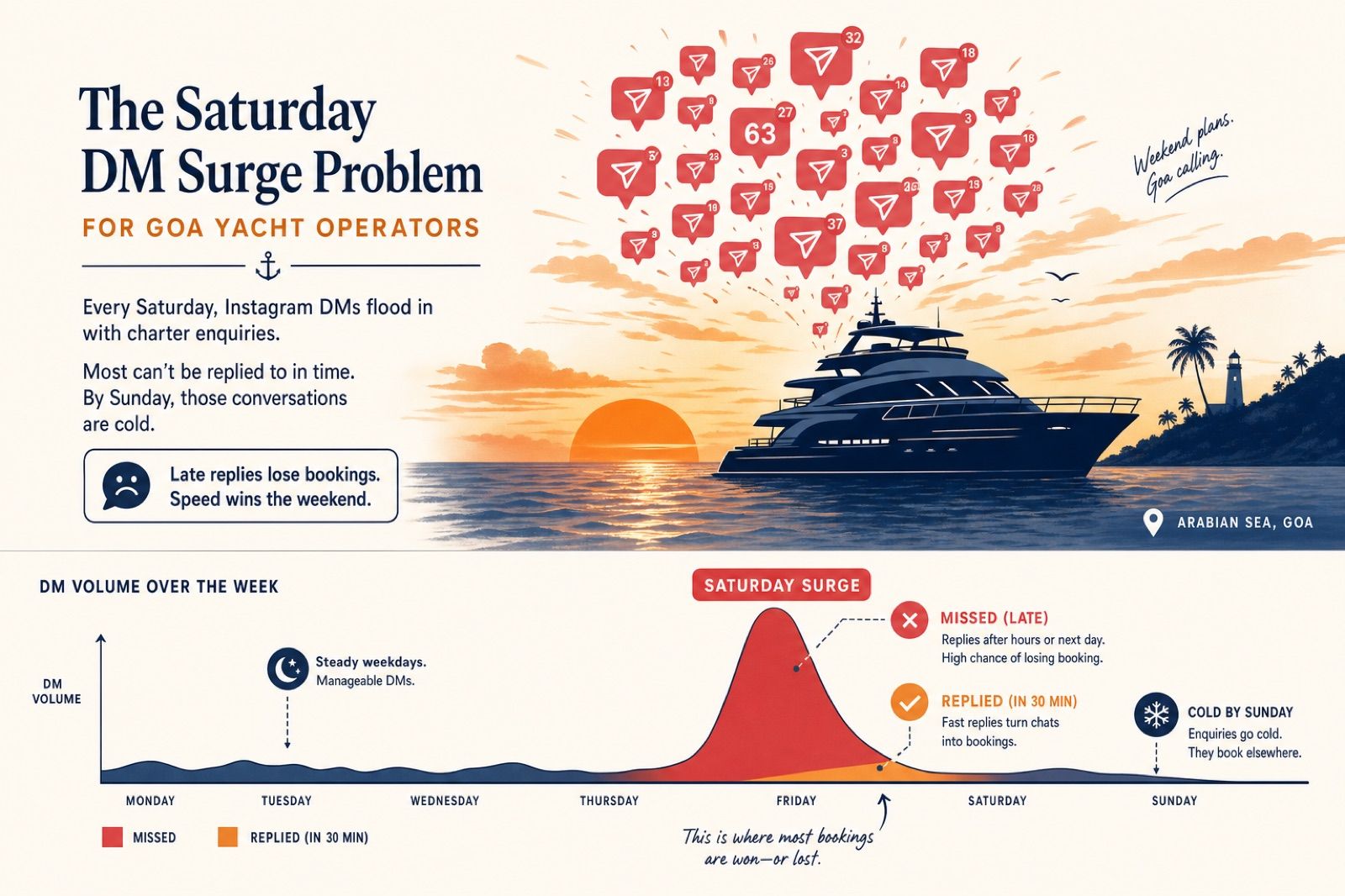
Goa yacht operators lose ₹3-6 lakh a month to missed Saturday DMs. The math, with real per-slot pricing, and the fix that closes the leak.
Goa yacht operators are leaking revenue on Saturday, not on price
I have been mapping the Instagram-to-WhatsApp flow for experience-event operators long enough to see the same pattern across Goa yacht businesses. The flow is consistent. The pricing is in the same range. The DM volume is heavy and bursty. The conversion gap is almost entirely created by how an operator handles Saturday between roughly 4 PM and 11 PM.
That window is where the booking decisions happen. Group sizes get finalised, dates get locked, a partner says yes or no, and someone messages a yacht operator on Instagram saying "still free for tomorrow evening?" If the reply arrives 90 seconds later, the booking usually happens. If the reply arrives 6 hours later when the operator catches up Sunday morning, the booking has already gone to someone else, or the group has decided to do something cheaper.
This post is the operator math for that gap, using real per-slot pricing from named Goa yacht operators, indicative DM volume for a mid-sized Instagram presence, and a workable Instagram-to-WhatsApp flow that closes the leak. The number for a typical Goa yacht operator is ₹3 to ₹6 lakh of recoverable monthly revenue, with the upper end going past ₹10 lakh once the operator runs at full capacity. I want to walk you through how that number is built so you can plug in your own inputs.
For broader context on where Instagram inbound dies for event businesses, the Instagram DM revenue leak teardown covers the cross-archetype shape. This post zooms into one archetype with arithmetic.
The booking shape for Goa yacht operators
Goa has a mature, fragmented yacht-charter market. The operators worth naming, all Instagram-active and all using a similar Instagram-driven discovery flow, include FunAway, Yacht Club India, Fun Cruises Goa, Cruise De Goa, Nirvana Cruise, Ripples Cruise, Gateway Fun Sailing, and Super Yacht Goa. Different fleets, different size points, different vibe. Same funnel shape.
Pricing is public and consistent enough to model. Pulled directly from operator sites:
| Operator | Yacht | Slot | Indicative rate |
|---|---|---|---|
| Fun Cruises Goa | Funliner | 1 hour cruise | ₹11,000 |
| Fun Cruises Goa | Sunset 42 (evening) | 1 hour cruise + 1 hour anchorage | ₹26,000 |
| Fun Cruises Goa | Polaris (20 pax) | 1.5 hour cruise + 30 min anchorage | ₹40,500 |
| Yacht Club India | Private charter | Per-slot, sunset preferred | ₹18,000 to ₹40,000 indicative |
| Cruise De Goa | Dinner cruise | Per ticket | ₹1,500 to ₹3,500 per head, group bookings stack |
A reasonable mid-point for the average booking across the segment, weighing private charters more than per-head dinner cruise tickets, is about ₹18,000. Some operators run lower, some run substantially higher. The point of the model is that you can substitute your own.
The funnel is the same everywhere. A reel goes up, often a sunset sail with friends, drone footage of the yacht against the Arabian Sea, sometimes a celebration. Comments accumulate. People DM. Standard questions: "how much for this Saturday", "do you have Friday evening free for 8 people", "what's included", "can we get food onboard", "is the upper deck included", "do you do birthday decor". The operator's job is to capture these, answer them quickly with enough specificity to keep intent warm, push the conversation to WhatsApp where confirmation and payment happen, and confirm a slot.
When the funnel works, an inbound DM closes inside 90 minutes. When it doesn't, the DM dies between three and twelve hours later with a one-line "ok thanks" that never comes back.
Where the revenue leaks for this archetype
Five failure modes show up across nearly every Goa yacht operator I have looked at. They are specific enough to fix.
1. The Saturday surge collides with thin staffing. Most Goa yacht operators have one or two people running Instagram. Saturday between 4 PM and 11 PM is when 35 to 45 percent of the weekly DM volume hits. The same window is also when those staff members are operating live charters or off the clock. A 90-minute reply is the floor on Tuesday. On Saturday evening it is 4 to 8 hours.
2. Slot availability is the unanswered question. Yacht slots are time-bound and limited. The customer's first question after price is usually "is Saturday still open" or "what about tomorrow morning". This is the question that decides the booking. If the operator cannot confirm slot availability in under 10 minutes, the customer DMs another operator. The 5-minute rule applies harder here than almost any other category. The 60-second response system for inbound is the broader case for why this matters.
3. The Instagram to WhatsApp handoff loses thread context. The customer asks about Friday sunset for 6 people on Instagram. The operator replies, sends a WhatsApp number, and the customer messages "hi" on WhatsApp. The full context, date, group size, occasion, sometimes price already shared, is gone. The customer is forced to re-explain. Drop-off at this step is significant, partly because the customer has just done that work and partly because by the time they re-message they are already comparing other operators.
4. The payment link sits unsent. A surprising amount of revenue dies between "yes I want to book Saturday sunset for 6" and "here is the payment link". This is the gap that follow-up automation closes. A single nudge 30 minutes after a payment link goes out has a meaningful recovery rate.
5. No structured re-engagement. Cold threads are not re-touched. A DM from someone who asked about a yacht three weeks ago, never booked, and is now planning a friend's birthday is a lead with strong intent. Most operators have no system to surface that thread. Recovery campaigns for this archetype are some of the highest-ROI work an operator can run.
The event companies WhatsApp playbook covers the close side of this in more detail. The leak is upstream though, in the DM-to-WhatsApp move.
The operator math model
This is the artifact. The numbers are an indicative model for a mid-sized Goa yacht operator. Plug in your own to get your delta.
Inputs
| Input | Value | Source |
|---|---|---|
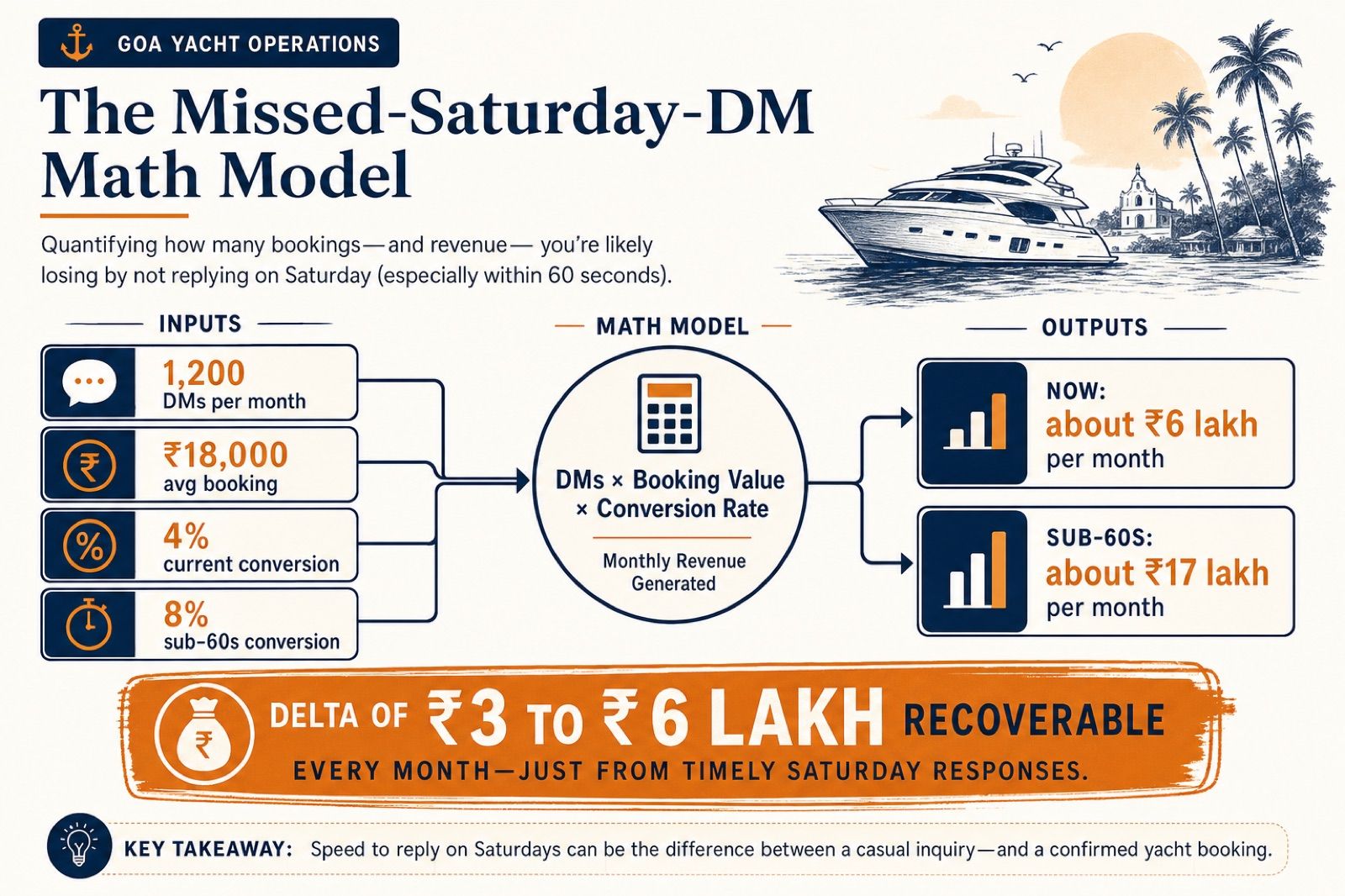
| Monthly Instagram DM volume | 1,200 | indicative for an operator at 25-60k followers, 6-10 reels per month |
| Share of DMs in Saturday window (Fri 6 PM to Sun noon) | 40 percent | observed surge behaviour |
| Weekday DM volume | 720 | 1,200 minus Saturday cluster |
| Saturday-cluster DM volume | 480 | 40 percent of 1,200 |
| Conversion if first reply lands within 60 seconds | 8 percent | recoverable rate, slightly below cited research highs to stay conservative |
| Conversion if first reply lands within 1-4 hours | 4 percent | typical weekday performance with one staff member |
| Conversion if first reply lands within 6-12 hours | 1 percent | typical Saturday performance for an unstaffed window |
| Average booking value | ₹18,000 | weighted average across operators above |
Current-state monthly revenue from Instagram DMs
Weekday DM revenue: 720 weekday DMs at 4 percent conversion equals 28.8 bookings. At ₹18,000 each that is ₹5.18 lakh.
Saturday-cluster DM revenue: 480 Saturday-cluster DMs at 1 percent conversion equals 4.8 bookings. At ₹18,000 each that is ₹0.86 lakh.
Current state monthly Instagram-driven bookings: 33.6 bookings, ₹6.05 lakh.
Sub-60-second response state
If the same volume flows through a system where the first response lands inside 60 seconds and the qualification questions are answered structurally before a human ever sees the thread, the conversion rate climbs toward the high single digits.
Apply 8 percent uniformly: 1,200 DMs at 8 percent equals 96 bookings. At ₹18,000 each that is ₹17.28 lakh.
Delta
Monthly delta: ₹17.28 lakh minus ₹6.05 lakh equals ₹11.23 lakh.
That is the optimistic ceiling, assuming full conversion lift across the whole funnel and no booking-capacity ceiling. Real-world recovery sits between 30 and 50 percent of that ceiling once you factor in operator capacity, weather cancellations, refunds, and the slow shift in Saturday performance.
A conservative landing: ₹3 to ₹6 lakh per month of recoverable revenue for a mid-sized Goa yacht operator. The number scales with average booking value and Instagram volume. Larger operators with ₹30,000 average bookings and 40 percent more DM volume comfortably push the recoverable amount into ₹10 lakh-plus territory.
The Instagram-to-WhatsApp flow that closes the leak
The system that recovers the delta is not a chatbot bolted onto Instagram. It is a coordinated sequence across three channels: Instagram comment, Instagram DM, and WhatsApp. The shape that works for yacht operators looks like this.
Message 1, public. Reel posted. Customer comments "price for Sunday evening for 6?"
Message 2, public reply. Auto-reply on the comment, within seconds: "Sent you a DM with options for Sunday evening for groups of 6." This signals to other readers that the operator replies fast. It also creates social proof in the comments.
Message 3, DM, instant. Inside the DM: "Hey, thanks for asking. Sunday evening still has the 5 PM sunset slot open on the Polaris (up to 20 pax) and the Funliner (up to 8 pax). Quick three questions so I can confirm the right boat: 1. How many guests? 2. Any add-ons (decor, cake, DJ, drone)? 3. Departure preference, Mandovi or Aguada side?" Three structured questions, not one open-ended "what are you looking for".
Message 4, DM, customer reply. Customer answers in DM. "6 people, just decor and cake, Mandovi side."
Message 5, DM, channel move. "Got it. Sunday 5 PM sunset, Funliner, 6 people, decor and cake, Mandovi. The full quote with photos and the booking link is on WhatsApp. Tap here to continue: [wa.me link with the customer's name and request pre-filled]."
Message 6, WhatsApp, instant. WhatsApp template message lands with all the context the customer just gave on Instagram already populated: date, time, boat, group size, add-ons, area, indicative price, and the booking link.
Message 7, WhatsApp, customer. Customer confirms or asks one more question. Average is one clarifying question, usually about pickup logistics or food.
Message 8, WhatsApp, payment link. Payment link sent. Calendar hold created on the operator side.
Message 9, WhatsApp, 30-minute follow-up. If the payment link is not used within 30 minutes, a nudge: "Sunday 5 PM is held for the next 30 minutes. Tap when ready: [link]. After that the slot opens up again." Time-bounded scarcity, not manipulation, because the slot literally does open up again.
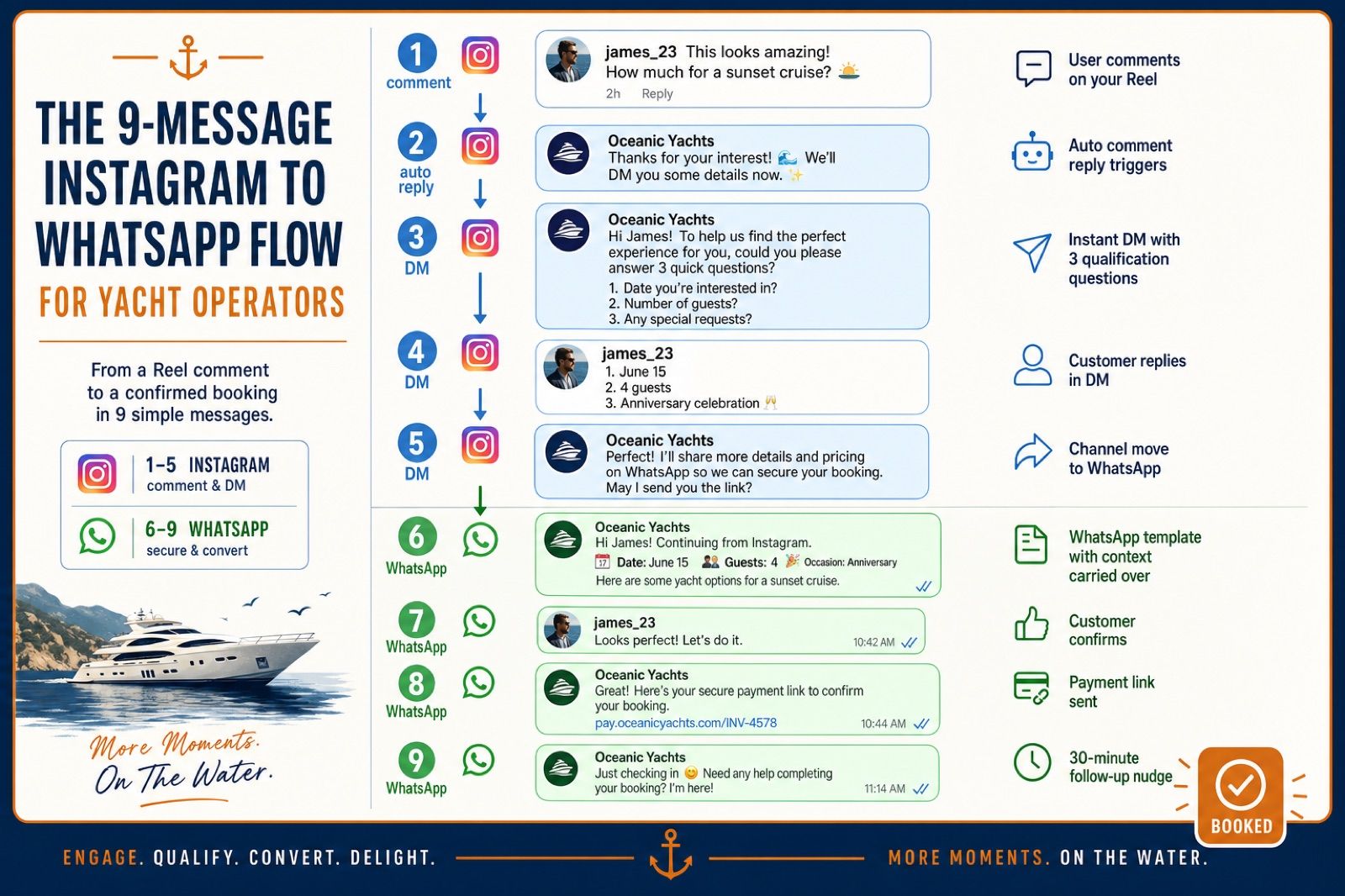
The carry-over of context between Instagram and WhatsApp is the part operators get wrong most often. It is also the part that decides drop-off rate.
What to instrument
Five numbers an operator should see every Monday morning. None of them require a CRM. A spreadsheet works.
| Metric | What it tells you |
|---|---|
| Median time to first reply on Instagram DMs | The leading indicator of conversion rate |
| Saturday surge multiplier | DM count Fri 6 PM to Sun noon, divided by weekday daily average. A healthy operator sits between 1.5 and 2.5. Above 3 means you have an unstaffed weekend. |
| DM-to-WhatsApp transition rate | Of qualified DMs, how many actually arrive on WhatsApp with context intact. Target 80 percent or higher. |
| WhatsApp-to-booking conversion | Of WhatsApp threads that received a payment link, how many paid. Target 35-50 percent. |
| 30-minute payment-nudge recovery rate | Of nudges sent, how many converted within 24 hours. Target 15-25 percent. |
If these five numbers move in the right direction, the ₹3 to ₹6 lakh delta is no longer theoretical.
FAQ
Does this work for operators below 20,000 Instagram followers?
Yes, with smaller numbers. A 5,000-follower operator running 4 reels a month generates roughly 250-400 DMs a month. The same percentages apply, the recoverable delta is smaller in absolute terms but a higher fraction of monthly revenue because smaller operators usually have fewer paid channels. The fix is the same.
What if our team is only available 10 AM to 7 PM?
That is the most common case. The sub-60-second first response is automated. A human takes over once the customer hits WhatsApp with a structured set of answers. Saturday evening is the highest-leverage automation window because that is when the team is least available and the customer is most ready to book.
How fast can we set this up before peak season?
The flow above takes 5 to 10 days to install for a single operator. Most of the work is the WhatsApp template approval through Meta, mapping the boat-and-slot inventory, and writing the three qualification questions per yacht class. The Instagram auto-reply and DM responder are quick once the boat inventory is mapped.
Do we still need a human on Saturday?
For closing, yes. The system qualifies and routes. A human confirms the booking on WhatsApp and handles edge cases like custom decor or unusual group dynamics. The shift is from "the team is the first responder" to "the team is the closer". For a 4-yacht operator, one person can close from a phone all Saturday evening.
What about Hindi and regional language DMs?
Most yacht operators in Goa get a mix of English, Hindi, and the occasional Marathi or Konkani. The DM responder should support all three at minimum. Intent classification works across languages with current models; the canned response templates need translation but the routing logic does not change.
How does this play with Meta lead ads?
Click-to-WhatsApp ads land directly on WhatsApp with no Instagram DM step. The flow shortens to messages 6 through 9 above. CTWA leads convert better but cost more per click. For a yacht operator, organic Instagram DMs at 8 percent conversion are usually cheaper per booking than CTWA at 12 percent conversion, once you factor in cost-per-click.
The bottom line
Goa yacht operators are not losing revenue because Instagram volume is low. They are losing it because the Saturday window collides with thin staffing and there is no system to capture intent while it is hot.
- The leak is concrete. Around ₹3 to ₹6 lakh per month for a mid-sized operator, more for larger ones.
- The fix is a nine-message Instagram-to-WhatsApp flow with auto-replies, structured qualification, context carry-over, and a 30-minute payment nudge.
- The math model substitutes cleanly. Plug in your own DM volume and average booking value to get your number.
- The five Monday-morning metrics tell you whether the system is working without needing a CRM.
- Most importantly, this is not a chatbot. It is a coordinated routing layer between channels you already use, with a human closing on WhatsApp.
If you want to see the architecture against your inbound, I run a free 7-day pilot where we install the flow on one campaign or set of reels and you get the system live for a cost-free week. If you want the audit version first, the free AI audit walks your current inbound shape and where the math says your delta is. Either way, the goal is the same: stop losing Saturday.
AI-native business systems
Bring a niche, or bring a workflow.
If you run the business, we build the system around it. If you sell into a niche, we build the system behind your offer.
PolarBuild case study →You sell the niche. We build the system.
We never compete for your end clients. One partnership conversation. You fulfil the same system across the accounts in your niche.
Free POC before dedicated software
A three-day sales demo of the system for your vertical before any large software investment. Implementation starts only when someone in that niche pays.
Replicate the niche, not a one-off build
UK dental becomes US dental with a new local partner and new integration targets. Same system thesis, new market.