
Company Notes
Best GPT-5.6 Model for AI Receptionists (Sol vs Terra)

GPT-5.6 ships as Sol, Terra, and Luna. Here is which tier to route for FAQs, booking tool-calls, and escalations on a production AI receptionist.
GPT-5.6 is public. The receptionist question is routing, not picking one model
OpenAI moved GPT-5.6 Sol, Terra, and Luna from a limited preview into broader public rollout in July 2026. Most of the coverage so far compares coding benchmarks or argues about API list prices. Almost none of it answers the question that matters if you run or build an AI voice agent for lead response: which of the three should handle which part of a receptionist workload?
The short answer: you should not run every call through the flagship. A receptionist stack is a mix of high-volume, low-stakes turns and low-volume, high-stakes turns. GPT-5.6 finally gives you three durable capability tiers at three price points, which is exactly the shape a routed receptionist architecture wants.
This post is a deployment strategy based on OpenAI's published tiering and launch-day pricing. We have not run GPT-5.6 in production on a live receptionist yet, so treat the routing map as an implementation plan, not a benchmark bake-off.
The three models, in plain terms
GPT-5.6 is a family, not a single model. The number marks the generation. Sol, Terra, and Luna mark capability tiers that can advance on their own schedule, which is a cleaner mental model than the older naming churn.
| Model | Model ID | Input (per 1M) | Output (per 1M) | Positioning |
|---|---|---|---|---|
| GPT-5.6 Sol | gpt-5.6-sol | $5.00 | $30.00 | Flagship tier for hardest reasoning and agentic work. |
| GPT-5.6 Terra | gpt-5.6-terra | $2.50 | $15.00 | Balanced tier for high-volume production and customer support. |
| GPT-5.6 Luna | gpt-5.6-luna | $1.00 | $6.00 | Fast, cheap tier for FAQs, routing, and routine automation. |
A few launch-day details worth keeping in the architecture notes:
- Terra is not a compromise tier. OpenAI positions it directly in the customer-support bucket. You do not have to stretch to justify Terra on a receptionist line.
- Luna is a new production bracket. There is no obvious GPT-5.x predecessor at $1/$6. That matters because FAQ traffic is where receptionist margins live or die.
- Prompt caching changed with 5.6. Per OpenAI's launch notes, cache writes bill at 1.25x uncached input and cache reads keep the 90% discount. Receptionist systems with stable system prompts and tool schemas should model caching into the unit economics from day one.
Pricing and access can still move during a fresh rollout. Use the table as launch figures, not permanent gospel.
Map tiers to receptionist tasks, not to vanity benchmarks
Not every inbound turn needs frontier reasoning. Routing everything through Sol is either overkill on cost or a sign that your intent classifier is not doing its job. Routing everything through Luna is how you get a cheerful receptionist that mishandles edge cases.
| Receptionist task | Recommended model | Why |
|---|---|---|
| FAQs: hours, location, parking, services, rough pricing bands | Luna | High volume, low complexity. Latency and cost matter more than depth. |
| Booking, rescheduling, calendar tool-calls, CRM writes | Terra | Reliable tool-use and multi-step reasoning at a rate that still works across hundreds of calls per day. This is the production default OpenAI built Terra for. |
| Complex requests, policy exceptions, frustrated callers, escalation decisions | Sol | Lower volume, higher stakes. These turns are rare but expensive to get wrong. |
| Post-call summarization, transcript cleanup, structured field extraction | Luna | Offline or async work. Perfect fit for the cheap tier. |
| Supervisor review of a flagged call before human handoff | Terra or Sol | Terra if the issue is procedural. Sol if the caller is ambiguous, emotional, or legally sensitive. |
The logic is simple: match cost to call volume, and reasoning depth to actual task complexity.
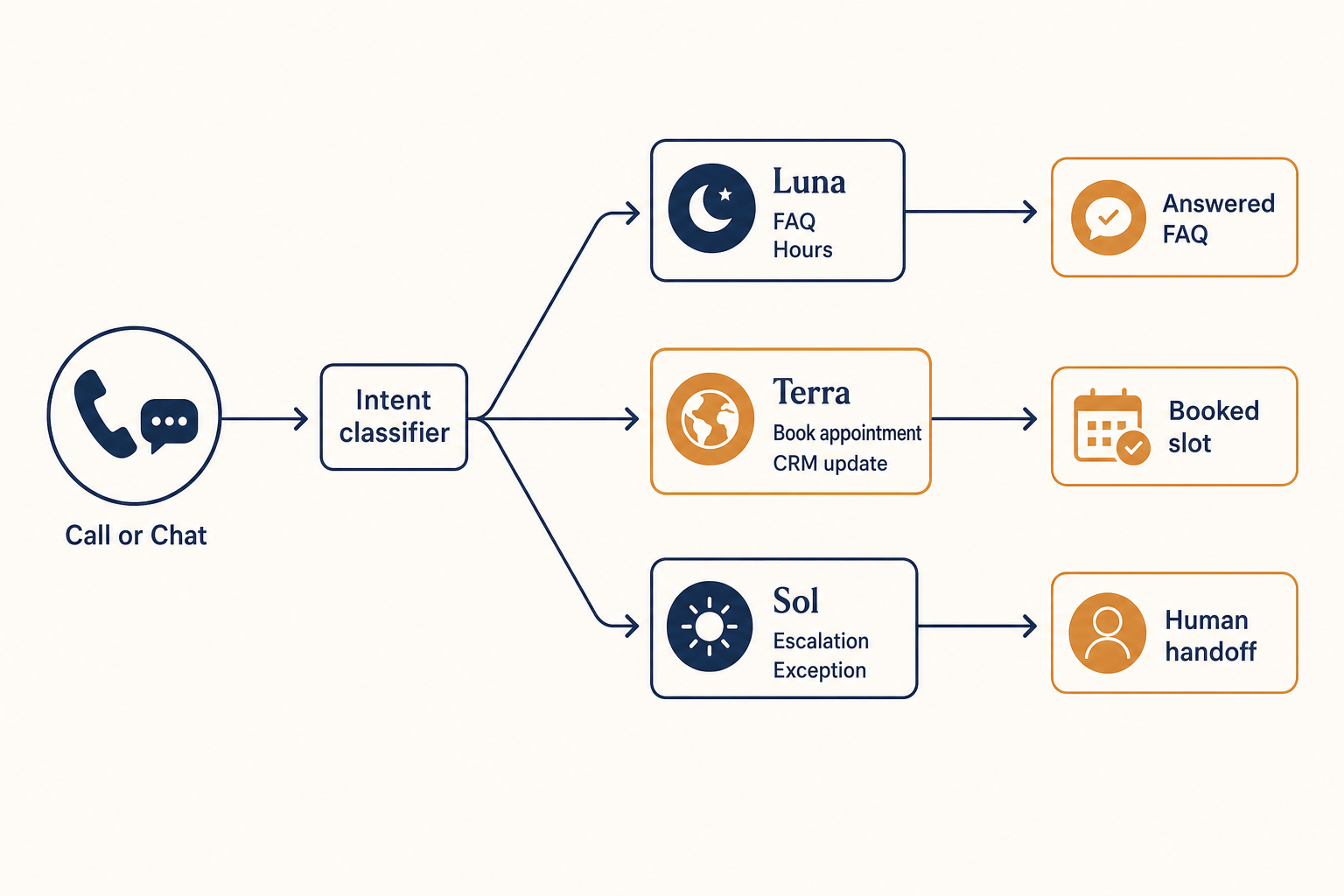
What a routed receptionist loop actually looks like
If you already run a speed-to-lead architecture, the model tier sits one layer below the channel orchestration.
A practical loop:
- Ingress. Call, web chat, Instagram DM, or WhatsApp message hits your telephony or messaging layer.
- Intent classification (Luna). A cheap first pass labels the turn:
faq_hours,book_appointment,reschedule,complaint,clinical_screen,unknown. - Route.
- FAQ intents stay on Luna with a tight system prompt and retrieval snippets.
- Booking and CRM intents move to Terra with tool definitions for calendar, PMS, or GoHighLevel.
complaint,unknown, or low-confidence classifications escalate to Sol, or straight to a human if your policy requires it.
- Tool execution (Terra). Availability lookup, slot hold, confirmation SMS, CRM note write.
- Post-turn hygiene (Luna). Summary, structured JSON for the CRM, disposition tag.
- Human handoff (Sol only when needed). Full transcript plus the model's recommended next action pushed to the front desk or on-call manager.
Two implementation details that save money without hurting quality:
- Keep the classifier on Luna even when the conversation is already on Terra. Re-classifying every turn is cheap insurance against scope creep mid-call.
- Cache the stable parts. System prompt, business hours, service menu, contraindication rules, and tool schemas are identical across calls. That is where GPT-5.6 caching pays back fastest.
Worked example: why single-model routing bleeds margin
Assume a med spa handling 400 inbound voice turns per day across three buckets:
| Bucket | Share of turns | Turns per day | Avg input tokens | Avg output tokens |
|---|---|---|---|---|
| FAQ | 55% | 220 | 800 | 120 |
| Booking / reschedule | 40% | 160 | 2,200 | 450 |
| Escalation / edge case | 5% | 20 | 4,500 | 900 |
Scenario A: everything on Sol
Daily token cost (list price, no caching):
- FAQ: 220 × (800 × $5 + 120 × $30) / 1M ≈ $1.67
- Booking: 160 × (2,200 × $5 + 450 × $30) / 1M ≈ $3.92
- Escalation: 20 × (4,500 × $5 + 900 × $30) / 1M ≈ $0.99
Total ≈ $6.58/day on model inference alone, before telephony, STT, TTS, or orchestration.
Scenario B: routed Luna / Terra / Sol
Same traffic, routed:
- FAQ on Luna: 220 × (800 × $1 + 120 × $6) / 1M ≈ $0.34
- Booking on Terra: 160 × (2,200 × $2.5 + 450 × $15) / 1M ≈ $1.96
- Escalation on Sol: 20 × (4,500 × $5 + 900 × $30) / 1M ≈ $0.99
Total ≈ $3.29/day.
That is roughly half the inference bill on identical traffic, before caching. On a 30-day month, the gap is about $98 in model spend alone. Scale that to a multi-location group or an agency rolling out per-client receptionists, and routing stops being a nice idea and becomes the margin line.
These numbers are illustrative. Your prompts, tool payloads, and average call length will move them. The direction will not.
Vertical examples: same router, different prompts
The tier map does not change much by industry. The prompts, tools, and escalation rules do.
| Vertical | Luna handles | Terra handles | Sol handles |
|---|---|---|---|
| Med spa | Hours, location, treatment menu FAQs | Consult booking, contraindication screen, reminder flows | Pregnancy edge cases, complication questions, upset callers asking for refunds |
| Dental | Insurance FAQ bands, office hours | New patient booking, hygiene recall scheduling | Pain calls, post-op complications routed to on-call protocol |
| Restaurant | Menu hours, dietary FAQ, wait-time bands | Resy/OpenTable booking, party size changes | Large-party exceptions, complaint calls, same-day cancellation disputes |
| Auto dealership | Store hours, service department hours | Test drive booking, service appointment slots | Trade-in valuation arguments, angry service customers, finance exceptions |
The pattern repeats: Luna for retrieval-style answers, Terra for tool-backed workflows, Sol for anything that sounds like it could become a one-star review or a compliance ticket.
If you are comparing this to a 45-second form-to-call system, the model tier decision sits after the call connects. Speed to answer is still the front door. Routing is what keeps the conversation profitable once the caller is on the line.
Where each tier will disappoint you if you misuse it
Luna on booking
Luna is fast, but booking is a chain of tool calls with failure modes: double booking, wrong provider, missing consent language, timezone drift. Putting the full booking loop on Luna because it is cheaper is how you get confident wrong confirmations.
Terra on angry callers
Terra is the right default for normal production conversation. It is not automatically the right choice for de-escalation where nuance, policy exceptions, and tone all matter at once. Those turns are 5% of volume and 50% of reputation risk.
Sol on hours and location
Using Sol to answer "Are you open Saturday?" is burning flagship tokens on a retrieval task. If your FAQ traffic is not on Luna, your unit economics are lying to you.
What changes on July 9 that actually matters for builders
Three shifts are worth acting on now:
- Tiered production is officially priced. Luna gives you a credible cheap lane. Terra gives you a credible default lane. Sol is no longer the only serious option in the family.
- Customer support is an explicit Terra use case. You do not need to reverse-engineer positioning from benchmark blog posts. OpenAI already drew the line.
- The naming is stable enough to design around. Sol / Terra / Luna is a better contract for architecture docs than "use the newest GPT-5.x whatever it is called this week."
There is also a timing angle. "GPT-5.6 for receptionists" content is still sparse compared with generic developer comparisons. Being specific about routing beats another shallow Sol vs Terra leaderboard post. That window closes fast once the big AI blogs recycle the same comparison tables.
Honest limits on this guide
We have not production-tested GPT-5.6 on a live receptionist line yet. This is not a "we benchmarked it" post. It is a routing plan built from:
- OpenAI's published tier descriptions and pricing
- How production receptionist loops actually split by intent today
- Unit economics on mixed call traffic
Launch-week pricing, access rules, and relative performance between tiers can shift. Revisit the table when you pin a production deployment, especially if you are quoting per-client margins to agency partners. OpenAI's API pricing page is the source of truth when list prices move.
Also: model choice is only one layer. A routed GPT-5.6 stack still needs clean telephony, low-latency STT/TTS, tool schemas that match the booking system, and a sub-60-second speed-to-lead target on outbound callbacks. The model tier does not fix a 40-second round-trip voice stack or a CRM integration that drops half the fields.
The shape of the response-time curve is older than most automation tools. The original Lead Response Management Study found that contact odds fall sharply after the first few minutes. Voice receptionists that answer instantly but route every turn to Sol still lose on cost; the speed win and the margin win are separate problems.
FAQ
Should I default new AI receptionist builds to Terra?
Yes for the conversational core that handles booking and multi-step intake. Pair it with Luna for classification and FAQ, and Sol for escalations. Terra is the workhorse, not the entire stable.
Can Luna handle voice receptionist calls end to end?
For narrow FAQ flows, sometimes. For full receptionist duty with tools, rarely. Voice adds latency pressure and tool-call complexity that usually pushes the main dialog layer to Terra.
Is Sol worth it if escalations are only 3 to 5% of calls?
Usually yes. Those calls correlate with revenue risk, reviews, and compliance exposure. Saving $0.50 per day while mishandling a high-value complaint is false economy.
Does this replace fine-tuning or retrieval?
No. Routing picks the reasoning budget per turn. Retrieval, business rules, and vertical prompts still do most of the domain work. Luna plus good retrieval often beats Sol with a vague prompt.
How does this compare to running one Claude or Gemini model for everything?
Same principle applies: route by task complexity. The GPT-5.6 story is notable because OpenAI priced three production-grade tiers explicitly for support workloads on day one.
What should I log in production before optimizing tiers?
Log intent label, chosen tier, tool-call success, handoff reason, and token counts per turn. Without those five fields you cannot tell whether Luna is stealing Terra's job or Terra is absorbing Sol's work.
The bottom line
GPT-5.6 is the first OpenAI generation where a receptionist builder can plausibly route by task instead of defaulting to the flagship and hoping the margin works.
- Luna is for FAQ traffic, classification, and post-call cleanup.
- Terra is the production default for booking, tool-calls, and normal conversation handling.
- Sol is for edge cases, escalations, and any turn where getting it wrong costs you the customer.
- Routing beats single-model defaults on both cost and quality when your intent split looks anything like a real front desk.
- Treat launch pricing as provisional and model caching into the architecture early.
Don't want to manage model routing, tool integrations, and escalation logic yourself? That's exactly what we do at FusionSync. We design and deploy AI voice and chat receptionists that route intelligently across models based on task complexity, not a one-size-fits-all setup. Book a call or see how it works.
AI-native business systems
Bring a niche, or bring a workflow.
If you run the business, we build the system around it. If you sell into a niche, we build the system behind your offer.
PolarBuild case study →You sell the niche. We build the system.
We never compete for your end clients. One partnership conversation. You fulfil the same system across the accounts in your niche.
Free POC before dedicated software
A three-day sales demo of the system for your vertical before any large software investment. Implementation starts only when someone in that niche pays.
Replicate the niche, not a one-off build
UK dental becomes US dental with a new local partner and new integration targets. Same system thesis, new market.