
Inbound Lead Management
Meta Ads 2026: Sabri Suby's Framework, Made Operational

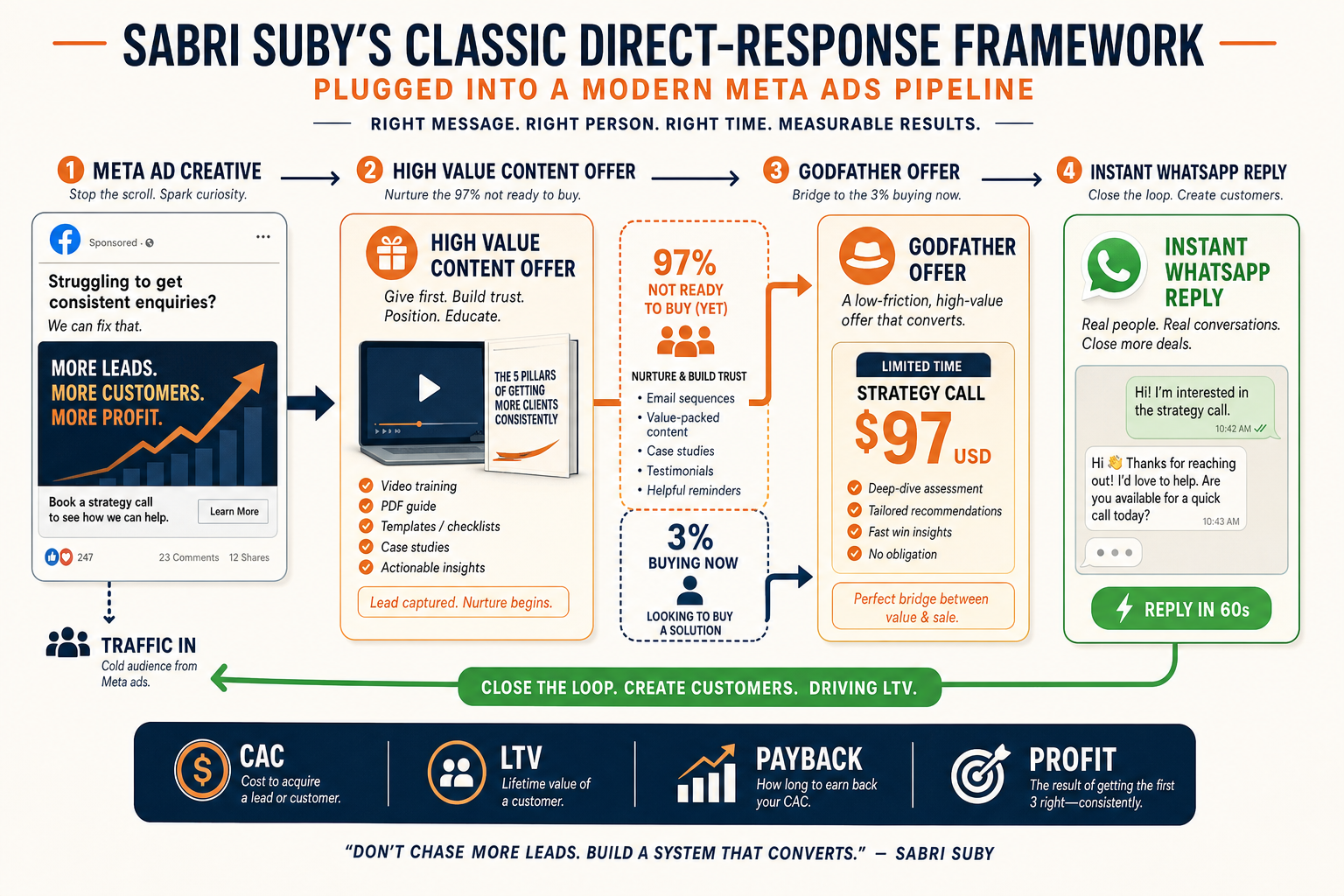
Sabri Suby's framework names every variable that decides Meta ad math. Here is how to apply it to service businesses in 2026.
The line in your Meta Ads dashboard that is actually killing you
Most service operators reading their Meta Ads dashboard stare at the wrong number. They look at cost per lead, conclude the channel is "expensive" or "broken," and either pull spend or blame the agency. The number that decides whether Meta works for you is not on that dashboard at all. It is the LTV to CAC ratio and the payback period that sits behind it.
This is the gap Sabri Suby's framework was built to close. Sell Like Crazy is mostly known as a direct-response playbook for e-commerce, but the spine of the book (CAC, LTV, payback, the Larger Market Formula, the Newif copy formula, the Godfather Offer) is exactly the set of variables a service business needs to make Meta ads work in 2026. The framework names every variable. It also quietly assumes one thing: that the moment a lead enters your pipeline, a real conversation begins. In 2026, that assumption is usually wrong, and that is where the math falls apart.
This post takes Suby's framework and rebuilds it for service operators (event companies, venues, charter businesses, home services) buying Meta traffic in 2026. It also names the load-bearing piece the framework leaves implicit: a follow-up infrastructure fast enough to keep his unit economics alive.
Three numbers Sabri Suby refuses to let you skip
There are three numbers in Sell Like Crazy that show up before any creative discussion: Customer Acquisition Cost, Lifetime Value, and the Payback Period. Get them wrong and no amount of clever copy fixes the channel.
Customer Acquisition Cost (CAC). Total cost to acquire one paying customer. CAC is not the same as cost per lead and not the same as cost per acquisition. CAC includes Meta spend, plus the ad agency or in-house labor, plus the tooling, plus any closer time you paid for between form fill and booking. A roofing operator with a $90 CPL, a 25 percent lead-to-quote rate, a 35 percent quote-to-job rate, and $20 of labor blended in is sitting at roughly $1,160 of CAC per closed job, not $90.
Lifetime Value (LTV). Total margin a customer produces across the relationship. For a one-time event company, LTV often equals the first booking margin plus the referral coefficient (the share of customers who send the next booking). For a charter business, LTV is the average first booking margin times the repeat rate over 24 months. The cleaner LTV becomes, the more willing you should be to spend on Meta.
Payback Period. How many days it takes to recover CAC out of gross margin. This is the one most service operators have never calculated. Suby anchors on aggressive payback (he uses "under 30 days" as the target that liquidates ad spend and unlocks scale). The 2026 SaaS median sits around 15 months, but service businesses with high average order values can credibly hit the 30 to 60 day band on Meta if the offer and follow-up are designed for it. Bessemer's widely cited payback ladder treats 0 to 6 months as best, 6 to 12 as better, 12 to 18 as good.
The 3 to 1 LTV to CAC ratio Suby cites is the same ratio every venture investor still uses as a sanity check. If you spend $1 to get $3 of lifetime margin, your unit economics are healthy. If you are at 1:1, you are running an expensive break-even hobby. If you are at 10:1, you are probably underspending and leaving growth on the table.
Maximum allowable CPL for a service business pops out of these three numbers as a clean formula:
For an event company with an average booking of ₹2,50,000, a 35 percent gross margin, and a 12 percent lead-to-booking rate, the maximum allowable CPL is about ₹3,500 before Meta starts costing more than it returns. The actual CPL you see in the dashboard is only meaningful when measured against that ceiling.
The 3 percent rule, and why it shapes every Meta ad you run
Suby's Larger Market Formula borrows directly from Chet Holmes's Buyers Pyramid, originally published in The Ultimate Sales Machine in 2007. Holmes polled thousands of audiences at live events for years. The pattern was consistent across markets. At any moment, only 3 percent of a market is actively buying. Another 7 percent is open to buying with a nudge. Sixty percent thinks they are either not interested or definitely not interested. The remaining 30 percent is not thinking about it at all.
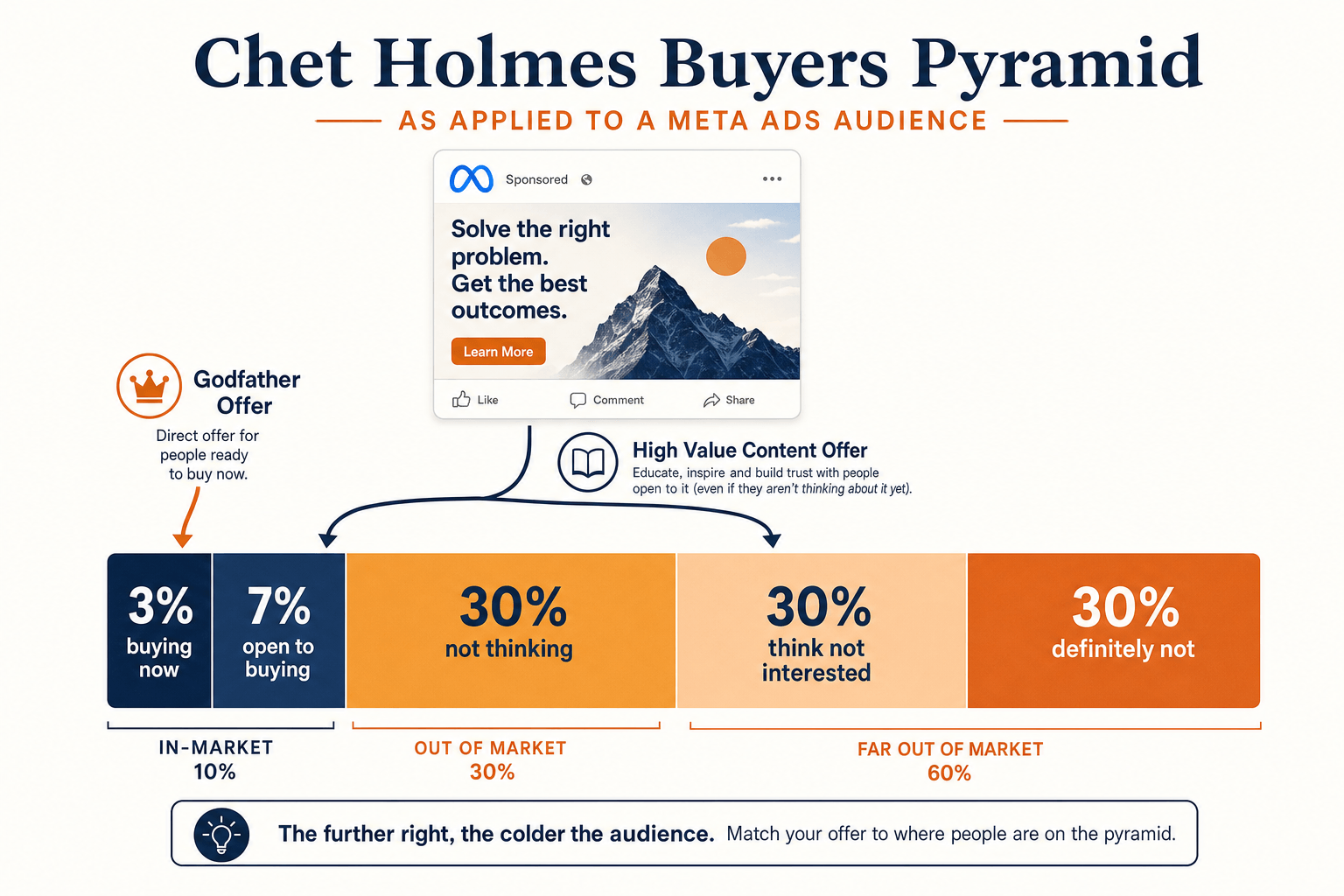
Most Meta ad campaigns for service businesses are aimed exclusively at the 3 percent. Headline asks for a booking. Form asks for a date and phone number. The creative carries an offer that only makes sense to someone already shopping. That works, until your competitors do the same thing in the same auction. The result is rising CPMs, falling conversion rates, and a campaign that looks fine on submission volume but kills you on cost per booking.
The Larger Market Formula says you have to design ad sets for the other 97 percent too. The tool Suby uses for this is the High Value Content Offer: a free educational asset (a PDF, a short video, a planning checklist) that addresses the problem the customer is aware of, weeks before they are ready to shop. For an event company, that might be "The 12-page wedding budget calculator we built for couples planning a 200-guest wedding in Goa." For a venue, it might be "What 40 corporate planners actually compared before booking us last quarter."
You run two Meta campaigns in parallel. One is the direct-response Godfather creative aimed at the 3 percent. The other is the HVCO creative aimed at the 97 percent, which feeds a nurture pipeline that warms those buyers over four to eight weeks. The math is brutal in favor of running both. The Godfather campaign has higher CPL but lower payback. The HVCO campaign has lower CPL, longer payback, and refills the funnel at half the cost the moment the Godfather audience starts saturating.
What the Newif formula looks like in a 2026 Meta ad
Suby's copy formula (often summarised as making the offer New, Unique, Exciting, Easy, Predictable, and Huge) is the same direct-response logic David Ogilvy used in 1962, updated for thumb-stop creative on Reels and Stories. The framework is not "be clever in the headline." It is a checklist for what an offer has to communicate before someone in a vertical scroll feed will stop moving.
| Element | What it does | Bad Meta ad opener | Good Meta ad opener |
|---|---|---|---|
| New | Signals novelty (not 2018 again) | "Premium event services" | "We tested 11 ways to qualify Goa wedding leads in 2026. One worked." |
| Unique | Differentiates from the auction | "Trusted by 500+ clients" | "The only event company in Goa that confirms an availability window in under 60 seconds." |
| Exciting | Trips emotional response | "Plan your perfect wedding with us" | "200 guests, no DJ panic at 11 PM. We engineer the schedule for it." |
| Easy | Removes friction | "Get a custom quote today" | "Reply with your date. We send three options inside ten minutes." |
| Predictable | Tells them what happens next | "Contact us to learn more" | "Step 1, you message us. Step 2, we send a date check. Step 3, you say yes or no." |
| Huge | Names the size of the win | "Quality service" | "Stop losing 40 percent of inbound leads to the operator who replied first." |
Run your existing Meta creative through this checklist tonight. Most service ads fail four out of six rows. Fix them one at a time. The single largest creative lift we see when porting Suby's formula into a Meta campaign comes from "Easy" and "Predictable." Buyers in 2026 do not want to be sold to. They want to know exactly what the next 90 seconds of their life looks like if they click.
The Godfather Offer, sized for a service business
The Godfather Offer in Sell Like Crazy is the offer the prospect cannot logically refuse. Suby breaks it into seven elements: rationale, value building, clear pricing, easy payment, attractive bonuses, a power guarantee, and genuine scarcity. The famous example is Casper's 100-night home trial. The Enso Homes example Suby cites (build the house in 30 weeks or pay the customer $5,000) is the same logic for a high-ticket service.
For a Meta ad campaign in 2026, a Godfather Offer for a service operator has to do four jobs in the first three lines of copy:
- Make the rationale concrete. Why this offer, why now. "We have an open slot the second weekend of August because a corporate event moved."
- Reverse the risk. A guarantee the customer can verify, written in their language. "If we do not confirm a venue and DJ inside 48 hours, the planning fee is free."
- Make scarcity defensible. Real scarcity beats fake urgency. "We take 14 weddings per quarter. Four slots left for Q4."
- Anchor the offer to a clean next step. Tie the click to a single specific reply path. "Reply 'AUG' to this ad and we run availability."
Two notes that matter for Meta specifically. First, anything that smells like fake urgency (countdown timers, "act now", invented scarcity) raises template-rejection risk if you are running Click to WhatsApp creative and increases the chance Meta auto-flags the ad set. Suby's guarantee logic survives that filter; vendor urgency does not. Second, the Godfather Offer can sit either on the landing page or directly inside the ad's first 90 characters of body copy. The closer it sits to the creative, the lower your CPL tends to fall, because the offer is now doing the qualification work the form used to do.
The follow-up infrastructure the framework quietly assumes
This is the part of Suby's framework that most service operators miss when they apply it.
Sell Like Crazy was written when the implicit assumption was that you had inside sales reps sitting on phones, calling Lead Ad submissions within minutes. That assumption is no longer true for most service businesses. The lead arrives in your CRM at 2:17 PM and a human reaches out at 11:08 PM. By then the customer is asleep, has booked your competitor, or has lost the conviction that made them fill the form. None of Suby's numbers (3:1 LTV:CAC, 30-day payback, the Godfather Offer's promised conversion lift) survive that gap.
The follow-up infrastructure is the load-bearing piece the framework needs to actually run. I have built and shipped enough of these for event operators to know the bar is now ruthless. Meta delivers a Lead Ad submission to your webhook in seconds. Harvard Business Review's analysis of 2.24 million leads showed companies that responded inside 5 minutes were 100 times more likely to make contact and 21 times more likely to qualify. Drift's later benchmark put the average response time at 47 hours. The Blazeo 2026 benchmark report found 81.2 percent of slow responders (over an hour) say they lose deals to faster competitors. The variance between "good Meta ads" and "Meta ads that print money" lives almost entirely in this gap.
For a service business in 2026, the architecture looks like this:
- Meta Lead Ad submission triggers a webhook in real time.
- The webhook fires an approved WhatsApp template inside 10 seconds.
- An in-thread qualifier asks one specific question (date, guest count, venue type), structured field extraction.
- The qualifier hands a closer-ready conversation to a human inside 90 seconds.
- CRM writeback carries the ad ID, the qualifying fields, and the transcript link.
The full teardown is in our sub-2-minute Meta Lead Ads architecture post. The strategic point here is that the Suby framework on its own does not contain this layer. Suby tells you the offer needs to convert. He does not tell you that, in 2026, "converts" requires sub-60-second contact or the offer collapses on platform inertia. The 60-second response infrastructure for service businesses is the system that turns his framework from a slide deck back into a P&L.
A 30-day payback model for an event company on Meta
Worked numbers, because frameworks without numbers are wallpaper. This is what the Suby framework looks like for a hypothetical mid-size event operator running Meta in 2026.
| Variable | Value | How we got it |
|---|---|---|
| Average booking value | ₹2,50,000 | One mid-size event |
| Gross margin per booking | 35% | After venue, F&B, crew, decor |
| Gross margin in INR | ₹87,500 | Margin × booking |
| Click-to-WhatsApp CPL | ₹400 | Meta Lead Ads + WhatsApp |
| Lead-to-qualified rate | 28% | With sub-60s WhatsApp follow-up |
| Qualified-to-booking rate | 35% | Closer-ready handoff |
| Effective CAC per booking | ₹4,082 | CPL / (0.28 × 0.35) |
| LTV:CAC | 21:1 | Margin / CAC |
| Payback period | Same day | Margin > CAC on first booking |
Now run the same numbers with the slow version of the same campaign (24-hour response, no in-thread qualifier, no template-based WhatsApp open).
| Variable | Slow value | Why |
|---|---|---|
| Click-to-WhatsApp CPL | ₹400 | Same Meta auction |
| Lead-to-qualified rate | 9% | With 24-hour follow-up |
| Qualified-to-booking rate | 35% | Same closer team |
| Effective CAC per booking | ₹12,698 | CPL / (0.09 × 0.35) |
| LTV:CAC | 6.9:1 | Margin / CAC |
| Payback period | Same day | Still works, just barely |
The slow version is not bankrupt. It is just three times more expensive than the fast version for the same Meta spend, the same creative, and the same closer team. That delta (CAC ₹4,082 versus CAC ₹12,698) is the dollar amount Suby's framework predicts and the follow-up infrastructure actually delivers. The Meta budget did not change. The variable that moved was time-to-first-useful-reply.
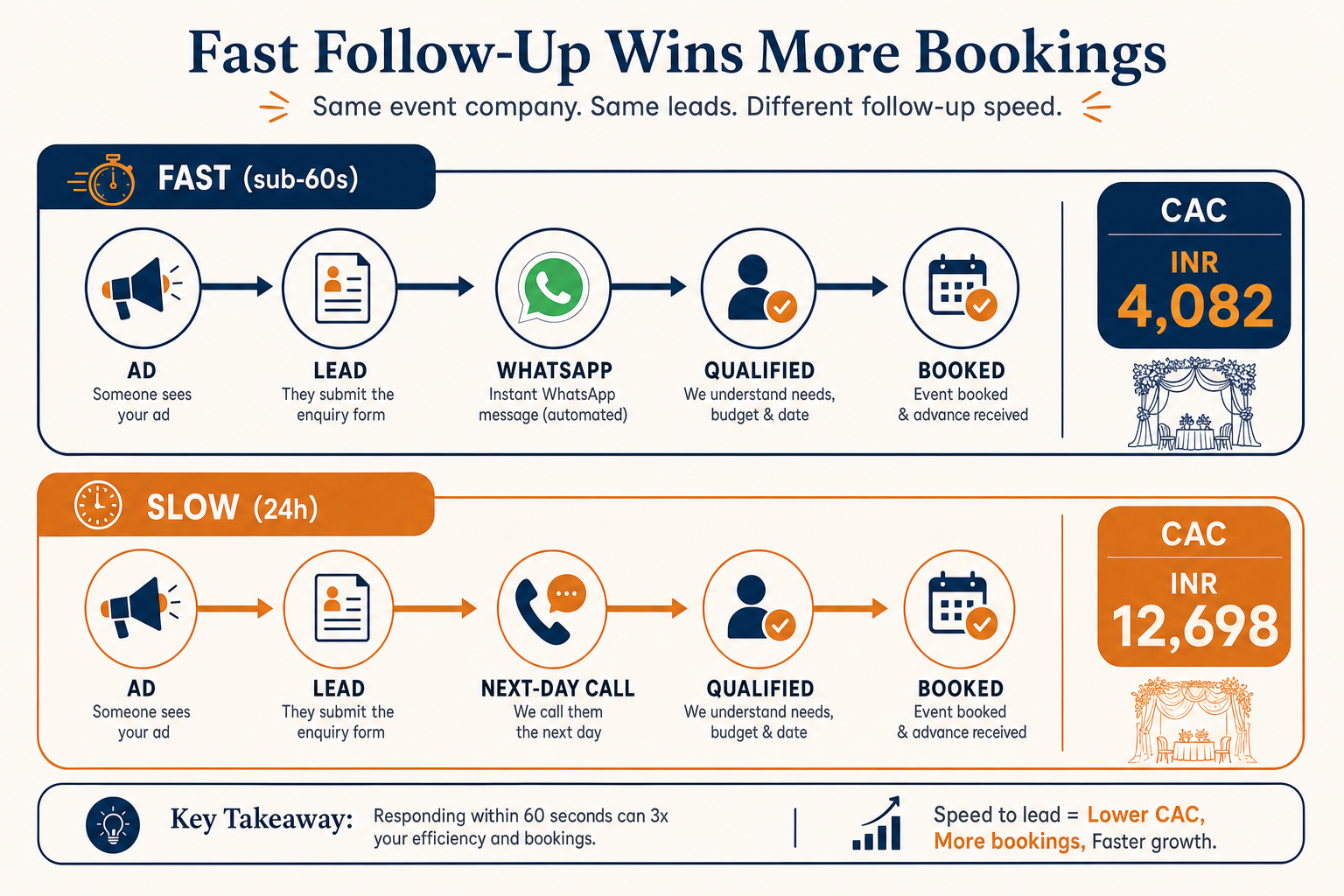
For most service businesses, this is the single highest-leverage variable in the entire framework. It is also the one Suby talks about least, because Sell Like Crazy was written before WhatsApp Business API, before Click to WhatsApp ads, and before the 2026 Meta auction made the auction itself the most expensive line in the spreadsheet.
Three ways this framework still dies in 2026
Even with the Suby spine applied correctly, the Meta channel can break for a service operator. Three failure modes worth naming.
1. The Godfather Offer is undifferentiated. Every event operator in the same city is now running "free venue tour" or "complimentary consultation." Meta's algorithm cannot tell yours apart. The fix is offer specificity that competitors will not copy. "Free 30-minute venue walkthrough" is a commodity. "We will pre-build your seating chart for 200 guests in under 24 hours, free, before you commit" is a Godfather offer that survives the auction.
2. The Conversions API loop is open. Meta optimises against whatever signal you send back. If you only send "form submitted" as a conversion event, the algorithm learns to find people who submit forms. If you wire up Meta's Conversions API to send "qualified by the WhatsApp closer" as the actual conversion event, the algorithm shifts inside 2 to 4 weeks to find people who qualify, not people who submit. Most service operators never close this loop and pay 3x for unqualified volume.
3. The 97 percent never get the HVCO. The Larger Market Formula only works if the nurture pipeline exists. For most service businesses, the HVCO ad set runs, downloads happen, and the contact then sits in a spreadsheet nobody touches for six months. The HVCO is only as valuable as the WhatsApp or email sequence that follows it, which is where most of the inbound operating system work actually pays off.
FAQ
Is Sabri Suby's framework only useful for e-commerce? No. The CAC, LTV, payback, and offer logic in Sell Like Crazy applies to any business with a paid acquisition channel. The Newif copy formula and the Godfather Offer translate directly to service businesses; the LTV math is actually more forgiving for services because the average ticket size is higher than most e-commerce SKUs.
What is a realistic LTV to CAC ratio for an event company on Meta? With sub-60-second WhatsApp follow-up and a Godfather offer aimed at a specific event type, we see ratios in the 12:1 to 25:1 range for event operators. With manual follow-up, the same campaigns run at 4:1 to 7:1. The variance lives in the follow-up speed, not the creative.
How do I calculate my maximum allowable CPL? Use Max CPL = (LTV × Gross Margin × Lead-to-Sale Rate) / 3. For a ₹2,50,000 average booking, 35 percent margin, and 12 percent lead-to-booking rate, that comes to about ₹3,500. Your actual Meta CPL is only meaningful when measured against that ceiling, not against industry averages.
What is the difference between the Godfather Offer and the High Value Content Offer? The Godfather Offer is aimed at the 3 percent of the market that is buying now. It is your direct-response creative. The HVCO is aimed at the 97 percent that is not yet ready. It is your nurture creative. Both run inside the same campaign structure; only one of them asks for the booking.
Does the framework work if I cannot respond inside 60 seconds? Partially. You will still get incremental lift on the Godfather offer and the Newif copy. You will not get the LTV:CAC ratios Suby's framework was designed around, because the leads that the framework qualifies require contact while intent is intact. That is the point of installing the Instagram-to-WhatsApp pipeline before you scale spend, not after.
How long before I see the Meta algorithm adapt to qualified-conversion events? 2 to 4 weeks of stable signal through the Conversions API. Below 50 qualified events per week the algorithm cannot optimise reliably; above 100 per week the shift toward qualified audiences is visible in cost-per-booking, not just cost-per-lead.
The bottom line
Sabri Suby's framework is still the cleanest set of variables I have seen for evaluating whether a Meta ads campaign is broken or just slow. CAC, LTV, payback, the 3 percent rule, the Newif copy formula, and the Godfather Offer name every variable that decides whether the channel pays. The piece Sell Like Crazy leaves implicit, and that breaks the math in 2026, is the assumption that a real conversation begins the moment a lead enters your pipeline. For service businesses, that is now a sub-60-second WhatsApp problem, not a "call them back tomorrow" problem.
- CAC, LTV, and payback are the only three numbers worth defending in a Meta ads review. Cost per lead is downstream of all three.
- The 3 percent rule from Chet Holmes means most service Meta campaigns are leaving 97 percent of the market on the table. Run a Godfather creative and an HVCO creative in parallel.
- Newif (New, Unique, Exciting, Easy, Predictable, Huge) is a copy checklist, not a slogan. Most service ads fail four of six rows. Fix Easy and Predictable first.
- The Godfather Offer needs concrete rationale, verifiable guarantee, defensible scarcity, and one clean next step. Avoid anything Meta might read as fake urgency.
- The framework's unit economics only survive if the follow-up infrastructure replies inside 60 seconds. Without that, CAC triples on the same ad spend.
If your Meta budget is delivering submissions faster than your team can convert them, the right next step is a 7-day production pilot where we install the follow-up infrastructure (Meta webhook, approved WhatsApp template, in-thread qualifier, CRM writeback) on one campaign and you watch the conversion math move. You keep running the same Meta spend. We just close the loop the framework assumes is already closed.
AI-native business systems
Bring a niche, or bring a workflow.
If you run the business, we build the system around it. If you sell into a niche, we build the system behind your offer.
PolarBuild case study →You sell the niche. We build the system.
We never compete for your end clients. One partnership conversation. You fulfil the same system across the accounts in your niche.
Free POC before dedicated software
A three-day sales demo of the system for your vertical before any large software investment. Implementation starts only when someone in that niche pays.
Replicate the niche, not a one-off build
UK dental becomes US dental with a new local partner and new integration targets. Same system thesis, new market.