
Production Teardowns
Dental Patient Acquisition System: A PMS-First Stack

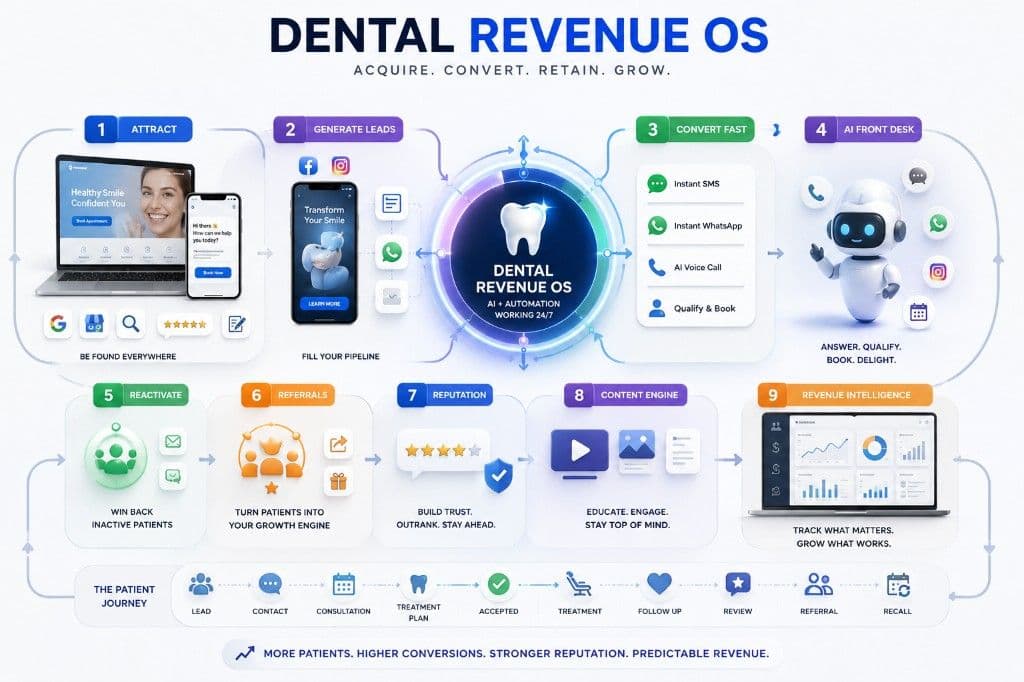
Most dental AI demos start with chatbots. The best acquisition systems start with the PMS. Here is the five-layer stack agencies can white-label.
Most dental AI systems are built backwards
Over the last few months, I have been mapping what a modern dental patient acquisition system actually looks like when you strip away the demo polish.
One observation keeps coming up:
Most vendors start with the AI.
The best systems start with the practice management system.
That inversion is the difference between a dental marketing stack and a dental patient acquisition system. Marketing stacks optimize channels. A patient acquisition system connects those channels to the systems that already run the practice: appointments, patients, treatment plans, recalls, and revenue.
If you are a dental marketing agency evaluating white-label fulfilment, the question is not "which chatbot looks best on a landing page." It is "which stack can book a real appointment into Dentally, Exact, or Dentrix without a human copying data between tabs at 9 PM."
We validated this pattern on a UK dental agency partnership: n8n orchestration, GoHighLevel pipelines, CRM Bridge sync into Exact and Dentally, AI intake, and Stripe deposits before any bespoke product scope. The lesson was the same every time. The PMS layer had to work first. Everything else was decoration until it did.
The strategic frame below is not speculation. It is backed by industry benchmarks on missed calls, response time, no-shows, case acceptance, and recall performance, plus what we measured in live UK dental deployments.
The mistake most vendors make
A typical dental AI demo looks impressive.
Website chatbot.
AI receptionist.
SMS automation.
WhatsApp automation.
Voice agents.
Appointment booking.
Everything appears connected.
Until you ask one question:
"How does this connect to the practice management system?"
That is usually where things get interesting.
Because the PMS is where reality lives.
Appointments.
Patients.
Treatment plans.
Provider schedules.
Operatory availability.
Recalls.
Revenue.
If the AI system does not understand that layer, it is essentially operating blind. It can reply fast. It cannot book accurately, respect provider constraints, trigger recalls from real patient history, or report revenue back to the source that matters.
This is why so many practices end up with two systems: a shiny front-end that handles conversations, and a front desk that still re-keys everything into the PMS. The demo sold speed. The daily reality sold double entry.
The architecture we are seeing emerge
The stack is becoming surprisingly consistent across UK, US, and ANZ dental groups. Five layers, one direction of truth.
| Layer | Role | What breaks if you skip it |
|---|---|---|
| 1. Practice management software | Source of truth for patients, schedules, treatment | AI books phantom slots or wrong providers |
| 2. Integration layer | Normalizes PMS data for the growth stack | Custom one-off connectors per clinic |
| 3. CRM and workflow layer | Patient journeys, not marketing automations | Leads sit in ads manager, never in ops |
| 4. Conversation layer | Text and voice agents with context | Generic replies with no booking authority |
| 5. Intelligence layer | Revenue reporting tied to source and stage | ROAS without show-up or acceptance data |
Replacing the PMS is rarely the goal. Integrating with it is.
Layer 1: Practice management software
This remains the source of truth. Examples include Software of Excellence, Dentally, Dentrix, Exact, Eaglesoft, and dozens of regional platforms.
Each PMS has its own data model for patients, appointments, recalls, and treatment plans. The growth stack does not get to invent a parallel version of that data. It reads and writes through sanctioned integration paths.
Layer 2: Integration layer
This is arguably the most important layer in the entire system.
Most practices do not realize they already have years of operational data trapped inside their PMS. Recall due dates. Incomplete treatment plans. Hygiene intervals. Provider-specific booking rules. That data is the fuel for reactivation, not another Meta campaign.
An integration layer such as CRM Bridge acts as the bridge between the PMS and the growth stack. Instead of building custom integrations for every PMS vendor on every new clinic, a single integration layer can expose:
- Patient records
- Appointment availability
- Recall information
- Provider schedules
- Treatment information
- Practice metadata
CRM Bridge alone supports more than 30 PMS platforms. That changes the economics of agency deployment completely. You white-label one workflow playbook and swap the PMS connector per client instead of rebuilding the plumbing from scratch.
Layer 3: CRM and workflow layer
Once PMS data becomes accessible, workflows become possible. Not marketing workflows. Patient workflows.
Example path:
Patient submits a Meta lead form → AI qualifies the inquiry → Available appointment slots pulled from PMS → Appointment booked → Confirmation sequence sent → Reminder sequence sent → Patient arrives → Treatment completed → Review request triggered → Recall workflow scheduled.
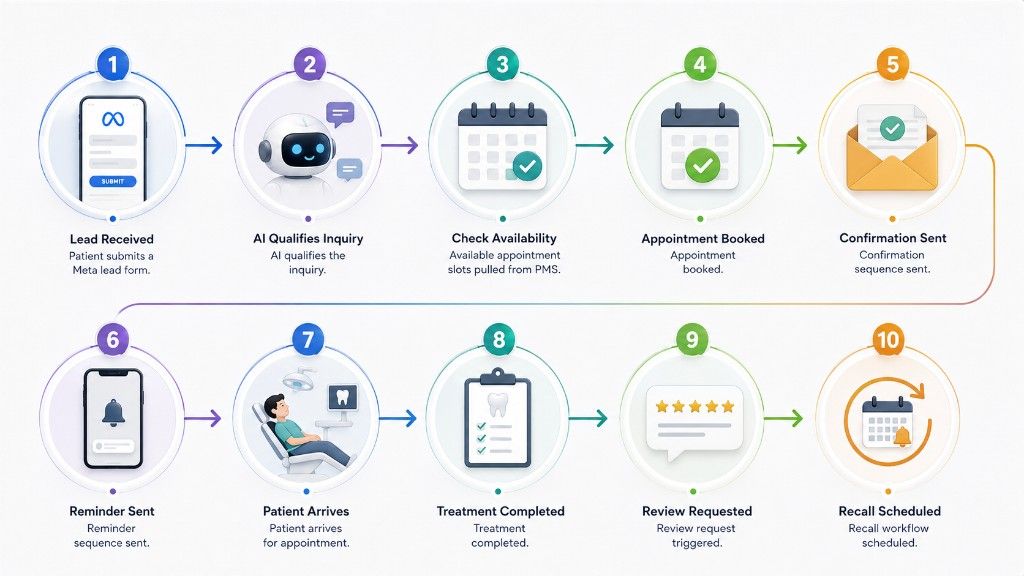
Now the system is operating on actual practice data instead of guesses. The sub-2-minute Meta Lead Ads follow-up architecture, built on Meta's Lead Ads webhook, is the acquisition front door. The CRM and workflow layer is what turns that reply into a booked chair with a confirmed patient ID in the PMS.
Where AI agents fit (and where they do not)
This is where most sales conversations start. In reality, AI agents sit above the operational layers, not below them.
Text agents
The text layer typically spans SMS, WhatsApp, Instagram DMs, email, and web chat.
The challenge is not generating responses. The challenge is generating compliant responses.
In healthcare environments, the conversation layer needs access to context while maintaining appropriate privacy and compliance requirements. This is where PHI-aware architectures become more important than model selection.
The model is rarely the bottleneck. The architecture is.
A text agent wired to CRM plus PHI-compliant LLM routing can:
- Qualify treatment interest without over-collecting clinical detail in the wrong channel
- Pull real availability before offering times
- Write conversation state back to the CRM with audit-friendly transcripts
- Hand off to a human with structured fields, not a raw chat dump
That is a different product category from a generic "AI chatbot" sitting on a marketing site with no PMS read access.
Voice agents
Voice is where things become more interesting for multi-location groups and compliance-sensitive buyers.
Most implementations rely entirely on third-party infrastructure. We are seeing increasing interest in self-hosted voice infrastructure, particularly among larger healthcare organizations. The reasons are usually predictable:
- Compliance requirements
- Data control
- Cost at scale
- Vendor independence
A self-hosted stack such as Dograh (on-premise or private cloud) can support both inbound and outbound use cases:
Inbound
- AI receptionist
- Appointment booking
- FAQ handling
- Call routing
Outbound
- Recall campaigns
- Follow-up calls
- Appointment confirmations
- Patient support
The AI voice agent becomes another interface into the operational system rather than a standalone tool. Pair that with the 45-second form-to-call pattern and you cover the two highest-intent entry points: paid form leads and missed inbound calls.
The real opportunity is not lead generation
Most practices already generate leads.
The leakage happens elsewhere.
Missed calls.
Slow response times.
Unbooked consultations.
Missed recalls.
Dormant patients.
Treatment plans that never get accepted.
That is where the revenue is hiding. Not in another ad campaign.
The numbers make this concrete. Vendor call-tracking audits and dental operations surveys consistently place missed inbound calls in the 20% to 38% range during business hours, with a meaningful share of callers never leaving voicemail. Henry Schein One's 2026 Catalyst Index benchmarks the average dental practice at a 4% no-show rate and top performers below 1%, while broader industry surveys often cite 11% to 20% depending on payer mix and confirmation workflows. Case acceptance averages near 42% to 45% in the same benchmarking data; top-decile practices run 75% or higher.
On speed, the original Harvard Business Review summary of lead response research found firms contacting a web lead within five minutes were roughly 21 times more likely to qualify the lead than firms waiting 30 minutes. Healthcare-specific follow-up studies put average dental inquiry response times at two hours or more, even though patient decision windows often close within the first 10 minutes of contact.
Recall is the other silent leak. Structured multi-channel recall sequences typically reactivate 15% to 30% of lapsed hygiene patients within 90 days when outreach starts early; practices that wait until patients are 12+ months overdue often cut recovery rates by more than half.
| Revenue leak | Industry benchmark | Why PMS-connected workflows matter |
|---|---|---|
| Missed calls | 20% to 38% of inbound calls unanswered in business hours | Failover text/voice can recover intent before the caller dials a competitor |
| Slow lead follow-up | 21x qualification gap: 5 min vs 30 min (HBR/Oldroyd research) | Webhook → qualify → book must run without a coordinator in the loop |
| No-shows | 4% avg (top performers); 11% to 20% in broader surveys | Reminders tied to real appointment IDs in the PMS, not a generic calendar |
| Case acceptance | 42% to 45% avg; 75%+ top decile (Catalyst Index) | Acceptance follow-up needs treatment plan value from the PMS |
| Hygiene recall | 15% to 30% reactivation with structured outreach | Recall dates must come from the PMS, not a stale CRM export |
The 2026 speed-to-lead standard applies to dental the same way it applies to event companies and home services. Sub-60-second first response is the floor when a prospect submits a form, sends a WhatsApp message, or calls during lunch hour. The difference in dental is what happens after the reply: can the system actually book, confirm, and sync to the PMS without a coordinator in the loop?
| Leak point | Typical symptom | What the system should do |
|---|---|---|
| Missed calls | Voicemail only, no callback | AI voice + SMS/WhatsApp failover |
| Slow Meta lead follow-up | Lead sits in Ads Manager | Webhook → qualify → book in under 2 minutes |
| Unbooked consults | Qualified lead, no slot offered | Live PMS availability in conversation |
| No-shows | Empty chair, no recovery | Reminder sequences + no-show rebooking workflow |
| Dormant patients | CRM full of lapsed hygiene | Recall campaigns from PMS recall dates |
| Open treatment plans | Plan presented, never accepted | Financing and acceptance follow-up automations |
What changed in a live UK dental deployment
Strategy only persuades when someone can point to a production path. In the PolarBuild UK dental engagement, the agency could generate interest for clinics, but retainers were fragile when practices blamed marketing for what happened after the lead arrived: slow follow-up, manual booking, and CRM/PMS double entry.
Before the stack was connected
| Area | Observed state |
|---|---|
| Lead follow-up | Inquiries stalled after the Meta click; no single system owned qualification through booking |
| Response model | Dependent on staff availability during clinic hours |
| Booking | Manual coordination between chat, CRM, and PMS |
| Pipeline visibility | Marketing metrics disconnected from booked chairs and PMS writeback |
| Agency offer | Campaigns without a resellable product layer |
After PMS-first integration shipped
| Area | Production outcome |
|---|---|
| Orchestration | 12 published n8n workflows covering agent chat, CRM sync, writeback polling, Stripe paid triggers, and booking |
| AI intake | Voice and chat agent with tools for availability lookup, patient creation, qualification notes, and appointment booking |
| CRM pipeline | Five GHL stages from New Lead through Deposit Paid, Booked in PMS, and Manual Action Required |
| PMS sync | CRM Bridge connectors into Exact and Dentally with token caching and sync outbox |
| Demo standard | Meta lead → in-channel qualification → live slot offer → deposit → confirmed PMS booking on a sales call |
PolarBuild did not need a hypothetical ROI slide. Nick could demo a complete acquisition path clinics understood immediately: pay a deposit, see the appointment land in the PMS, and watch the agency pipeline update in real time.
That is the pattern agencies should expect from a patient acquisition system: not "we installed a chatbot," but "we removed the manual gap between paid lead and booked chair." Individual clinic percentages will vary by ad spend, market, and staff adoption. The architecture determines whether improvement is measurable at all.
Representative targets when the full stack is live
These are sensible 90-day targets we use when auditing a clinic that already generates leads but leaks them operationally. Treat them as benchmarks to instrument toward, not guarantees.
| Metric | Typical before state | Target after PMS-connected workflows |
|---|---|---|
| Lead response time | 10 to 45+ minutes (manual inbox) | Under 60 seconds for paid/form leads; under 2 minutes for Meta Lead Ads |
| Lead-to-consult booked | 25% to 40% of qualified inquiries | 45% to 60% when booking happens in-channel against live PMS slots |
| Missed-call recovery | Voicemail only | 30% to 50% of missed calls recovered via instant SMS or voice failover |
| Hygiene recall reactivation | 12% to 18% (phone-only lists) | 20% to 35% with PMS-triggered multi-channel recall |
| Case acceptance follow-through | Plans presented, weak systematic follow-up | 5 to 15 point lift when financing and acceptance sequences run from PMS treatment data |
The five layers of a dental patient acquisition system
Most agencies still sell a "dental marketing system": ads, landing pages, chatbot, maybe a review tool. That is channel thinking.
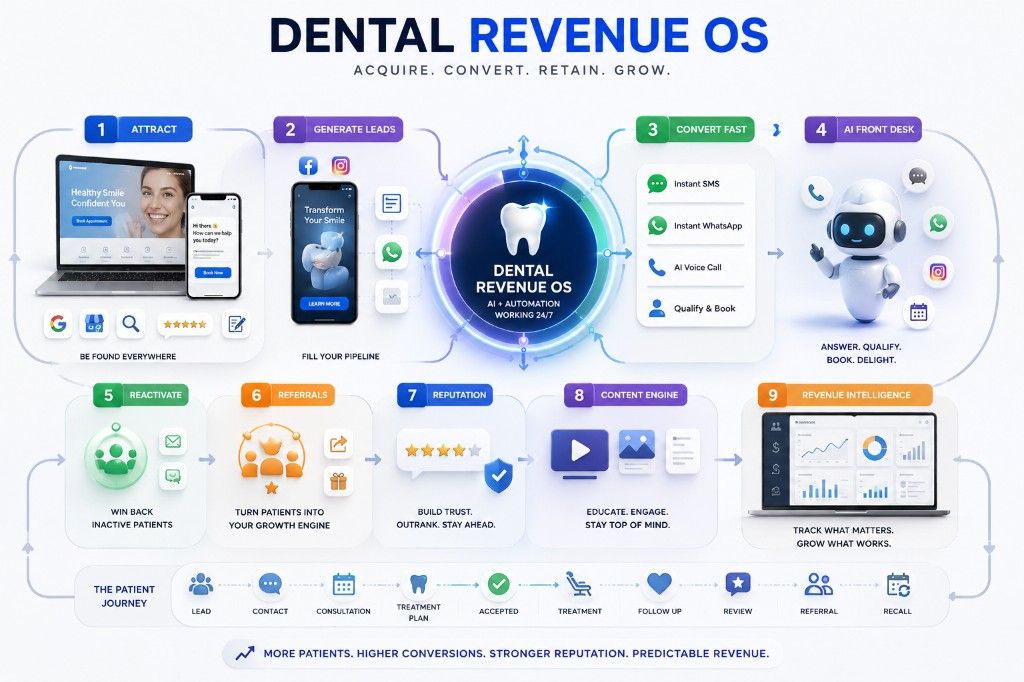
A dental patient acquisition system is infrastructure thinking: acquire, convert, retain, reactivate, and measure on one patient journey.
Layer 1: Patient acquisition
Visibility engine
- Website
- Google Business Profile
- Local SEO
- Programmatic SEO
- Review generation
- GBP posting
- AI chatbot (with PMS-aware booking path, not FAQ-only)
Demand generation engine
- Meta Ads
- Landing pages
- Lead magnets
- WhatsApp lead ads
- Conversion funnels
Content and reputation support visibility here; they are not peers to booking and recall. A blog post does not replace an empty hygiene schedule.
Layer 2: Lead conversion
Speed-to-lead engine
- Instant SMS
- Instant WhatsApp
- AI voice call
- Lead qualification
- Appointment booking against live PMS slots
AI front desk
- Voice AI receptionist
- SMS agent
- WhatsApp agent
- Instagram DM agent
- FAQ handling
- Scheduling with provider and operatory rules
Conversion optimization engine
- Call tracking
- Form tracking
- Appointment abandonment recovery
- AI concierge for complex inquiries
- Heatmaps
- Conversion reporting tied to booked appointments, not form fills
Layer 3: Patient retention
Recall and reactivation engine
- Hygiene recalls from PMS dates
- Missed treatment follow-up
- Implant follow-up sequences
- Dormant patient reactivation
- Outbound recall campaigns (text and voice)
Referral engine
- Patient referral campaigns
- Refer-a-friend offers
- Referral tracking
- WhatsApp referral workflows
Layer 4: Reputation and authority
Reputation engine
- Review requests post-visit
- Negative review alerts
- AI review responses (human-approved where required)
- Competitor monitoring
- GBP ranking tracking
Content engine
- Social posts
- Reels
- Patient education
- AI-assisted video creation
- Blog content
- GBP content repurposing
Content supports visibility and trust. It does not replace the operational layers beneath it.
Layer 5: Intelligence layer
Revenue intelligence dashboard
| Metric family | Examples |
|---|---|
| Marketing | Leads, CPL, ROAS, source attribution |
| Sales | Contact rate, booking rate, show-up rate, no-show rate |
| Practice | Treatment acceptance, revenue generated, revenue by source, revenue by procedure |
| Operational | Speed-to-lead, missed leads, front desk performance, AI agent performance |
This is the layer that lets an agency prove retained clients are worth the fee. Not impressions. Booked chairs, completed treatment, and recall compliance.
The architecture works across CRM and orchestration choices
This article references GoHighLevel, n8n, and CRM Bridge because that is the stack we validated in production for UK dental agencies. It is not the only valid configuration.
The architecture stays the same regardless of software brand:
- PMS remains source of truth for patients, appointments, recalls, and treatment plans.
- Integration layer normalizes PMS data for everything upstream.
- CRM stores pipeline state, attribution, and conversation history.
- Orchestration runs patient workflows with idempotent writeback.
- Conversation layer handles text and voice with compliance boundaries.
| Layer | Examples that work in production |
|---|---|
| CRM | GoHighLevel, HubSpot, Salesforce, Zoho CRM, Pipedrive |
| Orchestration | n8n, Make, Zapier, custom Node workers, AWS Step Functions |
| Integration | CRM Bridge, vendor-native APIs, custom middleware for single-PMS clients |
| Text channels | WhatsApp Business Platform, SMS via Twilio, Instagram DM routing, email |
| Voice | Managed providers, self-hosted stacks such as Dograh, hybrid overflow to staff |
A DSO on Salesforce plus a custom integration team should still follow the same five layers. A solo practice on HubSpot plus Make can run a lighter version if PMS read/write is reliable. The failure mode is never "wrong CRM." It is "CRM and AI layer never received authoritative PMS data."
If you are evaluating vendors, ask one question: does this tool read and write patient state from the PMS, or does it create a parallel database your front desk must reconcile? Everything else is implementation detail.
Patient journey automation: the missing center
Everything above exists to move one object through the practice: the patient lifecycle.
Track every patient through the lifecycle:
Lead → Consultation → Treatment plan → Accepted → Procedure → Follow-up → Review → Referral → Recall
Automations at every stage:
- Consultation reminders
- No-show recovery
- Treatment acceptance follow-up
- Financing follow-up
- Post-treatment check-ins
- Review requests
- Referral requests
- Recall reminders
This patient journey is the center of the system because ads, AI receptionist, SEO, and content are inputs to the journey, not the journey itself.
Agencies that white-label this stack are not reselling a chatbot. They are reselling predictable chair utilization under their brand. FusionSync's white-label dental growth system is built around that fulfilment model: agency keeps the client relationship, FusionSync ships the PMS-connected infrastructure per clinic.
What dental marketing agencies should demo
If I were demoing capability to a dental marketing agency owner, I would not lead with forty feature tiles.
I would lead with one executive frame:
Dental Patient Acquisition System
- Acquire patients
- Convert patients
- Retain patients
- Reactivate patients
- Measure revenue
Then I would show two proof paths:
- Acquisition path: Meta lead → qualified in-channel → booked into PMS → confirmation sent
- Retention path: Recall due in PMS → outbound voice or WhatsApp → booked hygiene → review request after visit
If either path requires manual re-entry into the PMS, the demo is not done.
For agency partners, the commercial model matches the technical one: validate on the proven stack (GHL, n8n, CRM Bridge), roll out per paying clinic, then productize when the playbook repeats. That is the arc we documented with PolarBuild. The same sequence works if your agency standardizes on HubSpot or Salesforce instead; the integration and workflow layers still anchor on the PMS.
What success looks like in numbers
Decision-makers do not buy architecture diagrams. They buy fewer empty chairs, faster follow-up, and clearer proof that marketing spend produced production.
When a dental patient acquisition system is instrumented correctly, these are the outcomes worth tracking in the first 90 days:
Lead conversion
- Median first response under 60 seconds for form and paid social leads
- Lead-to-booked-consultation rate moving from the 25% to 40% band toward 45% to 60%
- Cost per booked appointment falling even when CPL stays flat (because more leads become chairs)
Call handling
- Missed-call rate dropping as AI voice and instant text-back cover peak hours and lunch blocks
- Share of recovered missed calls converting to booked appointments (target 30% to 50% of recoverable calls)
Retention and recall
- Hygiene recall reactivation in the 20% to 35% range for patients 30 to 180 days overdue
- Hygiene reappointment rate climbing toward 85% to 92% (top-decile practices in Catalyst benchmarking sit near 92%)
Treatment and production
- Case acceptance rate improving 5 to 15 points when follow-up sequences reference real treatment plan value
- Monthly production per provider rising from better show-up rate and acceptance follow-through, not just more leads
Reporting
- Revenue attributed by source: Meta, Google, referral, recall, walk-in
- Speed-to-lead, booking rate, show-up rate, and acceptance rate on one dashboard tied to PMS-confirmed appointments
If you cannot report those metrics from one system of record, you still have a marketing stack, not a patient acquisition system.
FAQ
Why start with the PMS instead of the AI receptionist?
The PMS holds appointments, patients, recalls, and treatment plans. Without that connection, an AI receptionist can chat but cannot reliably book, reschedule against real provider availability, or trigger recall workflows from actual patient history. Starting with the PMS prevents the "two systems" problem where staff re-key every conversation.
What is CRM Bridge and why does it matter for agencies?
CRM Bridge is an integration layer that connects CRM and automation tools to 30+ dental PMS platforms. For agencies, it replaces bespoke PMS connectors per client with one normalized integration path, which makes white-label rollout economically viable.
Can text agents be HIPAA or GDPR compliant?
Compliance depends on architecture, not the chatbot brand. PHI-aware routing, approved subprocessors, BAA coverage where required, minimum necessary data in conversations, and audit logs matter more than which LLM generates the reply. Self-hosted or private-cloud options exist for buyers who cannot send call audio to shared multi-tenant infrastructure.
When does self-hosted voice infrastructure make sense?
Larger groups, DSOs, and compliance-sensitive buyers often choose self-hosted voice (for example Dograh on-premise) for data control, predictable cost at scale, and independence from a single SaaS vendor. Inbound receptionist and outbound recall campaigns both benefit when transcripts and audio stay inside the client's boundary.
Do I have to use GoHighLevel and n8n?
No. The five-layer architecture is vendor-agnostic. We validated GHL + n8n + CRM Bridge for UK dental agencies because that stack ships fast and white-labels cleanly. HubSpot, Salesforce, Zoho, Make, and custom orchestration all work if the PMS integration and writeback paths are reliable.
How is a dental patient acquisition system different from a dental marketing package?
A marketing package optimizes channels: ads, SEO, social. A dental patient acquisition system connects those channels to PMS-backed workflows for booking, retention, recalls, and revenue reporting. The outcome metric is booked and completed treatment, not leads alone.
What should a dental agency look for in a white-label tech partner?
Look for production proof on your stack (CRM Bridge, your CRM, n8n or equivalent orchestration), per-client rollout without rebuilding integrations, and a path from validated workflow to owned product when client count justifies it. Demos without PMS writeback are marketing theatre.
The bottom line
The future dental stack will not be defined by AI receptionists on a pricing page. It will be defined by how well those receptionists connect to the systems already running the practice.
Most vendors start with the conversation layer because it demos well. The agencies that win long-term client retention start with the PMS, add an integration layer, then wire text and voice agents on top of real patient data.
- Start with the PMS as source of truth; integration beats replacement.
- Use an integration layer so rollout scales per clinic without bespoke connectors every time.
- Pick CRM and orchestration tools your agency already sells; the principles do not change.
- Run patient workflows, not marketing automations, from lead through recall.
- Layer text and voice agents with PHI-aware architecture and optional self-hosted voice for compliance-sensitive buyers.
- Measure production outcomes: response time, bookings, show-ups, acceptance, and recall reactivation.
If you are a dental marketing agency evaluating white-label fulfilment, the fit conversation starts with your vertical, your paying clients, and whether your current stack can book into the PMS without manual re-entry. Book a free 7-day pilot on the proven stack or get a free AI audit of your current patient acquisition path.
White-label tech partner
Your agency has the clients. I have the tech layer.
You don't need to build a technical team before you can take on technical work. Whether you're an established agency or just getting started, I can provide the technical layer behind your delivery, from building the system to getting it into production.
PolarBuild case study →You only sell once
We never compete for your end clients. One partnership conversation. You fulfil for every account in your base.
Free POC before big builds
A three-day sales demo on the proven stack before any large software investment. You pitch to your prospects or existing clients. Implementation starts only when someone pays.
Geography replication
UK dental becomes US dental with a new local partner and new integration targets. Same playbook, new market.