
Inbound Lead Management
WhatsApp Flows for Event Lead Qualification in 2026

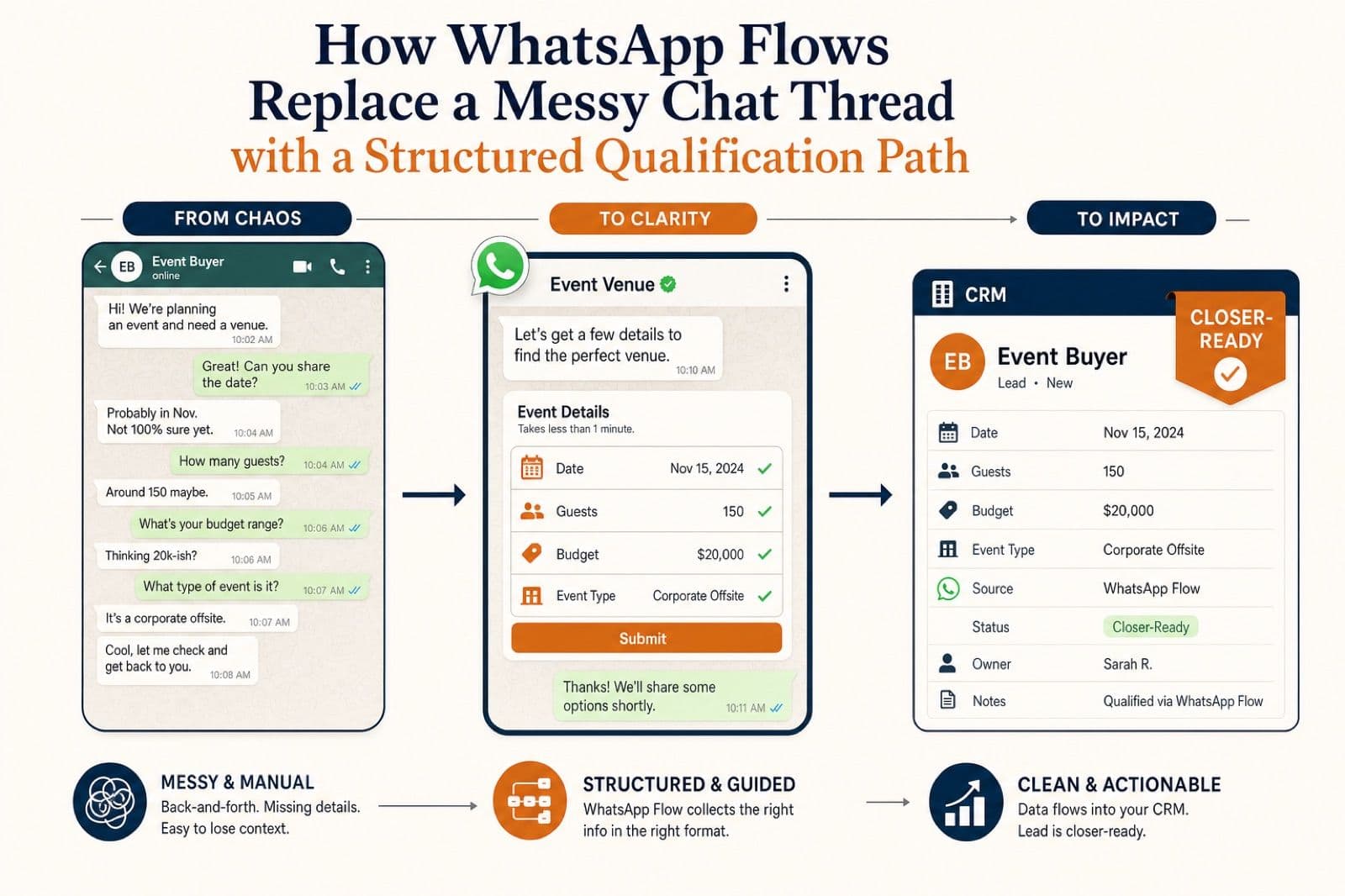
WhatsApp Flows turn messy event enquiries into structured date, guest, budget, and CRM data without sending buyers to a form.
The best WhatsApp lead form is not a form anymore
The most important WhatsApp update for event companies is not another AI reply model. It is WhatsApp Flows: native, structured forms that open inside the WhatsApp thread.
That sounds small until you map it against how event enquiries actually arrive.
A buyer does not wake up excited to fill a web form. They see a Reel, tap a Click-to-WhatsApp ad, ask "available for Dec 14?", and expect the answer to happen in the same thread. If your next move is a Google Form, a Typeform link, or a "please share details" paragraph, you just added friction at the exact moment intent was highest.
WhatsApp Flows changes the shape of that handoff. Instead of asking date, headcount, city, venue type, package interest, and budget one message at a time, you can open a native WhatsApp screen that captures those fields in one guided step. The buyer stays in WhatsApp. Your CRM gets structured data. Your closer gets a cleaner handoff.
This is not a replacement for the whole Instagram-to-WhatsApp inbound operating system. It is one high-leverage component inside it. The mistake will be treating Flows like a shiny form builder. The win is using Flows only where structured input beats conversation.
What WhatsApp Flows actually does
Meta describes WhatsApp Flows as a way to "build structured interactions for business messaging." In plain operator language: a Flow is a mini form or mini workflow that opens inside WhatsApp.
It can collect fields, show choices, move across multiple screens, call your endpoint for dynamic data, and submit a structured payload back to your system. Meta's own WhatsApp Flows 101 guide frames it around input forms, multi-screen workflows, data exchange endpoints, and webhooks for monitoring.
For event companies, that maps almost perfectly to the first layer of qualification:
| Qualification field | Bad free-text version | Better Flow input |
|---|---|---|
| Event date | "When is your event?" repeated in chat | Date picker or date text field |
| Guest count | Buyer types "around 200 maybe" | Number field or range picker |
| Event type | Team guesses from the message | Dropdown: wedding, birthday, corporate, workshop |
| City or venue | Buyer sends partial address | Text field with city first |
| Budget band | Awkward direct question | Range selection with friendly labels |
| Package interest | Screenshot chaos | Checkbox or radio selection |
The point is not that dropdowns are magical. The point is that structured answers are easier to route, score, price, and sync than free-text guesses.
Free text is still useful. It is how buyers ask questions, send nuance, share constraints, and feel heard. But free text is a bad way to collect six required fields from a buyer who is on a phone and already comparing vendors. WhatsApp Flows gives you the form without forcing them out of the chat.
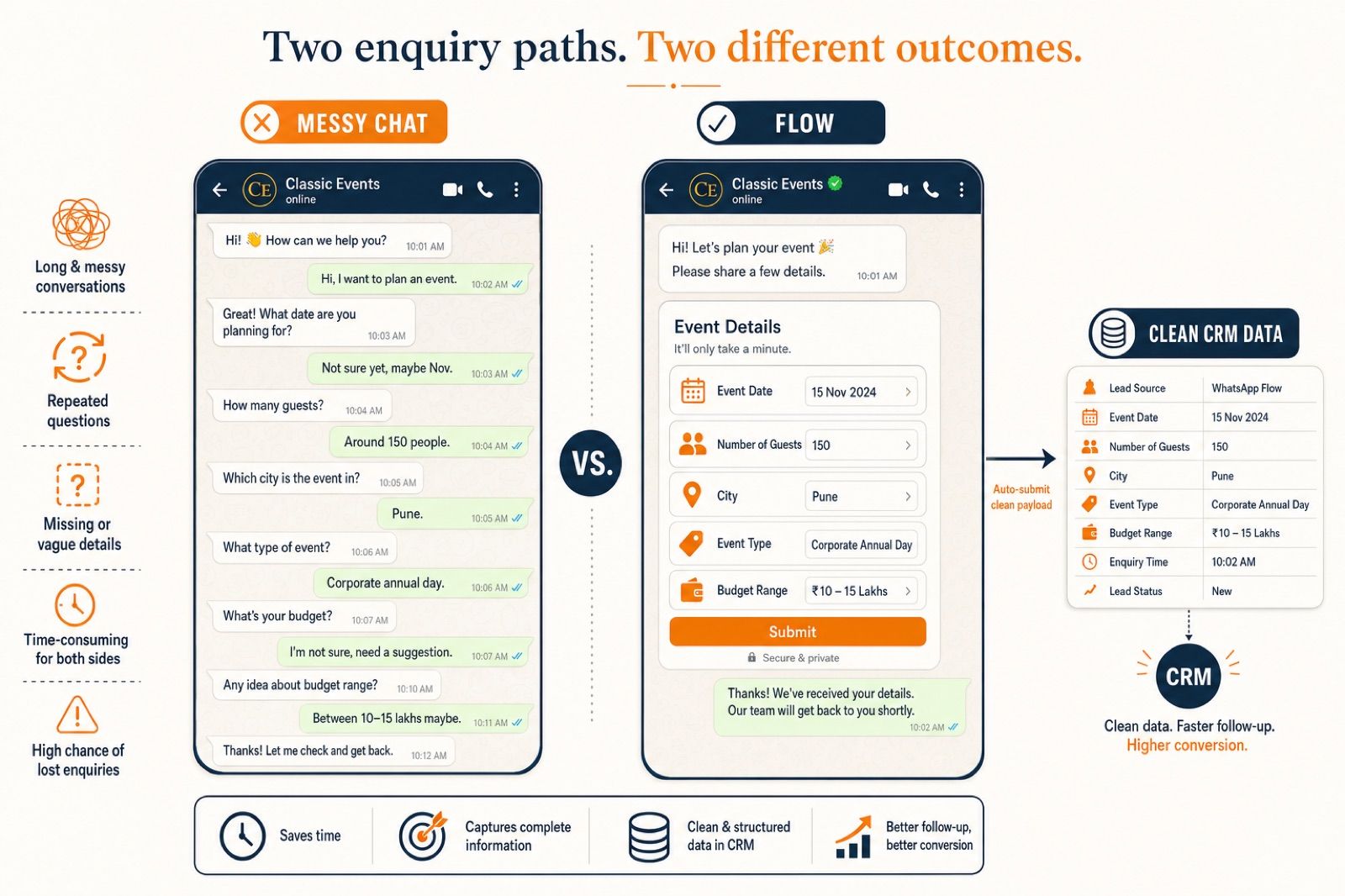
Why event companies should care before everyone else
Event sales has a qualification problem that looks like a response-time problem from the outside.
The founder sees missed bookings and thinks, "We need to reply faster." That is true, but it is incomplete. Fast replies only matter if the reply moves the buyer closer to a booking-ready state.
An event company usually needs a specific minimum dataset before a closer can do anything useful:
- Event date or date range
- Guest count
- Event type
- City or venue
- Budget band
- Decision maker or planning role
- Source thread, ad, Reel, or referral
If those fields are missing, the closer is not closing. They are doing admin inside WhatsApp.
That is why event companies overfeel inbound volume. Forty DMs in two hours is not only forty messages. It is forty half-formed qualification loops. Each loop needs five to eight pieces of data, and every missing field becomes another follow-up. By Monday, the inbox looks busy, but the CRM has almost nothing useful.
I mapped this in the Instagram DM revenue leak: the buyer is usually lost between first reply, qualification, WhatsApp handoff, and CRM sync. WhatsApp Flows does not solve all five leaks. It attacks the middle one with precision.
Flows are useful when the buyer is warm enough to give you structured detail, but not yet ready for a human closer. That is the exact moment most event teams mishandle.
The CTWA advantage: Flows belongs inside the 72-hour window
The highest-leverage entry point for WhatsApp Flows is a Click-to-WhatsApp ad.
Meta's WhatsApp pricing documentation says that when a user messages through a Click-to-WhatsApp ad or certain Meta CTA buttons, a 24-hour customer service window opens. If the business responds within 24 hours, a 72-hour free entry point window opens. While that window is open, any message type can be sent to that user at no charge.
That matters for Flows because the best Flow is not sent days later as a cold reactivation. It is opened while the buyer is still inside the ad-to-chat moment.
The operating model should look like this:
| Time | System move | Goal |
|---|---|---|
| Minute 0 | Buyer clicks Instagram ad and opens WhatsApp | Capture active intent |
| Minute 1 | First reply acknowledges the enquiry | Keep the thread warm |
| Minute 1-2 | Flow opens with event fields | Capture structured qualification |
| Minute 3 | CRM receives submitted fields | Create real lead record |
| Minute 3-5 | Hot leads route to closer | Human joins only when useful |
| Hour 1-72 | Follow-up happens inside the free entry point window | Avoid slow, paid cleanup |
The cost angle matters, but the conversion angle matters more. If the buyer has just clicked an ad, they are not asking for your brochure. They are asking whether their event can happen. A Flow gets you to that answer faster.
In the WhatsApp pricing post, I argued that the 72-hour CTWA window is the pricing cheat code most operators waste. WhatsApp Flows is the product layer that makes that window easier to use. You front-load the field capture while the window is open, instead of spending the next week paying for re-engagement templates because the thread never got qualified.
A working event-company Flow
Here is the Flow I would start with for most event companies.
Do not overbuild it. The first version should be short enough to finish in under one minute. If it feels like a venue onboarding questionnaire, you have already lost.
Screen 1: Event basics
Collect the fields that decide whether the lead can be routed at all:
- Event type
- Event date or rough month
- City or venue area
- Guest count range
The copy should feel like a concierge, not a form.
Example: "Quick check so we can confirm availability. This takes under 30 seconds."
Screen 2: Package fit
Collect the minimum commercial signal:
- Service interest
- Budget band
- Planning stage
- Decision maker status
For budget, use bands. Asking "what is your budget?" in open text invites vague answers. Asking "which range are you planning around?" gives the buyer a safer path to answer.
Screen 3: Contact and confirmation
Confirm the buyer wants a quote, call, or availability check:
- Name
- Preferred callback slot
- Best next action
Then submit to your backend and show a confirmation message: "Got it. We are checking availability and will reply here."
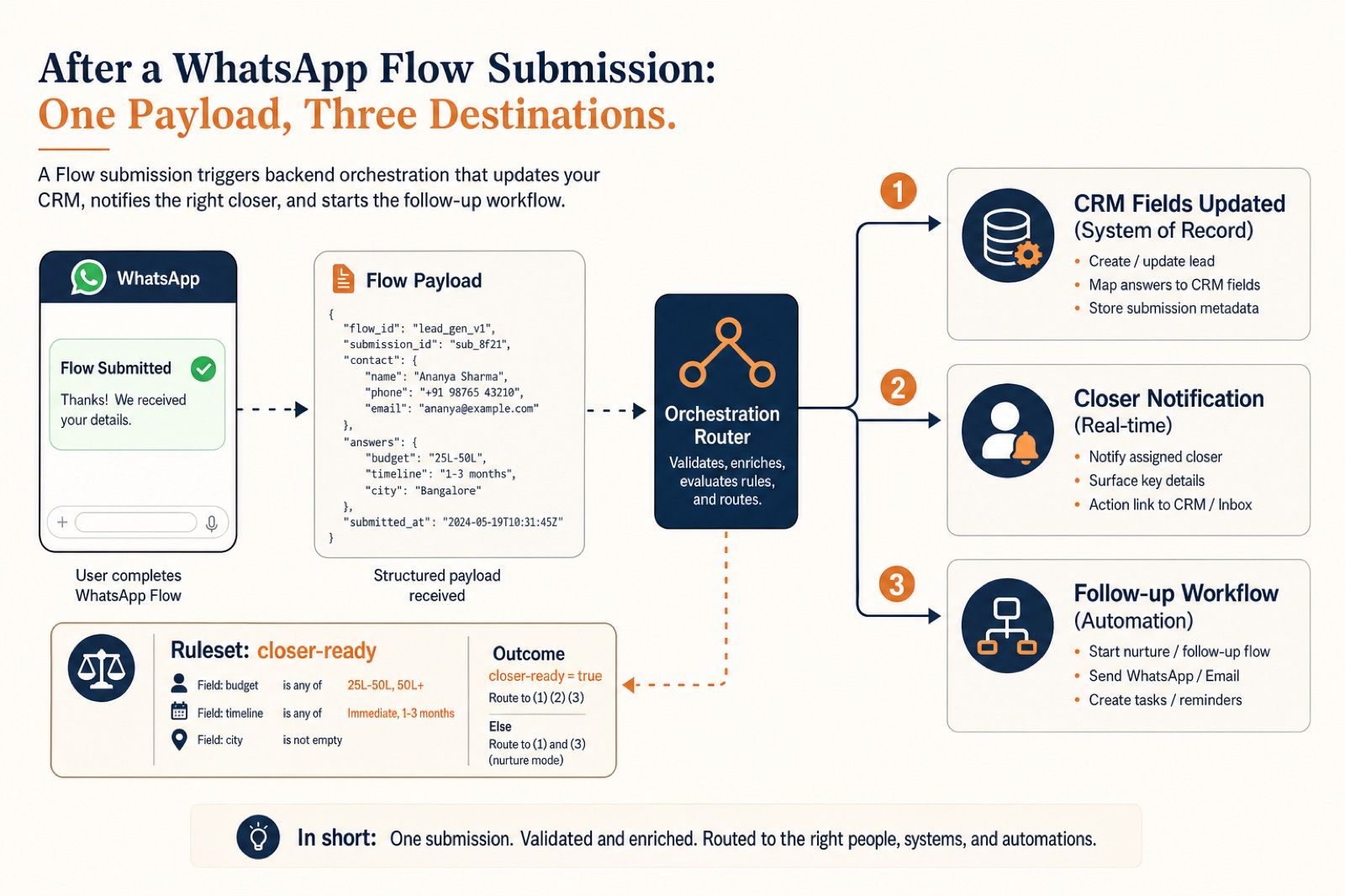
At this point, the Flow should do three things behind the scenes:
- Create or update the lead in CRM.
- Score the lead against your closer-ready ruleset.
- Notify a human only if the lead is worth human attention.
This is where most no-code Flow demos stop too early. They celebrate the form submission. The business value starts after submission.
Static Flow or dynamic Flow?
There are two useful mental models for WhatsApp Flows.
A static Flow is like a native WhatsApp form. The fields are mostly fixed. It works well when the same questions apply to almost every buyer.
A dynamic Flow connects to your endpoint. It can fetch live availability, validate values, change the next screen based on prior answers, and submit data into your system with more control.
For event companies, the decision is simple:
| Use case | Flow type | Why |
|---|---|---|
| Basic enquiry qualification | Static | Same fields for most buyers |
| Campaign-specific lead capture | Static | Fast to launch for one ad set |
| Live appointment slots | Dynamic | Needs calendar availability |
| Package recommendation | Dynamic | Depends on guest count, city, and budget |
| Venue or inventory availability | Dynamic | Needs backend data |
| Payment or booking deposit | Dynamic | Needs validation and transaction state |
Start static. Move dynamic only when the missing live data is costing bookings.
Meta's Flows docs mention endpoints and data exchange because Flows can become rich workflows. That does not mean your first event lead qualifier should become a mini app. The first version should prove that structured capture beats your current free-text loop. After that, add live slots, package logic, and CRM lookups.
The CRM payload matters more than the Flow UI
The visible Flow is the easy part. The payload is the part that decides whether your team actually gets leverage.
A submitted Flow should not land as one big note in the CRM. It should update structured fields your team can filter, score, and report on.
Minimum CRM writeback:
| CRM field | Example value | Why it matters |
|---|---|---|
| Lead source | `ctwa_sangeet_may_campaign` | Attribution |
| WhatsApp phone | `+91...` | Thread identity |
| Event date | `2026-12-14` | Availability and urgency |
| Guest count range | `200-300` | Package fit |
| Event type | `wedding` | Routing |
| City | `Delhi NCR` | Service area |
| Budget band | `5-8L` | Commercial fit |
| Status | `closer-ready` | Sales queue |
| Next action | `call_today` | Follow-up |
This is where FusionSync's positioning around CRM synced handoffs matters. A Flow without CRM sync is just a nicer form. A Flow with CRM sync becomes part of the inbound operating system.
The closer should not open a WhatsApp thread and ask, "Can you tell me more?" They should open a thread and say, "I have Dec 14, around 250 guests in Delhi NCR, wedding setup, 5 to 8 lakh planning range. Want me to check two package options?"
That is the difference between automation and handoff.
What not to put inside a WhatsApp Flow
The easiest way to ruin WhatsApp Flows is to turn it into your entire sales process.
Do not use Flows for everything. Use them for the parts of the conversation where structure beats text.
Bad Flow candidates:
- Emotional objections: "Can you make this feel premium but not too flashy?"
- Design taste: "I like this mandap but simpler."
- Negotiation: "Can you do something around 6 lakh?"
- Trust building: "Have you done this venue before?"
- Complex custom requirements: "We need two entrances, a baraat route, and a rain plan."
Those belong in conversation. The buyer wants a human or human-like response there.
Good Flow candidates:
- Date capture
- Guest range
- City or venue area
- Package interest
- Callback slot
- Consent and preference collection
- Survey-style feedback after the event
The principle is simple: if a salesperson would ask the same question the same way every time, it probably belongs in a Flow. If a great salesperson would adapt, listen, and ask a better follow-up, keep it conversational.
Proof that this pattern is already working
Meta's own Engelife case study is the clearest public proof point right now. Engelife Construtora e Incorporadora used WhatsApp Flows on ads that click to WhatsApp to pre-qualify real estate leads before a sales employee continued the conversation.
Meta reports the test drove:
- 26-point increase in lead qualification rate
- 37% reduction in cost per qualified lead
- 12-minute reduction in average time to qualify
Those are self-reported results, and Meta correctly notes individual results will differ. Still, the pattern is relevant. Real estate and events have similar inbound shape: high-intent buyers, expensive transactions, date or availability constraints, and a human closer who should not waste time extracting basic fields.
The lesson is not "copy a real estate Flow." The lesson is that ad-to-WhatsApp traffic becomes more valuable when qualification happens before the human joins.
Event companies are an even cleaner fit because the availability question is brutal. If the date is unavailable, route fast. If the date is available and the buyer fits, hand off fast. If the date is unclear, nurture without burning closer time.
Technical constraints to respect
WhatsApp Flows is powerful, but it is still a Meta surface with constraints. Treat it like production infrastructure, not a landing page experiment.
Meta's Flow JSON reference sets concrete technical boundaries. The Flow JSON content string cannot exceed 10 MB, and the routing model can have up to 10 branches. That is plenty for lead qualification, but it is a warning against building a giant app inside WhatsApp.
Operational constraints matter more:
- The Flow should load fast on mobile data.
- The copy should be short enough for a buyer standing at an event venue.
- Dynamic endpoints need health monitoring.
- Submission errors need a fallback message.
- Template category and timing affect delivery and cost.
- CRM field mapping needs version control.
The endpoint piece is the one most teams underestimate. A dynamic Flow that checks live availability is only as reliable as the endpoint behind it. If the endpoint is slow, unhealthy, or returns confusing states, the buyer sees friction inside the one channel that was supposed to feel frictionless.
So version the Flow like code. Test it against real bad inputs. Watch abandonment by screen. Keep the first production version boring.
The operating scorecard
If you launch WhatsApp Flows for event qualification, do not measure it by "people who opened the Flow." That is a vanity number.
Measure the flow like an inbound operating system:
| Metric | What it tells you |
|---|---|
| Flow open rate | Whether the first message creates enough trust |
| Flow completion rate | Whether the Flow is short and clear |
| Qualified lead rate | Whether the fields identify real buyers |
| Time to closer-ready | Whether the system reduces sales admin |
| CRM field completeness | Whether submitted data is usable |
| Human takeover rate | Whether routing is balanced |
| Booked call or quote rate | Whether the lead quality improved |
The two metrics I would watch first are completion rate and time to closer-ready.
If completion is low, the Flow is too long, too cold, or too early in the thread. If time to closer-ready does not improve, your CRM mapping and routing are broken. The buyer did the work, but the system did not convert that work into a better handoff.
This is the same rule behind Instagram OS: the automation is only valuable if it produces a better human moment downstream.
FAQ
Are WhatsApp Flows the same as a chatbot?
No. A chatbot replies conversationally. A WhatsApp Flow collects structured information through native WhatsApp screens. The best systems use both: conversation for context and trust, Flows for fields that should not be extracted one message at a time.
Do WhatsApp Flows replace website forms?
For WhatsApp-first campaigns, often yes. If the buyer starts inside WhatsApp, sending them to an external form adds unnecessary friction. Website forms still make sense for SEO traffic and longer research journeys. Click-to-WhatsApp traffic should usually qualify inside WhatsApp.
Are WhatsApp Flows free?
Building the Flow is not the billing driver. Messaging cost follows WhatsApp Business Platform pricing. Meta charges delivered template messages by category and country, while non-template messages inside an open customer service window are free. Messages inside a 72-hour free entry point window can also be free under Meta's rules.
Should an event company use static or dynamic Flows first?
Use static first for date, guest count, event type, city, and budget band. Move to dynamic when you need live availability, package recommendations, payment state, or CRM-specific personalization. Dynamic Flows are powerful, but they introduce endpoint reliability and testing work.
Where should the Flow appear in the sales journey?
Usually after the first acknowledgement and before human handoff. The first message should make the buyer feel seen. The Flow should then collect the fields needed to decide whether the thread is closer-ready, nurture-ready, or disqualified.
Can Flows work for Instagram enquiries too?
Yes, but the handoff matters. Instagram can capture the first intent, then route the buyer to WhatsApp with state. Once the buyer is in WhatsApp, a Flow can collect structured qualification and sync it to CRM. The Flow is strongest after the Instagram-to-WhatsApp handoff, not as a disconnected form link.
The bottom line
WhatsApp Flows is not "forms are back." It is the opposite: the form finally moved into the thread where the buyer already has intent. For event companies, that means the messy part of qualification can become structured without forcing the buyer out of WhatsApp, and without making the closer repeat basic questions.
- Use WhatsApp Flows for repeatable qualification fields: date, guests, city, event type, budget, package interest, and callback preference.
- Keep emotional selling, objections, negotiation, and custom requirements conversational.
- Put the Flow inside the CTWA or Instagram-to-WhatsApp moment while intent is warm.
- Sync every submitted field into CRM as structured data, not as one big note.
- Measure completion rate, time to closer-ready, and booked call or quote rate, not just Flow opens.
If your event business already gets meaningful Instagram or WhatsApp enquiries, this is a strong candidate for a free 7-day production pilot. We can install one Flow on one real campaign, wire it to your CRM, and measure whether it produces cleaner closer-ready handoffs. If you want the leak map first, start with a free AI audit and we will model where your current WhatsApp qualification is slowing down.
AI-native business systems
Bring a niche, or bring a workflow.
If you run the business, we build the system around it. If you sell into a niche, we build the system behind your offer.
PolarBuild case study →You sell the niche. We build the system.
We never compete for your end clients. One partnership conversation. You fulfil the same system across the accounts in your niche.
Free POC before dedicated software
A three-day sales demo of the system for your vertical before any large software investment. Implementation starts only when someone in that niche pays.
Replicate the niche, not a one-off build
UK dental becomes US dental with a new local partner and new integration targets. Same system thesis, new market.